

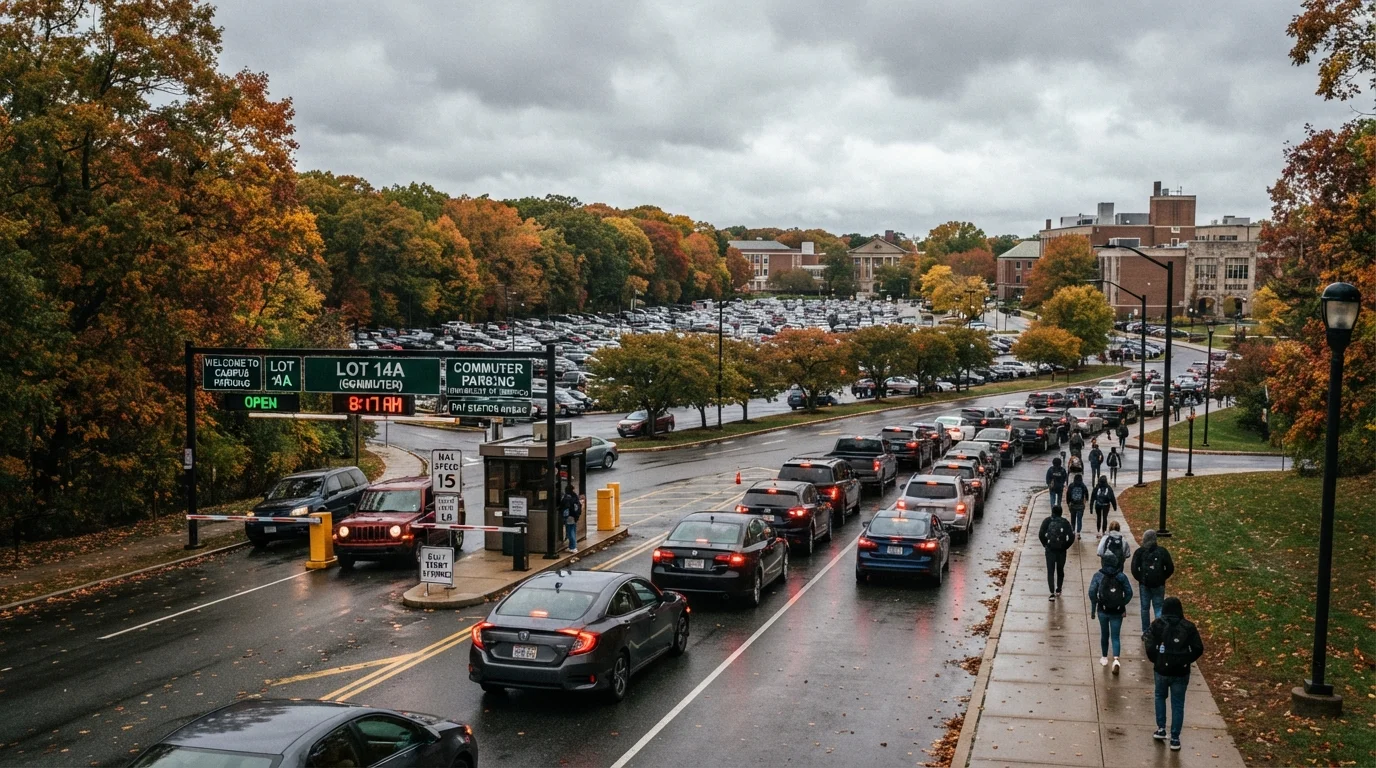
What 'Driving to Campus Every Day' Actually Looks Like
For many college students, driving to campus sounds straightforward - get in the car, drive to class, go home. In practice, the daily reality involves a series of friction points that stack up: finding a permit, navigating congested campus roads, circling for parking, and timing departures around class schedules that change every semester.
Campus environments are genuinely different from typical commuting roads. Pedestrian crossings fire constantly during class changes, cyclists move unpredictably, and narrow internal roads are shared by delivery vehicles, buses, and students on foot. As our guide on why campus traffic feels worse than regular rush hour explains, the congestion pattern is driven by synchronized class start times rather than traditional peak-hour flows - meaning traffic surges are brief, intense, and hard to time around.
Before committing to daily driving, it helps to spend a few days observing campus conditions at the times your classes actually run. What you see will give you a clearer sense of what you're signing up for than any estimate.
Map out your parking options before your first day of class - not on it. Walk each lot to your classroom building so you know the actual time cost, not an estimate.
Students who scout parking in advance consistently report lower stress and fewer late arrivals during the first weeks of semester, when lots are most competitive.
Track your commuting costs in a simple spreadsheet from week one. Fuel, permit fees, and one-off repairs become much easier to manage when you can see the running total.
Commuting expenses accumulate gradually, making them easy to underestimate until the end of semester - when the total often surprises students who weren't tracking.
The Real Costs You Need to Account For
Most students underestimate commuting costs by focusing only on fuel. The actual cost picture includes several recurring and one-off expenses:
- Fuel: Calculated by your round-trip mileage, driving frequency per week, your vehicle's fuel economy, and the local price per gallon.
- Parking permit: Campus permits typically range from a few hundred dollars to over $1,000 per academic year, depending on the institution and permit tier.
- Routine maintenance: More miles means more frequent oil changes, tire rotations, and brake wear. These costs are easy to overlook until they arrive all at once.
- Insurance: Adding regular commuting miles to your driving profile can affect your premium. Inform your insurer if your mileage changes significantly.
- Unexpected repairs: Even a reliable car incurs repair costs. Commuters who log high mileage encounter them more frequently.
For a thorough breakdown of every line item, see our guide on fuel costs, parking fees, and vehicle wear. You can also explore the broader student car costs hub for context on total vehicle ownership expenses in college.
~$1,000+
Annual parking permit cost at many large universities
Permit pricing varies widely by institution and lot tier; some urban campuses charge significantly more for close-in spaces.
15-20%
Portion of a car's wear attributed to short urban trips
Short stop-and-go campus commutes are harder on engines and brakes than equivalent highway miles, according to general automotive maintenance guidelines.
Parking: The Variable That Breaks Most Plans
Parking is frequently the most frustrating element of campus commuting - and the hardest to plan around. Permits sell out at many schools, so securing one early in the enrollment cycle matters. Even with a valid permit, the assigned lot may be a 10-15 minute walk from your building, or fill to capacity on high-attendance days.
Strategies that experienced commuters consistently report as helpful include:
- Arriving 20-30 minutes before class rather than right before start time.
- Identifying two or three fallback lots in advance so you're not searching under time pressure.
- Checking whether your campus offers remote parking with shuttle service, which is often less competitive.
- Learning enforcement patterns - ticketing hours and grace periods vary by campus zone.
Don't Assume a Permit Guarantees a Spot
Many campuses sell more permits than available spaces on the assumption that not all permit holders arrive at the same time. On high-demand days - exam periods, orientation weeks, major events - even permit holders may find their designated lot full. Always have a backup plan and allow extra time on days when campus activity is elevated.
If you're weighing commuting costs against on-campus housing, our article on commuter parking vs. on-campus housing offers a structured comparison that accounts for both sides of that equation.
Safety Considerations for the Daily Campus Drive
Campus roads present specific hazards that differ from suburban or highway driving. Pedestrians - often distracted by phones or earbuds - step off curbs without checking traffic. Speed limits on campus are low for good reason, and campus enforcement is real. Fatigue is also a genuine risk: early-morning drives after late study nights are a documented contributor to near-miss incidents among student drivers.
A few practices consistently reduce risk for campus commuters:
- Treat every intersection and crosswalk as occupied until you can confirm otherwise.
- Keep a consistent, predictable speed - sudden accelerations confuse pedestrians and cyclists.
- Build buffer time into your morning routine so you're never rushing to make a class start time.
- Know what to do when conditions change - our guide on driving in bad weather near campus covers the errors new drivers most commonly make in rain and ice.
It's also worth keeping your vehicle stocked with basic emergency items year-round. See what student commuters should keep in the car for a practical checklist.
Fatigue Behind the Wheel Is a Real Risk
Driving to an 8 a.m. class after a late study session is a genuinely higher-risk situation than most students acknowledge. Drowsy driving impairs reaction time in ways that mirror alcohol impairment, according to safety research. If you're too tired to drive safely, delay your departure, use an alternative, or ask someone else. No class start time is worth a collision.
How to Decide If Daily Driving Is Right for You
The decision comes down to a comparison across four dimensions: cost, time, convenience, and stress tolerance. No single answer applies to everyone.
When daily driving tends to work well: You live more than 3-4 miles from campus, public transit is limited or unreliable in your area, you have a flexible class schedule that lets you avoid peak congestion windows, and your total monthly driving cost fits your budget without strain.
When alternatives often make more sense: Parking is extremely limited or expensive at your institution, your schedule is concentrated in high-traffic windows, or you're sharing costs could meaningfully reduce your burden. Our overview of carpooling vs. solo driving walks through how sharing a ride changes the financial and logistical picture.
For students who decide to commute, building good habits from the start pays off. The guide on habits that make campus commuting less stressful covers the routine adjustments - from departure timing to parking strategy - that reduce daily friction. If you're brand new to commuting, the first-semester commuter overview is a practical starting point.
Ultimately, the students who handle campus commuting best are those who went in with realistic expectations - about cost, about time, and about the occasional bad parking day - rather than discovering those realities mid-semester.
Run Your Numbers Before the Semester Starts
Estimate your monthly fuel cost using your round-trip mileage, driving days per week, and your car's miles-per-gallon rating. Add your permit cost divided by the months it covers. That combined figure is your minimum baseline - before insurance or maintenance. Knowing it upfront prevents mid-semester budget surprises.
The content provided on our blog site traverses numerous categories, offering readers valuable and practical information. Readers can use the editorial team’s research and data to gain more insights into their topics of interest. However, they are requested not to treat the articles as conclusive. The website team cannot be held responsible for differences in data or inaccuracies found across other platforms. Please also note that the site might also miss out on various schemes and offers available that the readers may find more beneficial than the ones we cover.