

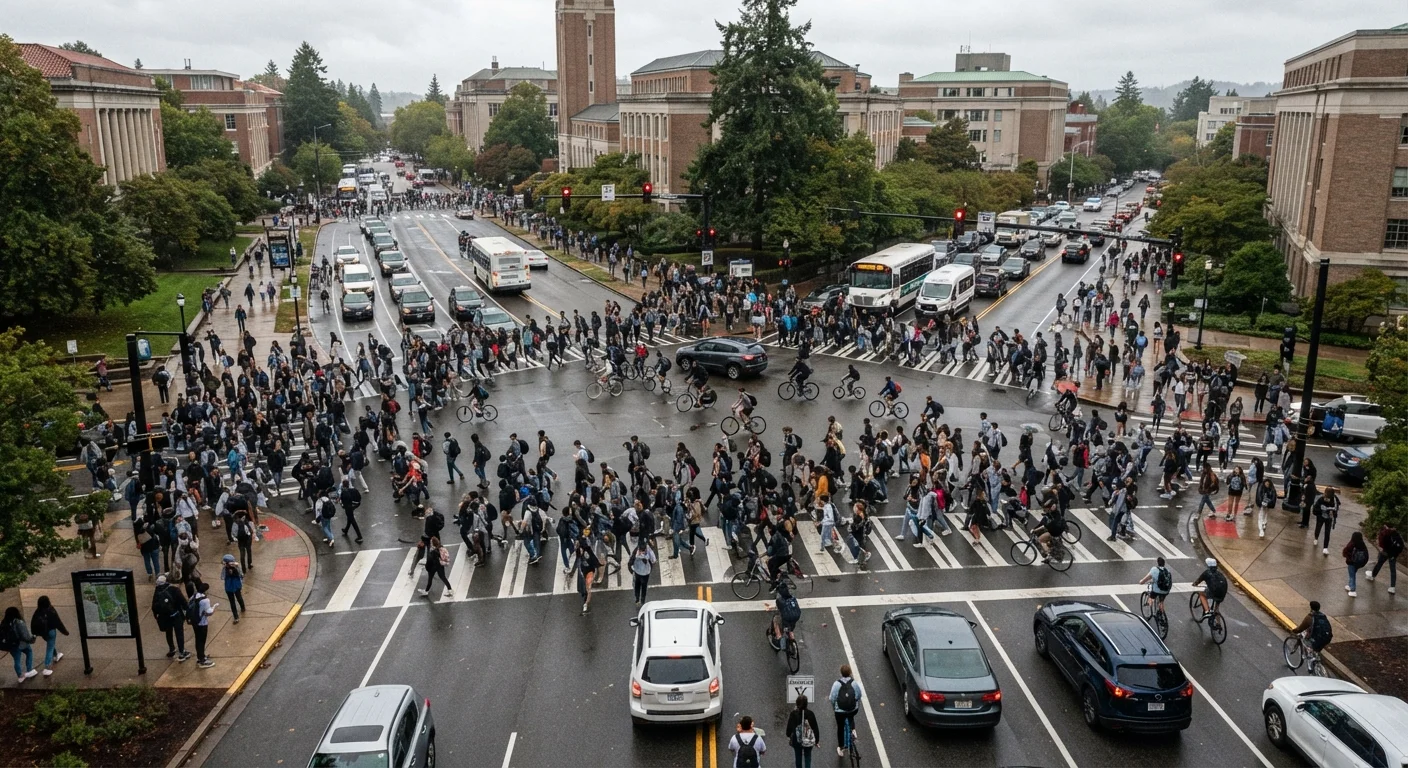
The Structural Reasons Campus Roads Slow to a Crawl
Campus roads were designed with pedestrians at the center - not vehicles. That single fact explains most of what you experience behind the wheel on or near a college campus. Lanes are narrower than city arterials, speed limits are lower (often 10-15 mph), and crosswalks appear mid-block with high frequency. Every one of these features exists for good safety reasons, but the cumulative effect on vehicle throughput is dramatic.
Add in shared paths where cyclists merge with slow-moving cars, delivery vehicles double-parking near academic buildings, and shuttle buses stopping in travel lanes, and you have a road environment structurally different from anything a typical commuter road is designed to handle. The friction doesn't come from the number of cars alone - it comes from how many competing uses are happening simultaneously in a confined space.
Campus Roads Are Intentionally Restrictive
The slow pace of campus driving isn't a design flaw - it's an intentional safety outcome. Universities deliberately limit vehicle speed and prioritize pedestrian crossings to protect the large volumes of foot traffic that move between buildings throughout the day. Treating campus roads as slower-by-design, rather than frustratingly slow, is a useful framing shift for new student drivers.
If you're still weighing whether driving to campus makes sense for your situation, our full breakdown of commuting by car covers costs, parking realities, and what students commonly underestimate before committing to the drive daily.
The Class-Change Surge: Why It Hits Harder Than Rush Hour
City rush hour builds gradually over 60-90 minutes as workers leave offices in staggered waves. Campus congestion doesn't work that way. When a 200-person lecture ends, every student in that hall moves at roughly the same moment - toward the same doors, the same crosswalks, and often the same parking structures. This simultaneous release repeats multiple times per day, at predictable intervals, tied directly to the class schedule.
The result is a traffic pattern with sharp, intense spikes rather than a slow build. A road that was moving freely at 9:48 a.m. can become gridlocked by 9:52 a.m. when a morning block ends. This unpredictability - combined with the speed of onset - makes campus congestion feel more stressful than longer but more gradual urban slowdowns.
3×
Slower vehicle travel per mile on campus vs. city roads
Traffic planning research on shared-use campus corridors consistently finds that pedestrian crosswalk frequency and low speed limits can reduce effective vehicle throughput to a third of comparable urban arterials.
10-15 min
Typical duration of post-class congestion surge
Most campus traffic spikes tied to class-change events dissipate within 10-15 minutes as pedestrian crosswalk demand drops and vehicles clear the immediate area.
8-10 a.m.
Peak arrival congestion window on most campuses
Surveys of student driving behavior at large universities commonly identify the 8-10 a.m. window as the highest-stress period for parking and campus road access.
Understanding when these spikes occur puts you in a much stronger position. If your class ends at 10:50 a.m. and your car is parked a 5-minute walk away, plan to reach it around 11:05 rather than rushing out immediately with hundreds of others heading the same direction.
Pedestrian Volume and Why Drivers Bear Most of the Wait
At a legal and design level, pedestrians have priority at most campus crosswalks - and they use them constantly. On a busy campus, crosswalk signals can cycle multiple times per block before a vehicle gets a clear opportunity to move. This is by design, and it's the right call for safety. But it means vehicle travel times on campus roads can be two to three times longer per mile than comparable city streets, even with lighter car traffic.
Drivers who aren't used to this environment sometimes make the mistake of becoming impatient or attempting to squeeze through gaps in pedestrian flow. This creates safety risks and, often, additional delays when near-misses force everyone to stop. The more effective response is to treat campus driving as a fundamentally slower mode of travel and schedule accordingly. Small routine adjustments to your departure timing and parking strategy can reduce this friction considerably.
How to Work With Campus Traffic Instead of Against It
The most important mindset shift for student drivers is accepting that campus traffic follows campus logic, not commuter logic. Once you understand the structure - class-change spikes, pedestrian priority, constrained infrastructure - you can plan around it rather than being caught off guard by it.
Practical approaches that consistently help include: arriving 15-20 minutes before your first class to avoid the peak parking scramble, using campus maps to identify secondary entry and exit routes that bypass high-pedestrian corridors, and leaving directly after class rather than lingering, since congestion typically clears within 15 minutes of the post-class surge. If flexibility in your schedule allows it, sharing the drive with a classmate also reduces the number of vehicles contributing to the bottleneck and splits your parking costs.
For a broader view of what campus driving actually costs - in time, money, and stress - see our honest look at car commuting advantages and drawbacks.
Time Your Departure Around the Schedule
If your class ends on the hour or half-hour, waiting just 10-12 minutes before walking to your car can mean the difference between sitting in gridlock and an unobstructed exit. Check when the largest lectures near your parking area end, and plan your post-class time accordingly. On bad-weather days - when pedestrian behavior becomes less predictable - give yourself even more buffer. See common mistakes student drivers make in bad weather for more context.
Frequently Asked Questions
When large lecture blocks end simultaneously, hundreds of students flood crosswalks, parking lots, and access roads within minutes. This creates a sudden demand spike that campus roads - built for foot traffic - simply aren't designed to absorb quickly. The result is a brief but intense gridlock that feels far worse than its duration suggests.
Yes. Campus roads typically have lower speed limits, more frequent crosswalks, narrower lanes, and shared paths for cyclists and pedestrians. These features are intentional safety measures, but they significantly reduce the number of vehicles that can move through at any given time.
The heaviest congestion typically occurs 5-10 minutes before and after classes that start on the hour or half-hour. Morning arrival windows between 8-10 a.m. and afternoon departure windows between 2-5 p.m. are usually the most congested periods on most campuses.
Significantly. Students circling for open spots, waiting for pedestrians in parking lot lanes, and blocking access roads while searching all contribute to bottlenecks. Parking behavior is one of the leading contributors to micro-congestion near campus buildings.
Adjusting your departure time by even 10 minutes before or after peak class-change windows can make a noticeable difference. Learning alternate entry and exit routes, and arriving early enough to park without circling, also helps considerably.
Carpooling reduces the number of vehicles competing for the same roads and parking spots, which can ease congestion over time. It also cuts your individual fuel and parking costs. The trade-off is reduced scheduling flexibility.
The content provided on our blog site traverses numerous categories, offering readers valuable and practical information. Readers can use the editorial team’s research and data to gain more insights into their topics of interest. However, they are requested not to treat the articles as conclusive. The website team cannot be held responsible for differences in data or inaccuracies found across other platforms. Please also note that the site might also miss out on various schemes and offers available that the readers may find more beneficial than the ones we cover.