

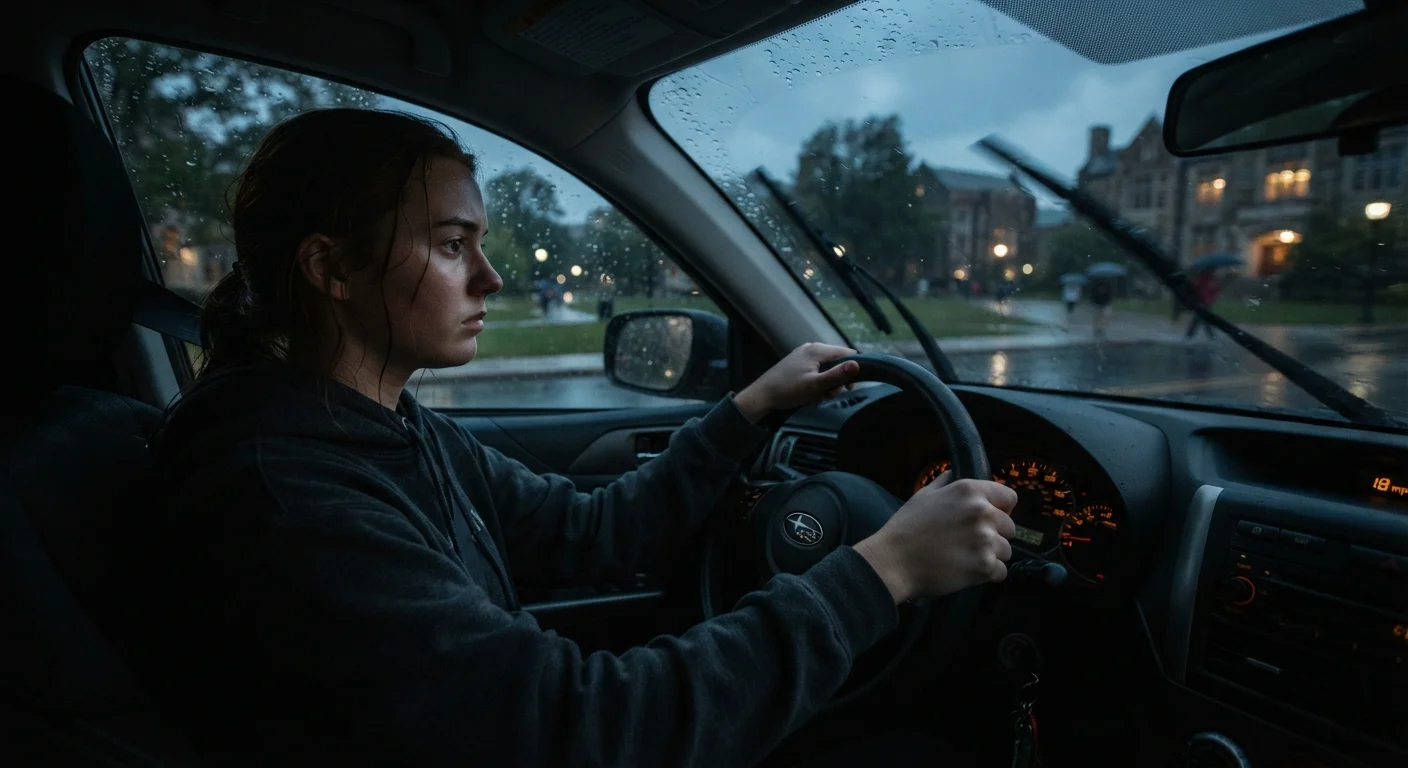
Why Campus Roads Are Particularly Risky in Bad Weather
College campuses concentrate a set of hazards that most public roads spread out more thinly: dense pedestrian crossings, narrow lanes, unfamiliar one-way systems, cyclists, and delivery vehicles - all mixed together in a compact area. Add rain, ice, or reduced visibility, and the margin for error shrinks fast.
New student drivers often arrive on campus with some highway or suburban driving experience, but that experience doesn't always transfer. Campus driving is stop-start, slow-speed, and heavily pedestrian-oriented. In bad weather, the low posted speeds can create false confidence - students assume that going 15 mph means danger is minimal. But stopping distances on ice don't care about speed limits, and a pedestrian can step off a curb in half a second.
If you're still weighing the full demands of driving to campus, our overview of what commuting to campus every day really involves is a useful starting point before winter sets in.
17%
Of traffic crashes linked to wet pavement
According to the U.S. Department of Transportation's Federal Highway Administration, approximately 17% of vehicle crashes occur on wet pavement annually.
3×
Longer stopping distance on ice vs. dry road
Transportation safety researchers have consistently found that braking distances on ice can be three times or more greater than on dry pavement at the same speed.
The Most Common Mistakes - and How to Correct Them
The errors below aren't unusual or careless - they're the predictable results of inexperience combined with conditions most new drivers haven't trained in. Recognizing them in advance is how you avoid making them yourself.
Keeping the same following distance in rain or snow as on dry roads.
Why it happens: Students accustomed to dry-weather driving underestimate how much longer it takes to stop on slick surfaces, especially at campus speeds they feel are already 'slow enough.'
Assuming all-wheel drive (AWD) provides better braking and cornering on ice.
Why it happens: AWD genuinely improves acceleration traction, which many drivers misinterpret as overall winter-weather capability. The distinction between getting moving and stopping safely is rarely explained.
Driving with underinflated tires or worn tread into wet or icy conditions.
Why it happens: Tire maintenance often gets overlooked until something goes visibly wrong. Students new to car ownership may not know how to check tread depth or may assume tires last much longer than they do.
Failing to account for campus pedestrian surges during class changes.
Why it happens: Students on foot move unpredictably and in large groups right at the hour and half-hour. Drivers unfamiliar with this rhythm are caught off guard, especially when visibility is already reduced.
Using worn or ineffective windshield wipers, reducing visibility in rain.
Why it happens: Wiper blades degrade gradually, so the decline in performance is easy to miss until rain hits and visibility drops sharply mid-drive.
Overcorrecting when the car begins to skid.
Why it happens: Panic is a natural response to losing control, and the instinct to steer hard against a skid - or to brake suddenly - is strong but counterproductive on low-traction surfaces.
Black Ice Is Nearly Invisible
Black ice forms when water freezes in a thin, nearly transparent layer on pavement - often near shaded campus paths, bridges, and drainage grates. It looks like a wet road but offers almost no traction. If temperatures are near or below freezing and pavement appears unusually shiny, treat it as ice. Slow down before the patch, not during it.
Beyond technique, preparation matters. Keeping an emergency kit in the car - including an ice scraper, a small flashlight, and a reflective triangle - can make a real difference if you do get into trouble. Our article on what student commuters should keep in the car year-round covers exactly what belongs in that kit.
Do Not Use Cruise Control in Rain or Snow
Cruise control is designed for consistent highway conditions. On wet or icy roads, it can maintain or even increase speed when your tires begin to lose traction, making a skid harder to correct. Always drive manually in poor weather so you retain full control of your acceleration and braking.
Building Better Habits Before the Weather Turns
The most effective time to address bad-weather driving is before bad weather arrives. A few routine habits reduce risk significantly without requiring special equipment or significant expense.
- Check conditions before you leave, not en route. A weather app or your campus's alert system can tell you whether roads are being treated for ice. If conditions are severe, asking whether the trip is necessary is a legitimate question.
- Allow extra time. Rushing in bad weather is one of the most reliable ways to make a minor skid or hazard into a collision. Build buffer time into your commute schedule on wet or icy mornings.
- Adjust your route. Some campus roads drain poorly or sit in shadow all day. Learning which sections ice over first - often bridges and underpasses - lets you plan around them.
- Keep your car ready at the start of each semester. The pre-semester car checklist helps you confirm tires, wipers, fluids, and lights are in good condition before conditions test them.
If you're new to the overall logistics of commuting by car, getting started as a campus commuter walks through the practical setup from permits to parking - all of which becomes more relevant when the weather complicates an already busy first semester.
The content provided on our blog site traverses numerous categories, offering readers valuable and practical information. Readers can use the editorial team’s research and data to gain more insights into their topics of interest. However, they are requested not to treat the articles as conclusive. The website team cannot be held responsible for differences in data or inaccuracies found across other platforms. Please also note that the site might also miss out on various schemes and offers available that the readers may find more beneficial than the ones we cover.