

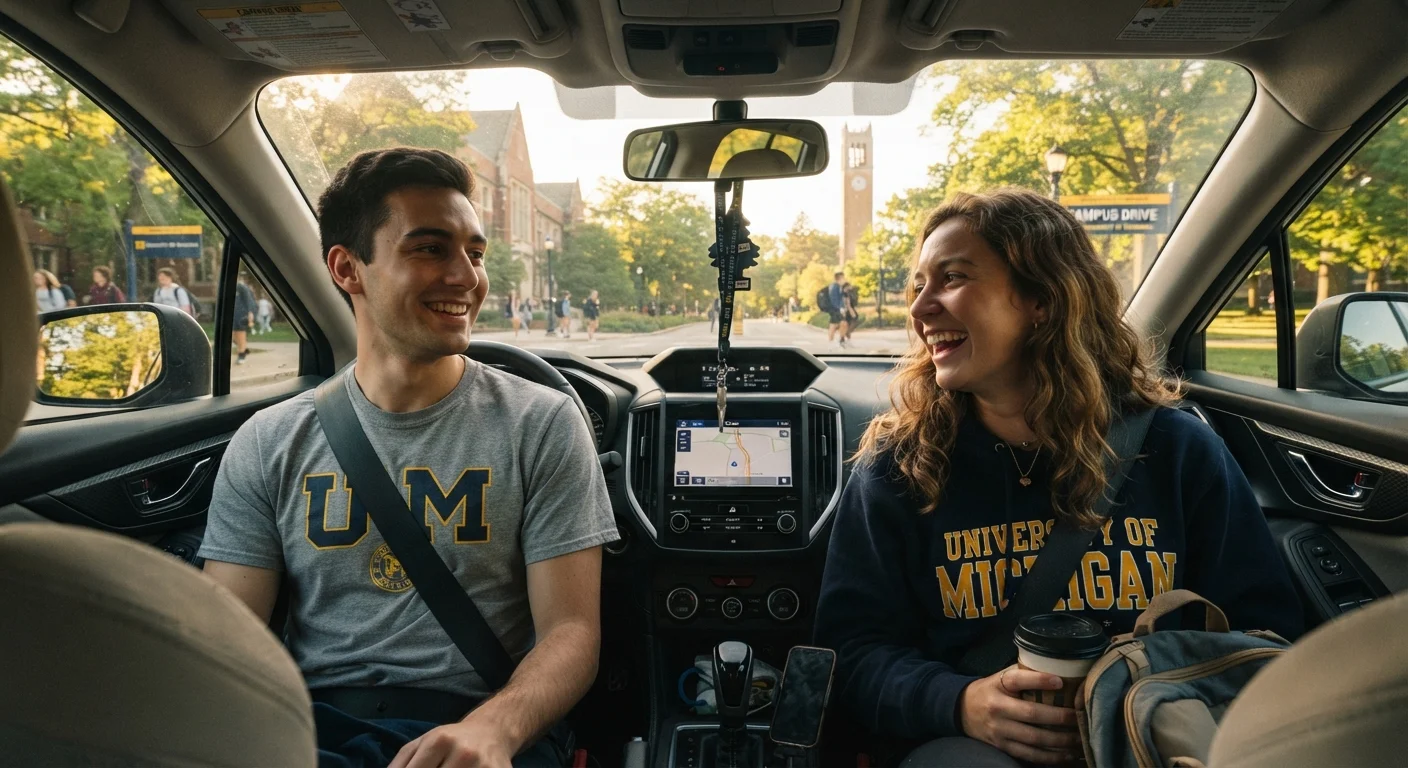
Option A
Carpooling
The cost-sharing, socially connected option.
Best for: Students with predictable schedules who live near classmates and want to reduce commuting expenses.
Option B
Solo Driving
The fully flexible, on-your-own-timeline option.
Best for: Students with variable class times, work shifts, or frequent after-campus commitments who need to leave and arrive independently.
The Real Cost Difference Between the Two Options
Cost is usually the first reason students consider carpooling - and the numbers do support it. When you drive solo, every dollar of fuel, every parking fee, and every mile of vehicle wear falls entirely on you. Split those same costs between two people and each person's share drops noticeably. With three riders, the savings are even more significant.
For a realistic breakdown of what solo commuting actually costs when you add fuel, permits, and depreciation together, see our guide on the true cost of commuting by car. Most students find the total is higher than they initially assumed.
Carpooling doesn't eliminate those costs, but it restructures who pays what. Some campuses also offer carpool-specific parking permits at reduced rates, which can add another layer of savings. The exact structures vary by institution, so it's worth checking your campus transportation office directly.
| Criterion | Carpooling | Solo Driving |
|---|---|---|
| Fuel cost per person | Shared - lower per person | Full cost, paid alone |
| Parking fees | Potentially split or reduced permit | Full permit cost, solo |
| Schedule flexibility | Constrained by partner's schedule | Fully flexible, leave anytime |
| Vehicle wear and depreciation | Shared if driving alternates | Entirely your vehicle's wear |
| Coordination required | Ongoing communication needed | None - fully independent |
| Stress level | Lower for passenger; shared as driver | Sole responsibility for trip |
| Suitability for irregular hours | Difficult to sustain | Works well |
Flexibility and Schedule Compatibility
Solo driving wins on flexibility without question. You leave when you're ready, stay as late as you need, and adjust on the fly when a lecture runs long or a study session extends into the evening. That kind of independence has real value, especially if your schedule shifts from week to week.
Carpooling introduces dependency. If your partner has an 8 a.m. class and you don't start until 10 a.m., you're either arriving two hours early or finding another way in. Even well-organised arrangements require ongoing communication. One unexpected schedule change - a lab moved, a shift picked up at work - can cascade into an inconvenience for everyone in the group.
Before committing to any daily driving arrangement, it helps to map out your weekly schedule honestly, including not just class times but also library hours, part-time work, and extracurriculars. The more variable those commitments are, the harder a carpool becomes to sustain.
Hybrid Arrangements Are Worth Considering
Some students find that a partial carpool - sharing rides on days with matching schedules and driving solo on others - offers a practical middle ground. This approach captures some of the cost savings without locking you into a rigid arrangement. It does require clear communication with your carpool partner about which days are shared, but many find it more sustainable over a full semester than an all-or-nothing commitment.
Stress, Safety, and the Social Dimension
Campus traffic is its own category of frustrating. Class-change surges and pedestrian-heavy intersections create bottlenecks that feel disproportionate to the distance involved. Driving through that alone versus with a passenger can feel quite different.
Carpooling can reduce the mental load of commuting in two specific ways: you share the driving itself (reducing fatigue on longer routes), and you have company, which some students find makes the trip feel shorter. Research on commuting generally suggests that unpredictability and lack of control are key stress drivers - factors that solo drivers face fully and carpool riders share.
On the safety side, having a co-pilot who can help navigate, watch for hazards, or simply keep a tired driver alert is a genuine advantage. That said, in-car distractions are also a real risk; a lively conversation with a passenger still competes for attention. Safe driving practices apply regardless of whether you're alone or sharing the ride.
For strategies to make whichever arrangement you choose feel less draining day-to-day, see habits that make campus commuting noticeably less stressful.
~$1,500-$3,000
Estimated annual solo commuting cost range for college students
Figures vary significantly based on distance, fuel prices, and parking fees; the AAA tracks annual driving cost components that can help you estimate your own total.
40-50%
Potential fuel cost reduction when splitting with one other person
Splitting a fixed per-mile fuel cost between two people roughly halves each person's share, assuming similar route distances and comparable fuel efficiency.
1 in 6
U.S. commuters who carpool regularly, per U.S. Census data
Carpooling is notably less common than solo driving nationally, though commute-sharing tends to be higher among cost-conscious groups including students.
How to Decide Which Approach Works for You
Neither option is universally better. The right choice depends on the specifics of your situation: how consistent your schedule is, how close you live to potential carpool partners, and how much financial pressure you're managing. Use the verdict cards above as a starting point, then stress-test the logic against your actual weekly calendar.
If you're leaning toward carpooling, start with a honest conversation about schedules and expectations before agreeing to anything. Decide upfront how you'll handle last-minute changes, who drives on which days, and how fuel costs will be split. A loose verbal agreement is more fragile than it seems when a midterm week hits.
If solo driving feels more realistic for your lifestyle, the priority becomes controlling the costs that come with it. Our overview of the honest advantages and real drawbacks of commuting by car can help you go in clear-eyed. And if you haven't yet sorted out permits and parking strategy, the first-semester campus commuter overview is a practical place to start.
The content provided on our blog site traverses numerous categories, offering readers valuable and practical information. Readers can use the editorial team’s research and data to gain more insights into their topics of interest. However, they are requested not to treat the articles as conclusive. The website team cannot be held responsible for differences in data or inaccuracies found across other platforms. Please also note that the site might also miss out on various schemes and offers available that the readers may find more beneficial than the ones we cover.