

How to Use This Reference
This guide breaks down three of the most student-friendly travel regions in the world — Southeast Asia, Latin America, and Eastern Europe — into comparable, scannable profiles. Each section covers typical daily cost ranges, local currency basics, and the entry-point destinations students most often start with. All figures are general estimates based on widely reported traveler data; actual costs vary by country, season, travel style, and exchange rates at the time of your trip.
Before booking anything, verify visa requirements, entry rules, and travel advisories directly through official government sources — conditions change and this article cannot substitute for up-to-date official guidance. For a step-by-step planning framework, see our guide for first-time student travellers.
| SEA Typical Daily Budget | $25–$45 USD (Based on widely reported hostel/street food travel style estimates) |
| Latin America Typical Daily Budget | $30–$50 USD (Varies significantly by country and currency conditions) |
| Eastern Europe Typical Daily Budget | $35–$60 USD (Major city estimates; rural areas often lower) |
| Countries Using USD (Latin America) | Ecuador, El Salvador, Panama (Simplifies budgeting for US travelers) |
| SEA Entry-Point Cities | Bangkok, Hanoi (High flight connectivity and budget infrastructure) |
| Eastern Europe Entry-Point Cities | Kraków, Budapest, Prague (Strong hostel networks and transport links) |
Southeast Asia: The Classic Student Circuit
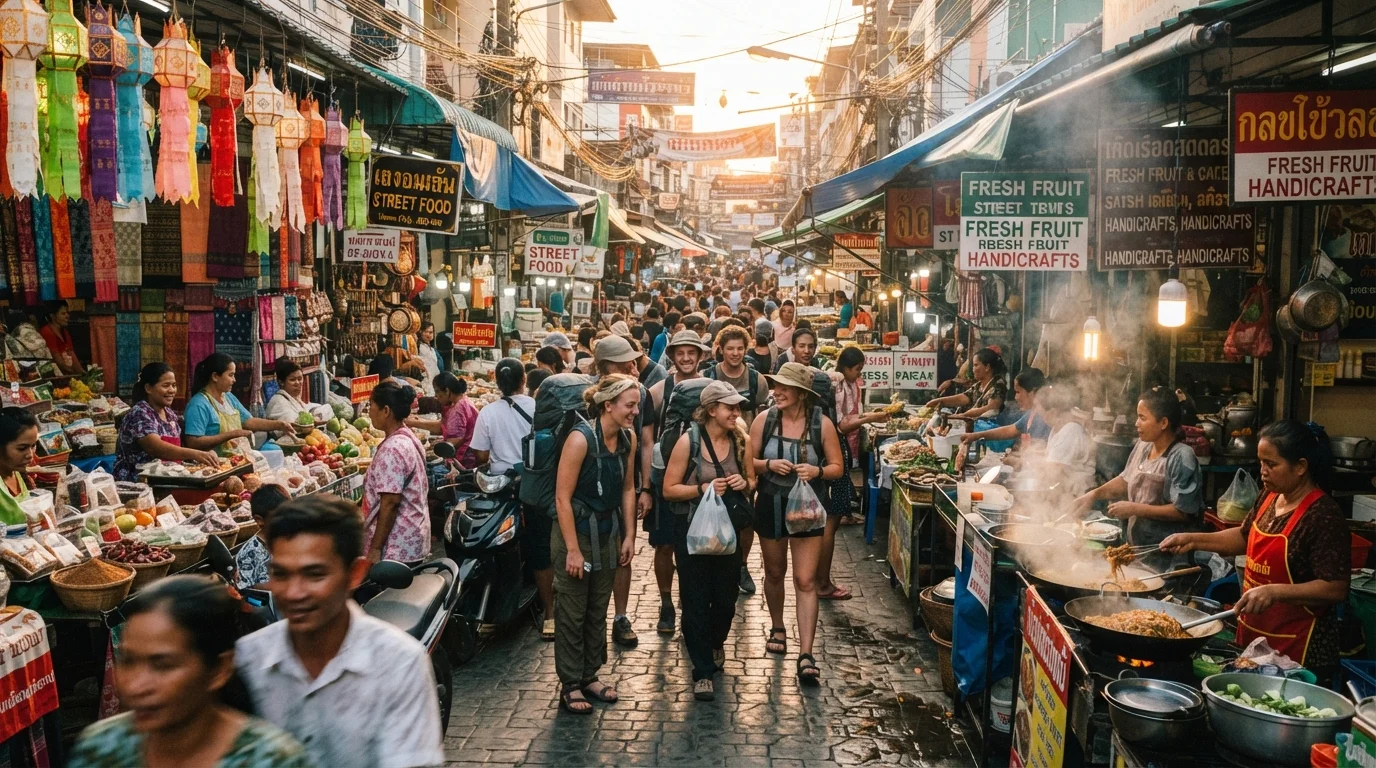
Southeast Asia consistently ranks as one of the most affordable long-haul destinations for students from North America. A budget traveler — staying in hostels, eating at street stalls and local restaurants, using buses and trains — can often manage on $25–$45 USD per day across Thailand, Vietnam, Cambodia, and Indonesia. That range shifts upward in Singapore and downward in Laos or rural Myanmar areas where tourism infrastructure is thinner.
Currency note: Each country has its own currency. The Thai Baht, Vietnamese Dong, and Indonesian Rupiah are not interchangeable. ATM withdrawal fees and foreign transaction charges add up fast — check our travel money tips hub for strategies to reduce these costs.
Common beginner entry points: Bangkok (Thailand) and Hanoi (Vietnam) are the most common starting cities due to high flight connectivity and well-established budget infrastructure. For a deeper look at what daily life actually costs across the region, see Southeast Asia on a Student Budget.
Daily budget
An estimate of what a traveler spends per day on accommodation, food, local transport, and basic activities. It does not include flights, visas, travel insurance, or big-ticket tours, which must be budgeted separately.
Foreign transaction fee
A charge — typically 1–3% — added by some banks or card issuers when you spend in a foreign currency. Using a card with no foreign transaction fees abroad can meaningfully reduce overall travel costs.
Hostel
Budget accommodation that offers shared dormitory-style sleeping rooms, usually with shared bathrooms. Hostels are among the lowest-cost lodging options for student travelers worldwide.
Exchange rate volatility
The degree to which a country's currency value fluctuates against other currencies. High volatility — common in some Latin American economies — means costs estimated in USD can change significantly between when you research and when you travel.
Tourist entry fee
A government-mandated charge collected at borders or specific attractions, separate from visa fees. These are common at UNESCO sites and national parks and are often not included in traveler daily budget estimates.
Latin America: Diverse Costs, Rich Experiences
Latin America spans a massive range of cost levels. Central American countries — Guatemala, Nicaragua, Honduras — are among the most affordable, with budget daily costs potentially under $30 USD. South American countries like Colombia, Peru, and Bolivia are similarly accessible. Brazil and Argentina's cost profile fluctuates more significantly with currency volatility and inflation.
Currency note: Several countries use the US dollar (Ecuador, El Salvador, Panama), which simplifies budgeting. Others have currencies subject to significant exchange rate movement — always check current rates before departure and understand that published cost estimates can go stale quickly.
Common beginner entry points: Medellín and Bogotá (Colombia), Guatemala City or Antigua (Guatemala), and Lima (Peru) are well-connected and have strong backpacker infrastructure. Budget travelers frequently report daily costs of $30–$50 USD in these cities on a careful plan. See Latin American destinations students should know about for specific city-level detail.
Don't overlook hidden costs like tourist entry fees at archaeological sites and domestic flight markups — these are covered in our article on hidden costs that blow student travel budgets.
Eastern Europe: Affordable and Underrated
Eastern Europe offers dramatically lower costs than Western Europe while still providing world-class history, architecture, and cultural depth. Countries like Poland, Czech Republic, Hungary, Romania, Bulgaria, and the Western Balkans (Serbia, North Macedonia, Albania) are consistently cited as affordable for student travelers.
Typical daily budget: $35–$60 USD in major cities like Kraków, Budapest, or Bucharest — covering a hostel bed, local meals, and public transit. Smaller cities and rural areas within these countries can run significantly lower.
Currency note: Not all Eastern European countries use the Euro. Poland uses the Złoty, Hungary the Forint, and Romania the Leu. Exchanging currency at airport kiosks typically carries poor rates — use in-network ATMs or research low-fee card options in advance.
Common beginner entry points: Kraków (Poland), Budapest (Hungary), and Prague (Czech Republic) have strong flight connections and well-developed hostel networks, making them logical first stops. For a side-by-side cost comparison with Western Europe, see Eastern Europe vs. Western Europe cost comparison. You can also find region-wide hacks in our student travel hacks hub.
This article provides general travel information for educational purposes. Costs, visa requirements, and entry conditions change frequently — always verify details through official government and embassy sources before you travel.
The content provided on our blog site traverses numerous categories, offering readers valuable and practical information. Readers can use the editorial team’s research and data to gain more insights into their topics of interest. However, they are requested not to treat the articles as conclusive. The website team cannot be held responsible for differences in data or inaccuracies found across other platforms. Please also note that the site might also miss out on various schemes and offers available that the readers may find more beneficial than the ones we cover.