

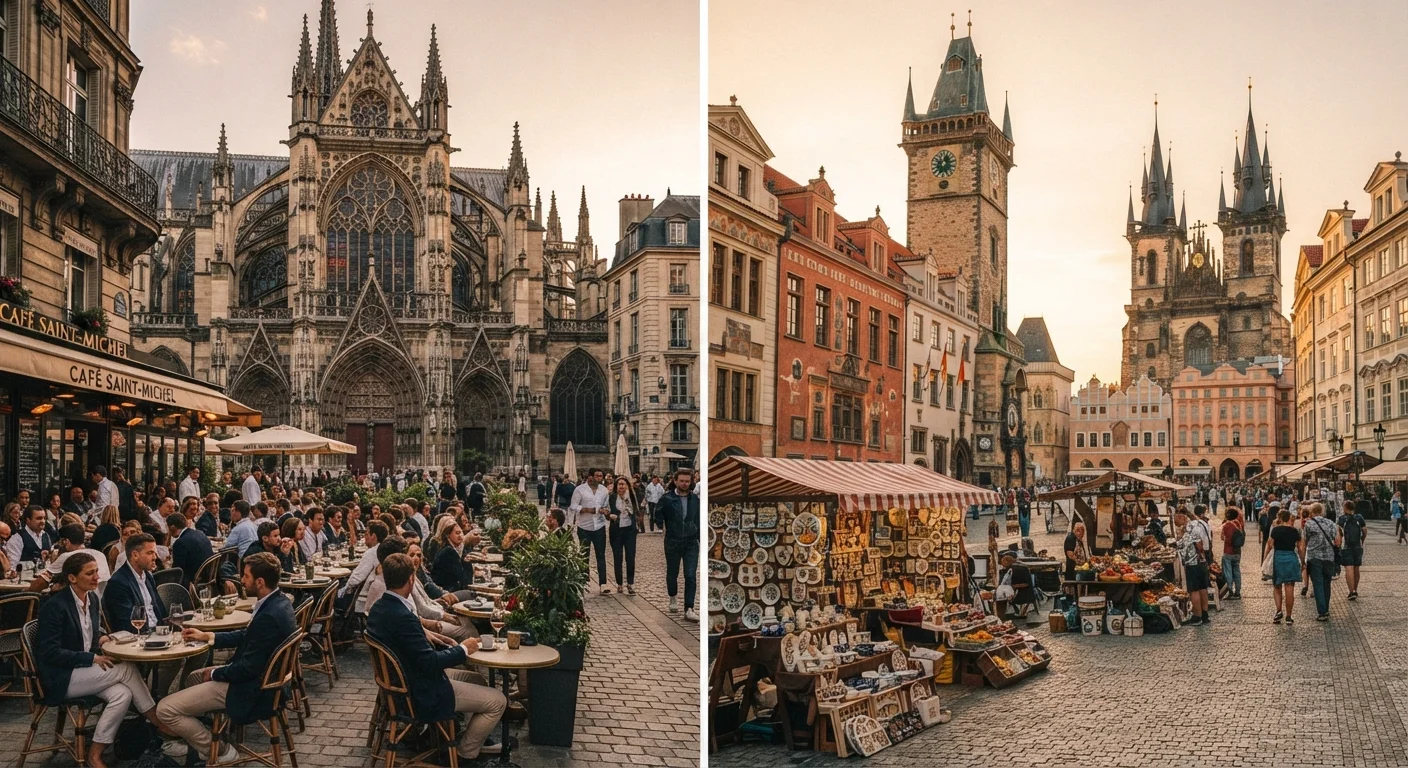
Option A
Eastern Europe
The high-value, under-the-radar region for student travelers.
Best for: Students who want to maximize daily experiences on a tight budget without sacrificing culture or history.
Option B
Western Europe
The classic, well-connected choice with a steeper price tag.
Best for: Students who prioritize iconic landmarks, established student infrastructure, and seamless logistics.
The Core Cost Gap: What the Numbers Actually Show
The price difference between Eastern and Western Europe isn't a myth — it's measurable and significant. Based on widely cited cost-of-travel indexes, a student traveling in cities like Warsaw, Budapest, or Sofia can typically spend $40–$60 USD per day covering a hostel bed, three meals, local transport, and one or two attractions. A comparable day in Paris, Amsterdam, or Zurich can run $120–$180 or more.
That gap compounds fast. Over a two-week trip, the difference in daily spend could amount to $700–$1,500 — real money that could fund an extra week of travel or cover a return flight home.
The largest cost drivers in Western Europe are accommodation and dining. Hostel dorm beds in major Western cities frequently cost $35–$60 per night. In Eastern European capitals, you'll often find comparable quality for $12–$25. Sit-down restaurant meals follow a similar pattern: a budget lunch in Kraków or Tallinn might run $5–$8, while the same in Copenhagen or London is closer to $15–$25.
| Criterion | Eastern Europe | Western Europe |
|---|---|---|
| Avg. hostel dorm bed/night | $12–$25 | $35–$60 |
| Budget restaurant meal | $5–$8 | $15–$25 |
| Local transit (single ride) | $0.50–$1.50 | $2.50–$5.00 |
| Typical daily budget (student) | $40–$60 | $120–$180 |
| English widely spoken | Varies; cities improving | Broadly yes |
| Student discount infrastructure | Growing but inconsistent | Robust and widespread |
| Inter-city rail speed | Slower, cheaper | Faster, more expensive |
It's worth noting that not all of Eastern Europe is uniformly cheap, and not all of Western Europe is uniformly expensive. Prague and Ljubljana have crept up in price as tourism has grown, while Portugal's smaller cities remain relatively affordable by Western European standards. For a fuller picture of how to evaluate what a destination truly costs, see why 'cheap destination' can be misleading.
What You Get for Your Money: Culture, Access, and Experience
Cost is only part of the equation. What you actually experience day-to-day matters too — and both regions have distinct strengths.
Eastern Europe offers extraordinary density of history, architecture, and culture at prices that rarely feel like trade-offs. Cities like Tallinn's medieval old town, Budapest's thermal baths, and Kraków's Jewish quarter deliver rich, layered experiences with minimal entry fees. Many state museums across Poland, the Czech Republic, and the Baltics offer free admission on certain days or heavily reduced student rates.
Western Europe competes on the depth of its student infrastructure. The British Museum (London), the Louvre (Paris), and the Prado (Madrid) all offer free general admission, and youth or student cards like the ISIC are widely accepted across the region. The EU's student mobility programs also mean many exchange students find their way to Western European universities with some institutional support built in.
40–60%
Lower daily costs in Eastern vs. Western Europe
Cost-of-living indexes from sources such as Numbeo consistently show Eastern European capitals costing substantially less than Western counterparts on an equivalent lifestyle basis.
$700–$1,500
Potential two-week savings choosing Eastern Europe
Based on estimated daily spend differentials between regions; actual savings vary by city, season, and travel style.
3 of 10
Most affordable European cities are in Eastern Europe
Recurring budget travel indices (including ECA International and Mercer cost-of-living data) frequently place Sofia, Warsaw, and Bucharest among the least expensive European capitals.
Transportation between cities is also a key factor. Western Europe's rail network is faster and more frequent, but tickets are pricier. Eastern Europe's buses and regional trains are slower yet dramatically cheaper. If you're planning to move between countries, check out whether a rail pass actually saves money for student travelers before buying one.
One often-overlooked consideration: hidden costs. Tourist taxes, airport-to-city transport, and premium pricing in tourist zones exist in both regions. Hidden costs are one of the most common ways student travel budgets unravel — budget for them regardless of which region you choose.
For broader regional comparisons including Southeast Asia and Latin America, the region-by-region budget travel reference puts European costs in global perspective. And for a grounded overview of managing money while on the road, the Travel Money Tips hub covers the essentials.
The content provided on our blog site traverses numerous categories, offering readers valuable and practical information. Readers can use the editorial team’s research and data to gain more insights into their topics of interest. However, they are requested not to treat the articles as conclusive. The website team cannot be held responsible for differences in data or inaccuracies found across other platforms. Please also note that the site might also miss out on various schemes and offers available that the readers may find more beneficial than the ones we cover.