

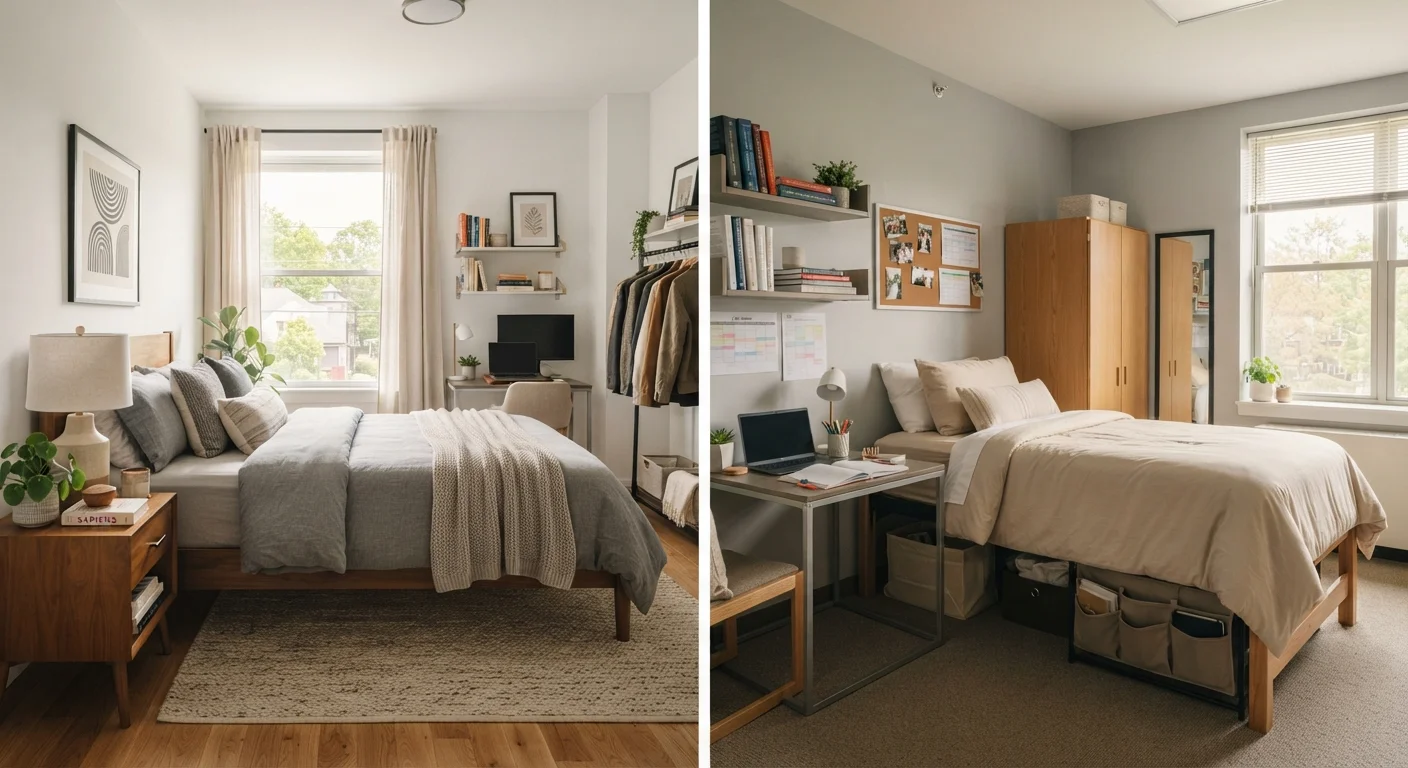
Option A
Off-Campus Renting
The independent, flexible path to housing.
Best for: Students who want more privacy, personal space, and control over their living environment and budget.
Option B
Student Halls (On-Campus Housing)
The structured, community-centered option.
Best for: First-year students who want built-in social connections, proximity to campus, and minimal logistical overhead.
The Core Difference in How Each Option Works
Student halls — also called residence halls or dorms — are housing units managed directly by a college or university. You apply through the school, pay a semester or annual housing fee, and agree to the institution's rules. Most contracts are tied to the academic year, not a calendar year, which makes them easier to exit when school ends.
Off-campus renting means signing a standard lease with a private landlord or property management company. You're a tenant under your state's landlord-tenant law, responsible for rent, utilities, and the upkeep expectations spelled out in your lease. For a fuller picture of that process, see our complete introduction to apartment renting for students.
The distinction matters because it shapes everything — cost structure, social environment, flexibility, and the skills you'll need to manage your living situation day to day.
Cost: What You're Actually Paying For
Sticker price comparisons between halls and apartments can be misleading. Halls often include utilities, internet, and sometimes a meal plan — costs that appear separately when you rent. Once you add electricity, gas, Wi-Fi, and groceries to an apartment's base rent, the gap frequently narrows or reverses.
That said, apartments can be cheaper depending on location, the number of roommates, and your lifestyle. Splitting a two-bedroom unit with a roommate in a college town may cost less per month than a standard double room in a campus residence hall. The key is to compare total monthly costs, not just rent versus housing fees.
| Criterion | Off-Campus Renting | Student Halls |
|---|---|---|
| Contract type | Private lease (6–12 months) | Academic-year housing agreement |
| Utilities included | Rarely; paid separately | Usually included in fee |
| Meal plan | Not included; self-catered | Often bundled or required |
| Privacy | Higher; own space | Lower; shared bathrooms common |
| Social environment | Self-directed; less built-in | Built-in community on site |
| Campus proximity | Varies; commute likely | On or adjacent to campus |
| Maintenance responsibility | Tenant reports to landlord | Campus facilities handle it |
| Independence required | High; self-managed | Low; structured environment |
If you do pursue off-campus housing, read our guide on apartment hunting on a student budget before signing anything.
Social Life, Independence, and Daily Logistics
Student halls put you in the center of campus social life. Floor-wide events, shared lounges, and geographic proximity to classmates make it easier to form friendships, particularly in the first semester when everyone is new. For students who are introverted or anxious about starting college, that built-in community can reduce isolation meaningfully.
Off-campus housing, by contrast, requires you to build social connections more deliberately. You're not as physically embedded in campus life, and your roommates may not be classmates. That said, many students find the greater independence — choosing your own space, cooking your own food, setting your own schedule — to be well worth the trade-off. If you're staying in halls and want to make the most of that space first, the Dorm Room Setup hub has practical tips for organizing your room.
Check Your School's Housing Requirements
Many colleges require first- and second-year students to live on campus unless they meet specific exemptions (living with family nearby, medical accommodations, etc.). Before assuming off-campus renting is an option, confirm your school's residency policy. Violating a mandatory housing requirement can have academic and financial consequences.
Logistically, halls are simpler to manage: maintenance requests go to campus facilities, rules are enforced by an RA, and there's no lease to negotiate. Renting puts those responsibilities on you, which can be a learning curve but also genuine preparation for post-college adult life.
Which Option Fits Your Situation?
Neither renting nor living in halls is the objectively superior choice — the right answer depends on where you are in your college career, your financial situation, and your personal priorities.
Most schools require or strongly encourage first-year students to live on campus, and for good reason: the transition to college is easier when your housing, dining, and social infrastructure are already in place. Upperclassmen who know their campus, have an established social network, and feel ready to manage a lease often find that off-campus living suits them better.
Before committing to an apartment, think carefully about what type of space you actually need. Our article on picking the right apartment type walks through the real trade-offs between studios, one-bedrooms, and shared units. You'll also want to weigh practical questions like furniture — our overview of furnished vs. unfurnished rentals explains what each setup actually costs and demands.
~55%
Students living off campus nationally
According to the National Center for Education Statistics, the majority of US college students live off campus, including those commuting from home.
12 months
Typical off-campus lease length
Most private landlords in college towns use standard 12-month leases, meaning students may pay rent over summer even when not in residence.
If financial planning around transportation is also part of your decision, the commuter parking vs. on-campus housing comparison offers a useful framework for thinking through driving costs alongside housing costs.
The content provided on our blog site traverses numerous categories, offering readers valuable and practical information. Readers can use the editorial team’s research and data to gain more insights into their topics of interest. However, they are requested not to treat the articles as conclusive. The website team cannot be held responsible for differences in data or inaccuracies found across other platforms. Please also note that the site might also miss out on various schemes and offers available that the readers may find more beneficial than the ones we cover.