

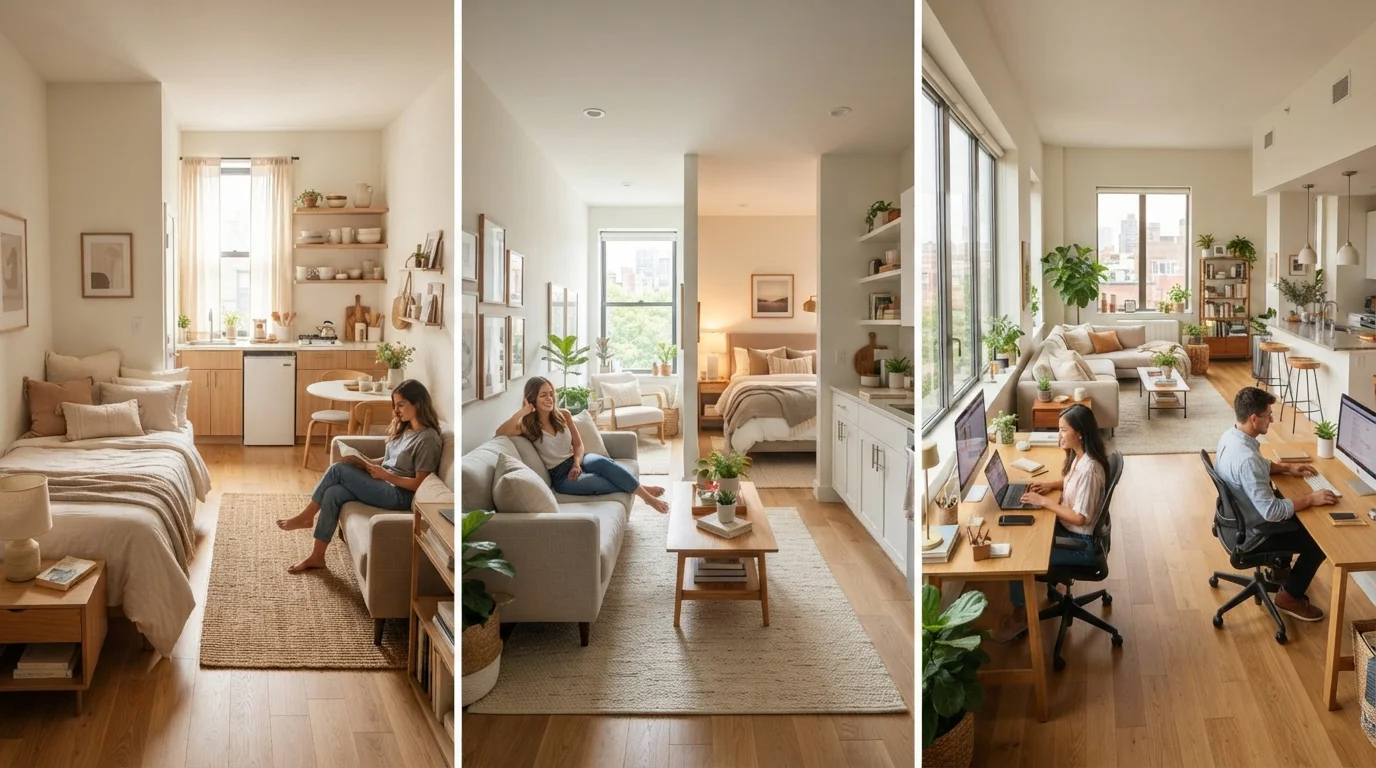
Our Verdict
There is no universally right choice — each apartment type serves a different type of student well. Studios work best for light-sleepers and self-sufficient students on a tight budget; one-bedrooms suit those who can stretch their finances for genuine peace and quiet; shared apartments offer the biggest savings but demand social and practical compatibility with the people you live with.
| Best for | Recommended |
|---|---|
| Budget-conscious students who live independently and don't need separate rooms | Studio apartment |
| Students who prioritize quiet, personal space, and can afford higher rent | One-bedroom apartment |
| Students who want to significantly reduce monthly costs and are comfortable with shared living | Shared apartment |
What Each Apartment Type Actually Means
Before comparing options, it helps to be precise about what each term means — because listings aren't always consistent.
- Studio: A single open room that combines your sleeping area, living area, and kitchen, with a separate bathroom. Everything happens in one shared space.
- One-bedroom: A distinct bedroom physically separated from the living room and kitchen. You have a private space to sleep and work away from the main area.
- Shared apartment: Any unit — studio, one-bedroom, or larger — where you rent a room or space alongside one or more roommates. Common areas like the kitchen, bathroom, and living room are shared.
Understanding this distinction matters when searching listings. A "shared studio," for example, means two people in one open room — a very different situation from a shared two-bedroom. For a broader introduction to how rentals work, see the complete renting introduction for students.
Cost: Where the Numbers Actually Land
Rent is usually the deciding factor, so it's worth being honest about what each option typically costs — and what drives those costs.
~30–50%
Potential rent savings in shared housing
Splitting a two-bedroom apartment with one roommate can reduce each person's rent substantially compared to renting a one-bedroom alone, though exact figures depend heavily on local market conditions.
43%
Students citing cost as top housing factor
According to College Pulse survey data, a plurality of college students identify affordability as the single most important factor when choosing off-campus housing.
Studios are generally the cheapest solo rental option. You're paying for one room, one set of utilities, and no roommate coordination. However, in high-demand college cities, a studio can still be surprisingly expensive relative to a shared situation.
One-bedrooms are typically the most expensive option for a single occupant. You're paying for the square footage and layout of a full apartment on your own. Utilities are also your sole responsibility.
Shared apartments almost always offer the best per-person cost. Splitting a two-bedroom with one roommate can cut your rent by 30–50% compared to renting a one-bedroom alone, depending on your market. Shared utilities further reduce monthly outgoings.
For guidance on weighing location, commute, and price during your search, the apartment hunting priorities guide is a useful companion.
| Studio | One-Bedroom | Shared Apartment | |
|---|---|---|---|
| Typical monthly cost (solo) | Moderate — lowest solo option | High — full rent alone | Low — split with roommate(s) |
| Privacy from others | High — live alone | High — live alone | Lower — shared common areas |
| Internal space separation | None — one open room | Good — distinct bedroom | Varies — depends on layout |
| Noise control | Full control — solo space | Full control — solo space | Shared — depends on roommates |
| Social interaction built in | None — fully independent | None — fully independent | Yes — daily with roommates |
| Lease risk | Solo responsibility | Solo responsibility | Joint or individual — check lease |
| Best fit | Self-sufficient, budget-aware | Privacy-focused, financially able | Cost-focused, socially compatible |
Privacy, Noise, and Your Study Environment
Cost tells you what you can afford. Lifestyle fit tells you whether you'll actually be comfortable there.
Studios offer complete personal privacy from other people — you have the whole space to yourself — but zero separation within that space. If you take a video call, your bed is in the background. If you want to study while music plays, there's nowhere else to go. Students who are light sleepers or who need a distinct workspace often find studios harder to live in than they expected.
One-bedrooms solve the internal separation problem. Your bedroom is a dedicated retreat; your living room is for everything else. This separation genuinely matters for sleep quality and focus. The trade-off is that you bear every cost alone.
Shared apartments introduce a different variable: other people. Noise, guest policies, kitchen schedules, and cleaning standards all require agreement. If you and your roommates are compatible — similar sleep schedules, similar standards — shared living can actually feel comfortable and social. If you're not, it can be a source of ongoing stress.
Have the Compatibility Conversation Early
Before signing a lease with a potential roommate, discuss sleep schedules, guest policies, cleanliness expectations, and how you'll handle shared bills. These conversations feel awkward but prevent far more painful conflicts later. Many experienced student renters recommend a written roommate agreement — even a simple one — to set expectations in writing from day one.
It's also worth thinking about your study setup. A dedicated desk configuration for studying looks very different depending on how much private space you have.
Making Your Decision: Questions to Ask Yourself
Rather than defaulting to whatever seems cheapest or most independent, work through these questions honestly before signing a lease.
- What does my daily routine look like? If you keep irregular hours — late nights studying, early morning classes — consider how that intersects with shared living or open studio layouts.
- How important is having a separate bedroom door? For many students, this single feature makes the largest practical difference to sleep and focus.
- Do I know who I'd room with? Rooming with a trusted friend or vetted classmate is a different proposition from being matched with a stranger. Both can work, but the risk profile differs.
- Can I handle the full rent if something goes wrong? In a shared apartment, if a roommate can't pay their share, you may still be liable under the lease. Understand what you're signing.
- Am I comparing apples to apples? Always factor in utilities, parking, laundry access, and proximity to campus — not just the listed rent figure.
If you're also weighing whether to rent privately at all versus staying in student housing, the comparison of off-campus renting vs. student halls covers that decision in depth. And once you've moved in, basic home maintenance skills will help you keep your space in good shape regardless of which type you choose.
The content provided on our blog site traverses numerous categories, offering readers valuable and practical information. Readers can use the editorial team’s research and data to gain more insights into their topics of interest. However, they are requested not to treat the articles as conclusive. The website team cannot be held responsible for differences in data or inaccuracies found across other platforms. Please also note that the site might also miss out on various schemes and offers available that the readers may find more beneficial than the ones we cover.