

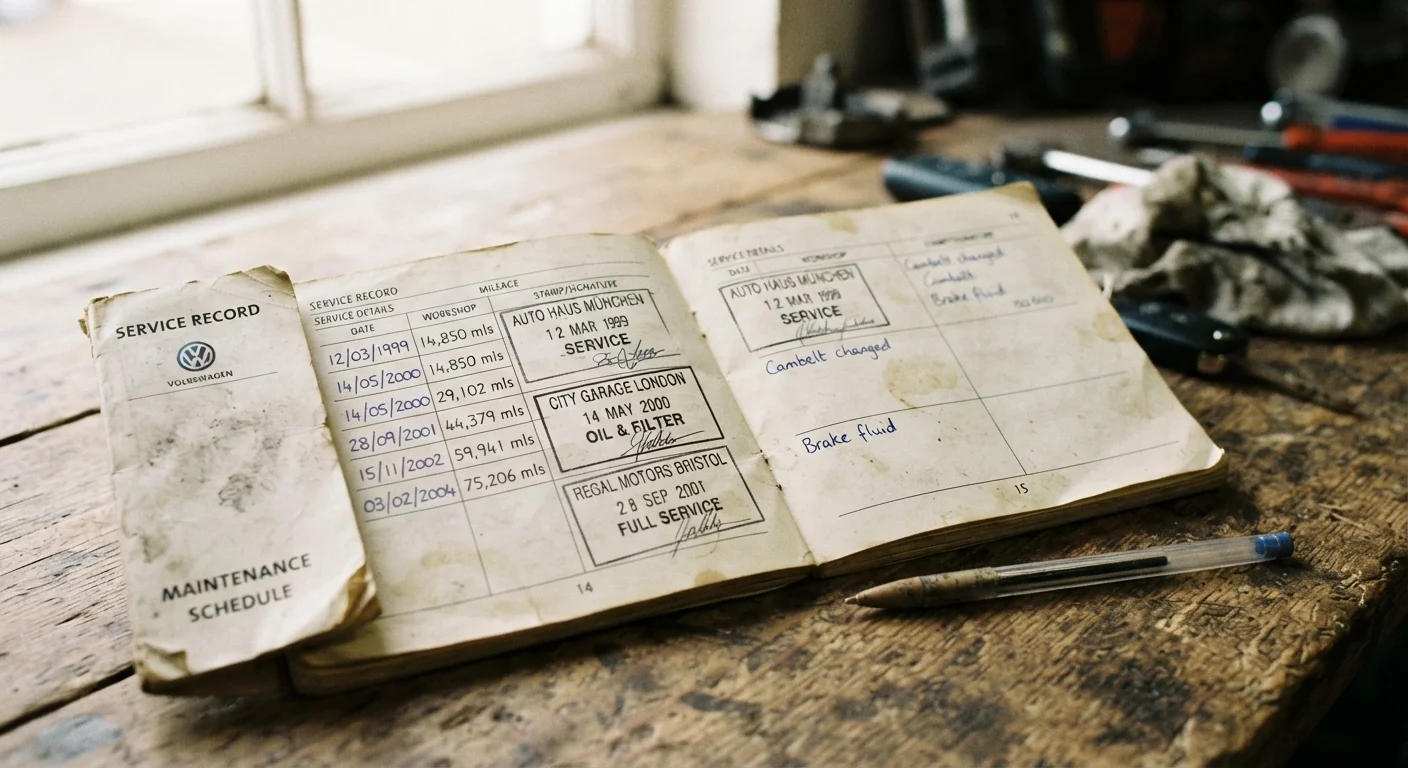
What You're Actually Looking At
When someone hands you a service booklet - or shows you a screen of digital records - it can look like a wall of dates, mileage figures, and garage stamps. The core purpose is straightforward: the document is meant to show that the car was maintained at regular intervals and that a qualified person did the work.
Each entry should include the date of the service, the mileage at the time, a description of what was done, and confirmation of who carried out the work. In a paper booklet, this last part appears as a rubber stamp from the garage. In a digital system, it's a logged entry tied to a real business account.
To understand why the records matter, it helps to know the basics of what a car needs to function. Our plain-language guide to how cars work covers the key systems that scheduled servicing is designed to keep healthy.
~60,000 mi
Typical timing belt replacement interval
Manufacturer intervals vary, but many recommend replacement between 60,000 and 100,000 miles - always check your specific model's schedule.
1 in 3
Used cars with incomplete service records
Industry estimates suggest a significant proportion of used vehicles sold privately have partial or missing service documentation.
The Entries That Matter Most
Not every line in a service record carries the same weight. Here's how to prioritise what you're reading:
- Oil and filter changes: Engine oil degrades over time and mileage. Regular oil changes are the single most important routine task. Look for these at every service interval - typically every 12 months or 10,000-12,000 miles, though this varies by manufacturer.
- Timing belt (or chain) replacement: This is one of the most expensive and critical jobs on the maintenance schedule. A snapped timing belt can destroy an engine. Check whether the replacement is logged and whether it's due again based on the car's current mileage.
- Brake fluid replacement: Brake fluid absorbs moisture over time, reducing its effectiveness. It's usually recommended every two years regardless of mileage.
- Coolant and other fluid top-ups: These are less critical individually but reflect whether the car was being actively monitored.
If you see consistent entries for oil changes but nothing on a timing belt that should have been replaced by 60,000 miles - and the car has 80,000 on the clock - that's a direct question to ask the seller.
Bring a Notepad to Every Viewing
Write down the mileage figures from each service stamp and compare them against the car's current odometer reading and its MOT history. Inconsistencies between these three sources are the clearest early warning sign that something isn't right. Taking notes also makes it easier to follow up with garages after the viewing.
Spotting Red Flags and Gaps
A gap in the service history doesn't automatically mean something went wrong, but it does require an explanation. Common reasons for gaps include private ownership with DIY servicing, a period of low use, or a change of ownership where records were lost. The problem is distinguishing genuine gaps from deliberate concealment.
Look for these warning signs:
- Inconsistent mileage progression: The mileage recorded at each service should increase logically over time. If it jumps backward or stays suspiciously flat, treat this as a serious concern - it may indicate clocking (tampering with the odometer).
- Stamps from garages that don't exist: Search the listed garage name and address. If it doesn't appear online and the phone number goes nowhere, the stamp may be fraudulent.
- Repeated repairs for the same component: Seeing the same part replaced or adjusted multiple times suggests an underlying fault that was never properly resolved.
MOT records provide a useful cross-check. They're stored on the UK government's free online database and show pass/fail outcomes, advisory notes, and mileage readings at each test. Our article on what an MOT result actually tells you explains how to interpret those entries alongside the service record.
How to Verify What You've Been Shown
Reading the records is only the first step - verification is what gives you confidence. Here's a practical approach:
- Check the MOT history online using the vehicle's registration number. The government's free tool shows every MOT result, mileage recorded, and any advisories logged at each test. Compare the mileage figures against those in the service booklet.
- Call the garages listed. A quick phone call to confirm they carried out the service is one of the most underused verification steps. Most reputable workshops keep records and can confirm the work.
- Ask for invoices. Stamps alone are not invoices. A well-maintained car will often have a folder of receipts corresponding to the service entries. Missing invoices don't disqualify a car, but their presence is reassuring.
- Consider an independent pre-purchase inspection. A qualified mechanic can assess whether the car's physical condition is consistent with its documented history. Our guide to why a pre-purchase inspection matters explains what this involves and when it's worth arranging.
“The service history is the biography of the car. A few missing chapters are explainable; a book with most of its pages torn out tells its own story.”
— Student Car Guide Editorial Team, Automotive guidance resource for college students
Being thorough at this stage takes less than an hour and can prevent costly surprises down the line. Also see our article on common mistakes new drivers make with car care to understand what good ongoing maintenance should look like once you own the vehicle.
Frequently Asked Questions
Full service history (FSH) means the car has been serviced at every interval recommended by the manufacturer, with documented proof. Each service entry should include a date, mileage, description of work, and a garage stamp or digital confirmation. A car with FSH is generally considered lower risk because its maintenance pattern is transparent.
Yes. Many manufacturers and franchised dealers have moved to digital service records stored in a central database. These are often more reliable than paper booklets because they're harder to fake. Ask the seller which system was used and verify the records directly with the manufacturer's portal or dealer network if possible.
One missed or late service is not necessarily a dealbreaker, especially on older cars. Multiple gaps - or a history that simply goes quiet for several years - deserve a clear explanation from the seller. The severity also depends on what was due: a missed oil change is more concerning than a delayed pollen filter replacement.
Paper booklets can be stamped fraudulently, so cross-check stamps against invoices and verify garages actually exist. Digital records from manufacturer databases are significantly harder to alter. If you have doubts, a pre-purchase inspection by an independent mechanic provides an additional layer of verification.
A service record documents planned maintenance carried out by a garage or owner. An MOT record documents the outcome of a legally required annual roadworthiness test. Both are important, but they measure different things - servicing tracks ongoing care, while MOT history flags safety and emissions issues at specific points in time.
The content provided on our blog site traverses numerous categories, offering readers valuable and practical information. Readers can use the editorial team’s research and data to gain more insights into their topics of interest. However, they are requested not to treat the articles as conclusive. The website team cannot be held responsible for differences in data or inaccuracies found across other platforms. Please also note that the site might also miss out on various schemes and offers available that the readers may find more beneficial than the ones we cover.