

What a Test Drive Actually Tells You
A test drive is a valuable first filter — but its scope is limited. When you take a car around the block, you're primarily gathering sensory information: how the steering feels, whether the engine sounds rough at idle, if the brakes pull to one side. These impressions matter, but they only reflect the car's behaviour at that moment, in those conditions.
A skilled seller can mask a number of problems before you arrive. Warming up the engine beforehand hides cold-start issues. Fresh air freshener covers oil or damp smells. A recently topped-up fluid reservoir disguises a slow leak. None of these tactics require dishonesty — they can simply reflect routine preparation — but they mean you're getting a polished version of the car, not a complete one.
Test drives also rarely cover enough distance or variety of road conditions to surface intermittent faults, transmission hesitation at higher speeds, or suspension weaknesses that only appear under load. For a first-time buyer, knowing what you don't know is the most important starting point. See our honest comparison of used vs. new car trade-offs for broader context on what buying used actually involves.
What an Independent Inspection Uncovers
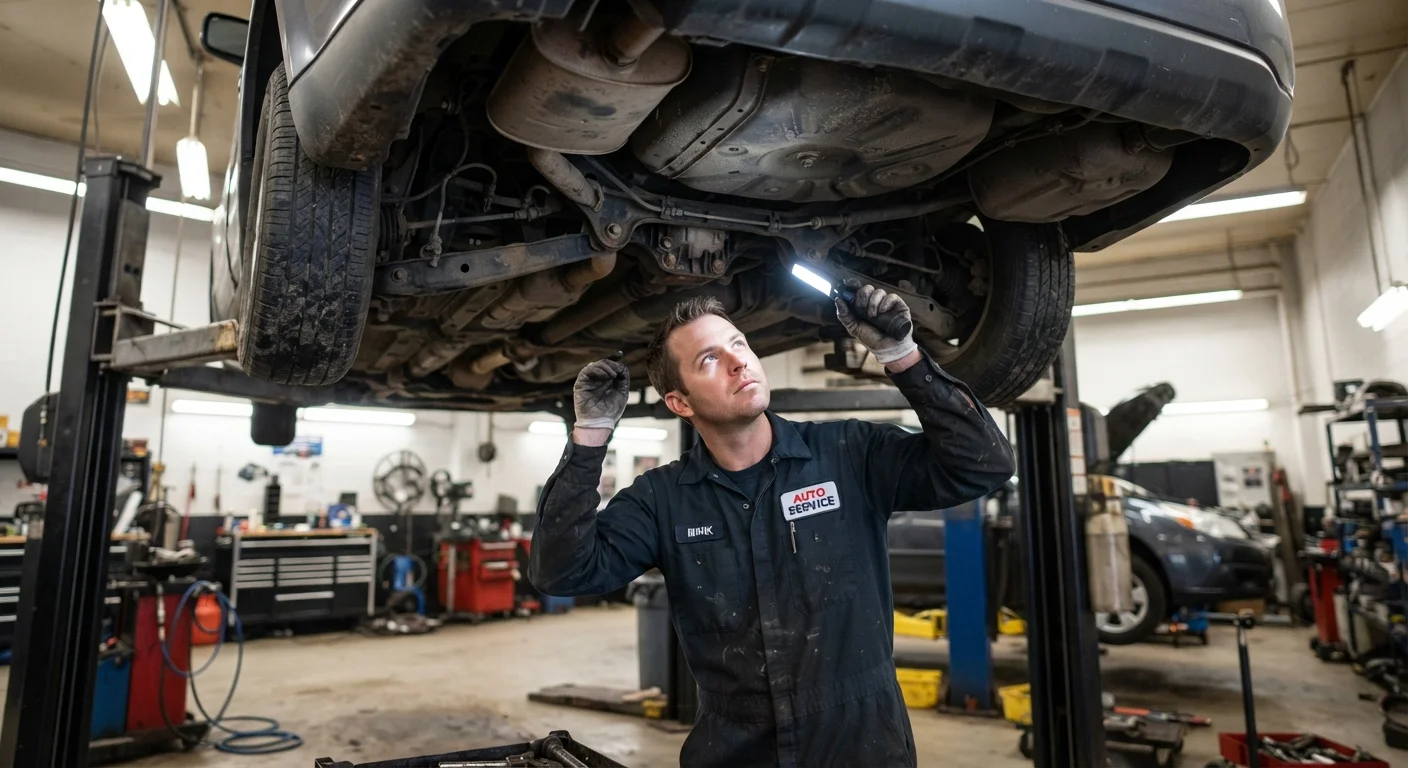
A pre-purchase vehicle inspection (sometimes called a PDI or pre-buy inspection) is carried out by a qualified mechanic who has no financial interest in whether you buy the car. That independence is the whole point. You arrange it, you pay for it, and the findings go directly to you.
A thorough inspection typically covers:
- Underbody and chassis: rust, corrosion, signs of accident repair or welding
- Brakes: pad thickness, disc condition, brake lines
- Suspension and steering: worn bushings, ball joints, shock absorbers
- Engine and transmission: oil condition, coolant level, signs of leaks or overheating
- Electrics: battery health, warning lights, ancillary systems
- Tyres: tread depth, uneven wear patterns that suggest alignment problems
Many of these items are completely invisible during a test drive. A car can drive smoothly with 2mm of brake pad remaining, but that's a safety hazard and an imminent cost. An inspection makes the invisible visible.
How to Arrange an Independent Inspection
Most inspections are conducted at a garage of your choosing or by a mobile mechanic who will travel to the vehicle's location. Some motoring organisations also offer structured inspection services — check what's available in your area and confirm exactly what the inspection covers before booking. Always ensure the inspector is qualified and has no connection to the seller.
Most inspections are conducted at a garage of your choosing or by a mobile mechanic. Some motoring organisations also offer inspection services — check what's available in your area and confirm exactly what the inspection covers before booking.
Best Practices for Using Both Steps Wisely
Always book an inspection with a mechanic who has no connection to the seller.
Independence is what makes the inspection trustworthy. A garage recommended by the seller has an incentive — whether conscious or not — to deliver a reassuring result. Your inspector works for you, not for the transaction.
Request a written report with photographs, not just a verbal summary.
A written report creates a record you can revisit, share, and use in price negotiations. A verbal summary given at the roadside is easy to misremember and impossible to verify later.
Use the inspection findings to negotiate, not just to decide.
A problem found during inspection doesn't necessarily mean you should walk away. It gives you factual grounds to renegotiate the price to reflect the cost of repair, or to ask the seller to address it before sale.
Check the car's MOT history alongside the inspection report.
MOT records are publicly available and reveal a pattern of advisories, failures, and recurring issues over time. A single inspection is a snapshot; MOT history gives you the longer story.
Factor the inspection cost into your total purchase budget from the start.
Students often treat the inspection as an optional extra to save money — but skipping it is where the real financial risk lies. A £100 inspection that reveals a £600 repair need is money extremely well spent.
Used together, the test drive and independent inspection give you a complete picture. The test drive tells you whether you want the car; the inspection tells you whether you should buy it. Neither replaces the other, but if you had to prioritise one for protecting your money, the inspection wins every time.
You can also pair inspection findings with a car's paper trail. Our guide to reading a car's service history explains how to cross-reference what a mechanic finds with what the logbook actually records — inconsistencies between the two are a significant warning sign.
Quick Actions Before You Commit
Once you've completed both steps and you're satisfied, you're in a much stronger position than most first-time buyers. You'll have documented evidence of the car's condition, a clearer sense of any costs likely to arise soon, and real leverage if you want to negotiate on price. Before you drive the car home for the first time, it's also worth building a simple habit — our first-time owner's pre-journey checklist covers the basics every new driver should check before setting off.
This article is for general informational and educational purposes only. Always consult a qualified mechanic for advice specific to any vehicle you are considering purchasing. Costs and services mentioned are illustrative and will vary by region and provider.
The content provided on our blog site traverses numerous categories, offering readers valuable and practical information. Readers can use the editorial team’s research and data to gain more insights into their topics of interest. However, they are requested not to treat the articles as conclusive. The website team cannot be held responsible for differences in data or inaccuracies found across other platforms. Please also note that the site might also miss out on various schemes and offers available that the readers may find more beneficial than the ones we cover.