

Why Campus Parking Signs Trip Students Up
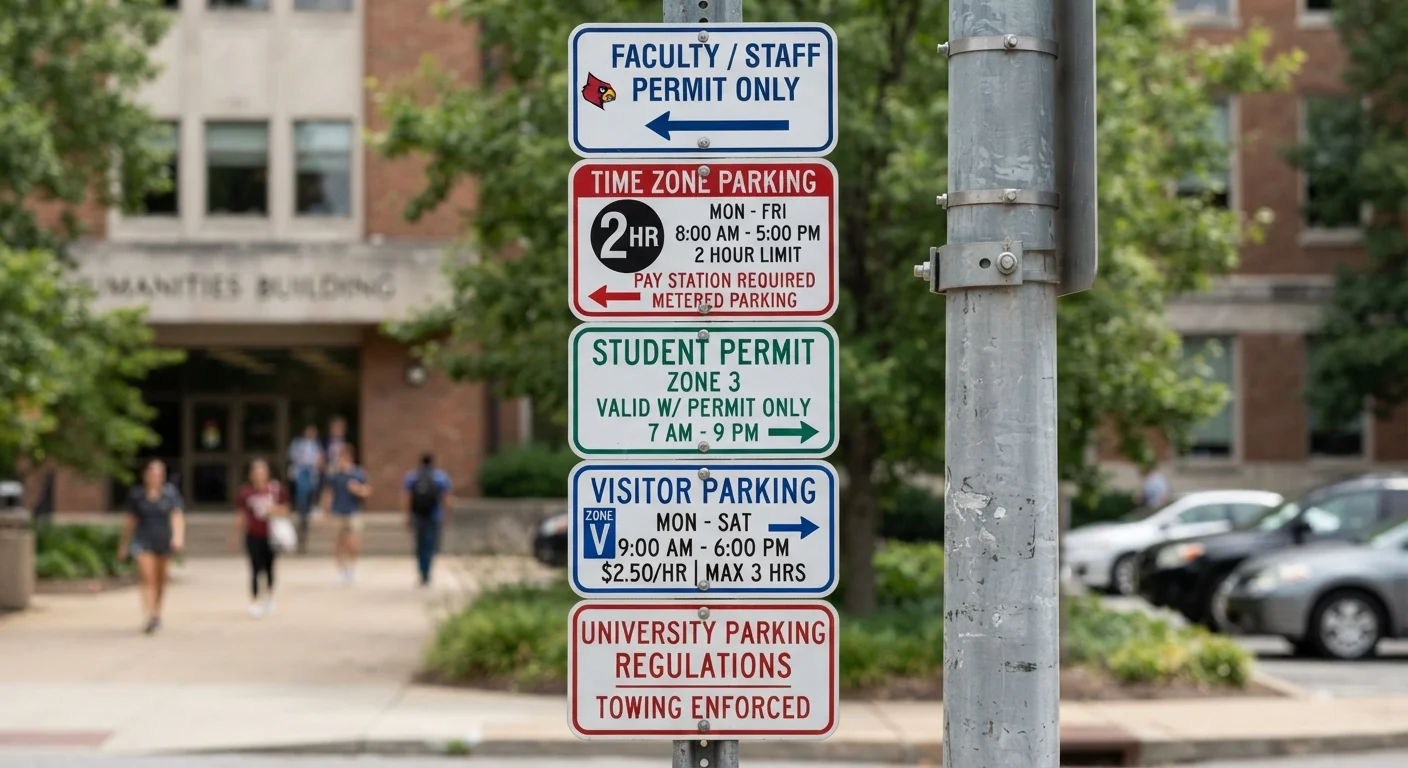
Campus parking systems are more layered than most public street parking. A single post can display three or four signs simultaneously, each adding a condition - time limit, permit requirement, enforcement schedule, or vehicle class restriction. Reading only one sign and ignoring the rest is the most common mistake new student drivers make.
The core rule: every sign on a post applies at the same time. A space may be permit-only and have a two-hour maximum and prohibit overnight parking. All three conditions must be met for your parking to be legal.
This guide is part of a broader look at campus commuting. If you're just getting started, the practical first semester overview covers the full picture from permits to parking strategy.
| Most common citation cause | Expired or missing permit in a permit-only zone |
| Typical timed-zone limit | 15 minutes to 2 hours, depending on zone |
| Standard enforcement schedule | Monday-Friday, 7 a.m.-5 p.m. (varies by campus) |
| ADA violation fines | Up to $250 under federal minimums; state fines often higher (U.S. Department of Justice ADA guidelines) |
| Signs to read together | All signs on a single post apply simultaneously |
Decoding the Most Common Sign Types
Permit-Only Signs
These signs display a zone designation (often a letter, color, or number - such as "Zone A" or "Red Permit") and state that only vehicles displaying that permit may park there. Even a permit from a different campus zone is not valid. Check which zone your permit covers before pulling in.
For a full explanation of how permit zones are structured, see Campus Parking Permits Explained.
Timed Zone Signs
A timed zone sign states a maximum stay (e.g., "30 Min Parking") and usually specifies the hours during which the limit applies. If the sign reads "30 Min - 8AM-5PM Mon-Fri," parking there for an hour on Saturday morning is generally permitted. But parking for 35 minutes on a Tuesday at noon is a violation, regardless of whether an officer happens to pass by.
No Parking / No Stopping / No Standing
These three terms are legally distinct. No Parking typically allows brief stops to drop off or pick up passengers. No Stopping prohibits even momentary stops. No Standing falls in between - you may stop to let someone out, but you cannot wait with the vehicle stationary. Campus enforcement officers apply these definitions literally.
Reserved and ADA Spaces
Reserved spaces are marked for specific users - faculty, staff, specific departments, or vehicles with disabilities. ADA-designated spaces require a valid state-issued disability placard or license plate. A campus parking permit, regardless of its tier, never qualifies a vehicle to use an ADA space.
Permit Zone
A designated parking area that requires a valid, zone-specific permit displayed in or on your vehicle. Parking here without the correct permit - even briefly - typically results in a citation.
Enforcement Hours
The specific times of day and days of the week during which parking rules are actively enforced by campus or municipal officers. Outside these hours, some restrictions may not apply, but you must confirm this on the sign itself.
Timed Zone
A parking area where vehicles may only remain for a stated maximum duration (e.g., 30 minutes, 2 hours). Overstaying this limit is a common cause of citations.
Loading Zone
A short-stay area designated for active loading or unloading of goods or passengers. Leaving an unattended vehicle here - even for a few minutes - usually violates the zone's rules.
ADA Space
A parking space reserved under the Americans with Disabilities Act for drivers or passengers with qualifying disabilities. These require a valid state-issued placard or license plate; campus permits do not substitute.
Visitor Parking
Spaces designated for non-permit-holding guests of the campus. Students are generally not permitted to use visitor spaces, even when other lots appear full.
Enforcement Hours and What Happens Outside Them
Most campus parking restrictions include enforcement hours printed directly on the sign. Outside those hours, some restrictions lift - but not all. Certain rules apply 24 hours a day, seven days a week: ADA spaces, fire lanes, loading zones, and no-stopping zones typically carry no time exceptions.
A common misconception is that weekend or evening parking is always free. Parking myths that keep costing students money - including the idea that enforcement doesn't happen after 5 p.m. - are responsible for a significant share of avoidable fines. Check the sign's stated hours; do not assume.
Signs Change - Check Before Each Semester
Campus parking zones are often redrawn between semesters to accommodate construction, events, or policy updates. A spot that was unrestricted last semester may now require a permit. Always recheck signage at the start of each term, and review your campus transportation office's current lot map rather than relying on memory.
If a sign shows no enforcement hours at all, treat the restriction as applying around the clock. When in doubt, contact your campus transportation office before parking rather than after receiving a citation.
Drop-Off Zones, Loading Bays, and Short-Stay Areas
These areas are among the most frequently misused on campus. A drop-off zone is designed for active passenger loading - you stay in or immediately beside the vehicle while someone gets in or out, then you leave. Parking and walking away, even for two minutes, converts that stop into a violation.
Loading bays follow a similar logic but are sized and timed for freight or equipment delivery. They are almost never appropriate for student use during delivery hours. Short-stay lots (sometimes called "express" or "convenience" lots) operate like timed zones but are often monitored more closely because they serve high-traffic areas like libraries or admin buildings.
For a detailed breakdown of how these areas work across a typical campus, see Navigating Campus Drop-Off Zones, Loading Bays, and Short-Stay Parking.
Understanding these distinctions is also part of managing the real costs of running a car in college - repeated fines add up quickly and aren't covered by financial aid budgets.
The content provided on our blog site traverses numerous categories, offering readers valuable and practical information. Readers can use the editorial team’s research and data to gain more insights into their topics of interest. However, they are requested not to treat the articles as conclusive. The website team cannot be held responsible for differences in data or inaccuracies found across other platforms. Please also note that the site might also miss out on various schemes and offers available that the readers may find more beneficial than the ones we cover.