

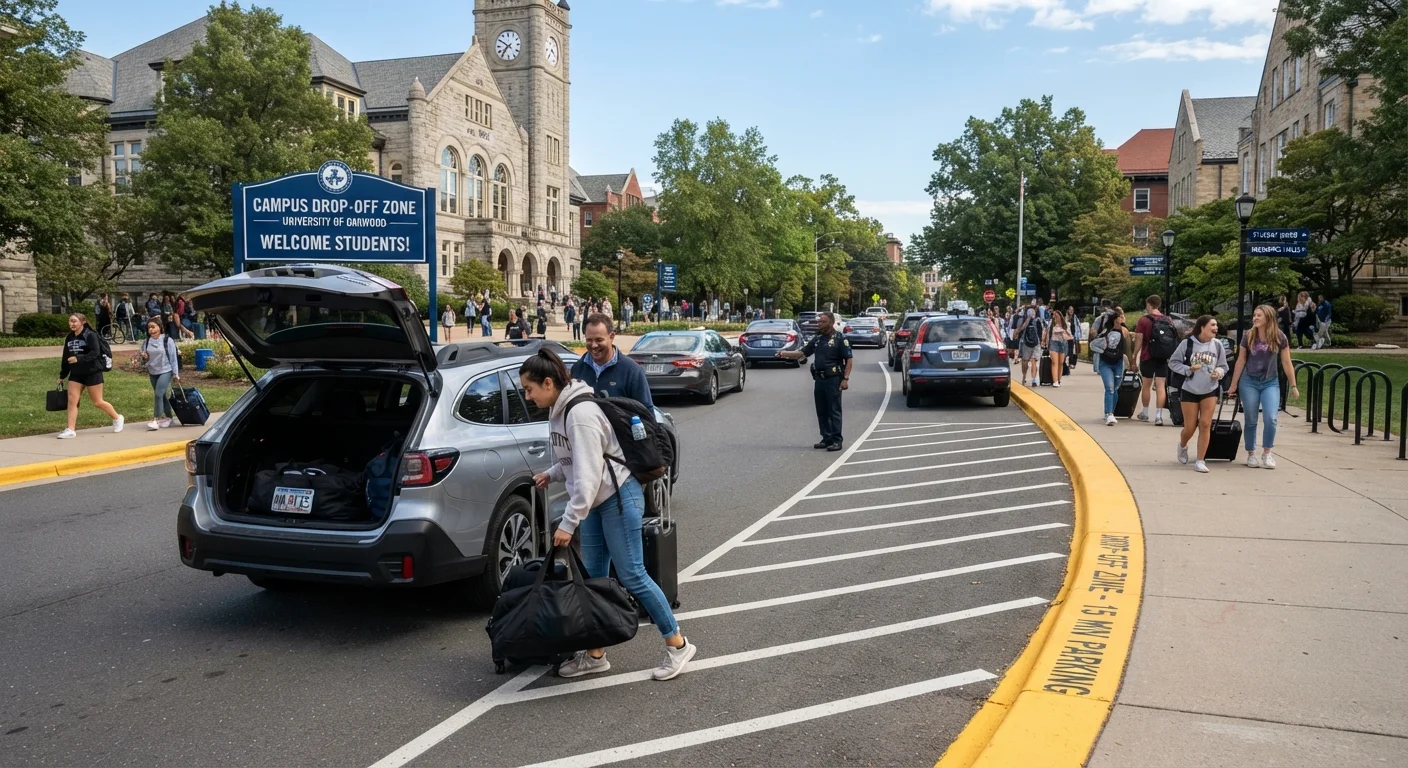
Why These Zones Exist - and Why Students Get Caught Out
Drop-off zones, loading bays, and short-stay parking areas all serve specific, distinct functions in campus traffic management. They exist to keep vehicle flow moving safely near high-pedestrian areas - building entrances, transit stops, and residence halls. When they're misused, congestion builds quickly and the risk of accidents near pedestrian crossings increases.
Students often get caught out because these zones look similar and the differences between them aren't always intuitively obvious. A loading bay and a drop-off zone can be side by side with signs that are easy to misread under time pressure. Assumptions formed at one campus don't always transfer to another. And enforcement - often more consistent than students expect - follows the letter of the posted sign, not a reasonable interpretation of intent.
For a broader look at parking misconceptions that cost students money, the parking myths article is worth reviewing before your first semester begins.
Check the Campus Map Before Move-In Day
Campus parking offices typically publish updated maps and temporary drop-off arrangements before each semester begins. Downloading the current map - especially for move-in weekend, when zones are often reconfigured - can save you significant frustration. Pair this with the pre-semester driving checklist to make sure you're fully prepared.
Tools and Preparation
Before following the steps below, make sure you have the basics in place.
What you will need
Campus Parking Map
Identifies the exact locations of drop-off zones, loading bays, and short-stay areas on your specific campus.
Parking Office Contact or App
Used to clarify zone rules, request temporary permits, or report signage issues.
Timer or Phone Clock
Helps you track time-limited stays so you don't inadvertently exceed posted limits.
Step-by-Step: Using Campus Drop-Off and Short-Stay Areas Correctly
Follow these steps each time you need to use a drop-off zone or short-stay space on campus. The rules are consistent in principle but vary in detail - treating every stop as requiring fresh attention is the habit that prevents fines.
Locate drop-off zones on the campus map before you arrive
Campus parking maps - available from your institution's transportation or parking services office, usually online - mark drop-off zones separately from permit and metered parking. Identify the zone closest to your destination building rather than improvising on arrival. On large campuses, a zone near the wrong entrance can add a significant walk.
Read the posted sign before you stop
Even within an area labelled as a drop-off zone, individual bays can have different time limits, permitted vehicle types, or enforcement hours. A sign reading "No Stopping 7am-9am Mon-Fri" means the zone is completely off-limits during those times - not just for extended stays. Check the sign every time; don't rely on what it said last week. See our guide to reading campus parking signs for help decoding common sign formats.
Stay with your vehicle if the zone requires it
Most drop-off zones require that the driver remain with the vehicle and be ready to move at any time. This is what legally distinguishes a drop-off from parking. If you need to walk someone inside, help carry items to a room, or complete any task away from your car, you are no longer in compliance with drop-off rules - you are parking without authorization.
Use short-stay parking for anything longer than a quick stop
Short-stay spaces - typically marked with a time limit such as 15, 30, or 60 minutes - are the appropriate option when you need to briefly enter a building. These spaces may require payment at a meter or kiosk, or in some cases a valid student permit. Check whether your permit covers short-stay areas, as not all permit types do. For a broader overview of how campus permit categories work, see campus parking permits explained.
Never use a loading bay as a substitute drop-off
Loading bays are operationally distinct from drop-off zones. They exist to allow service vehicles - deliveries, campus facilities, catering - to stop safely without disrupting traffic. Blocking a loading bay, even briefly, can delay building operations and result in immediate ticketing or towing. If you see a loading bay near a convenient entrance, treat it as off-limits unless campus parking services have explicitly authorized your vehicle for that bay.
Plan alternative arrangements for move-in, move-out, and heavy unloading
Situations involving large volumes of luggage, furniture, or equipment cannot be handled safely within a standard drop-off zone's time limits. Most campuses operate special temporary parking arrangements during move-in and move-out periods. Contact the parking office ahead of time to find out whether a temporary unloading permit or a reserved slot is available for your situation. Arriving without a plan during these high-traffic periods is likely to result in a fine or a very long detour.
Unattended Vehicles Get Ticketed Fast
Leaving your car unattended in a drop-off zone - even for two minutes to help someone carry bags - is treated as illegal parking at most institutions. Enforcement officers patrol these areas frequently during class change times. A fine for this violation can be significantly higher than a standard parking ticket.
Loading Bays Are Not Student Parking
Loading bays are reserved for service vehicles, deliveries, and facilities staff - not students, not even briefly. Using one risks a ticket, towing, or both. If you need to unload heavy equipment near a building, check with campus parking services for an approved alternative in advance.
This article provides general educational information about campus parking zones. Rules, signage, and enforcement policies vary significantly between institutions. Always consult your campus parking services office for guidance specific to your institution.
The content provided on our blog site traverses numerous categories, offering readers valuable and practical information. Readers can use the editorial team’s research and data to gain more insights into their topics of interest. However, they are requested not to treat the articles as conclusive. The website team cannot be held responsible for differences in data or inaccuracies found across other platforms. Please also note that the site might also miss out on various schemes and offers available that the readers may find more beneficial than the ones we cover.