

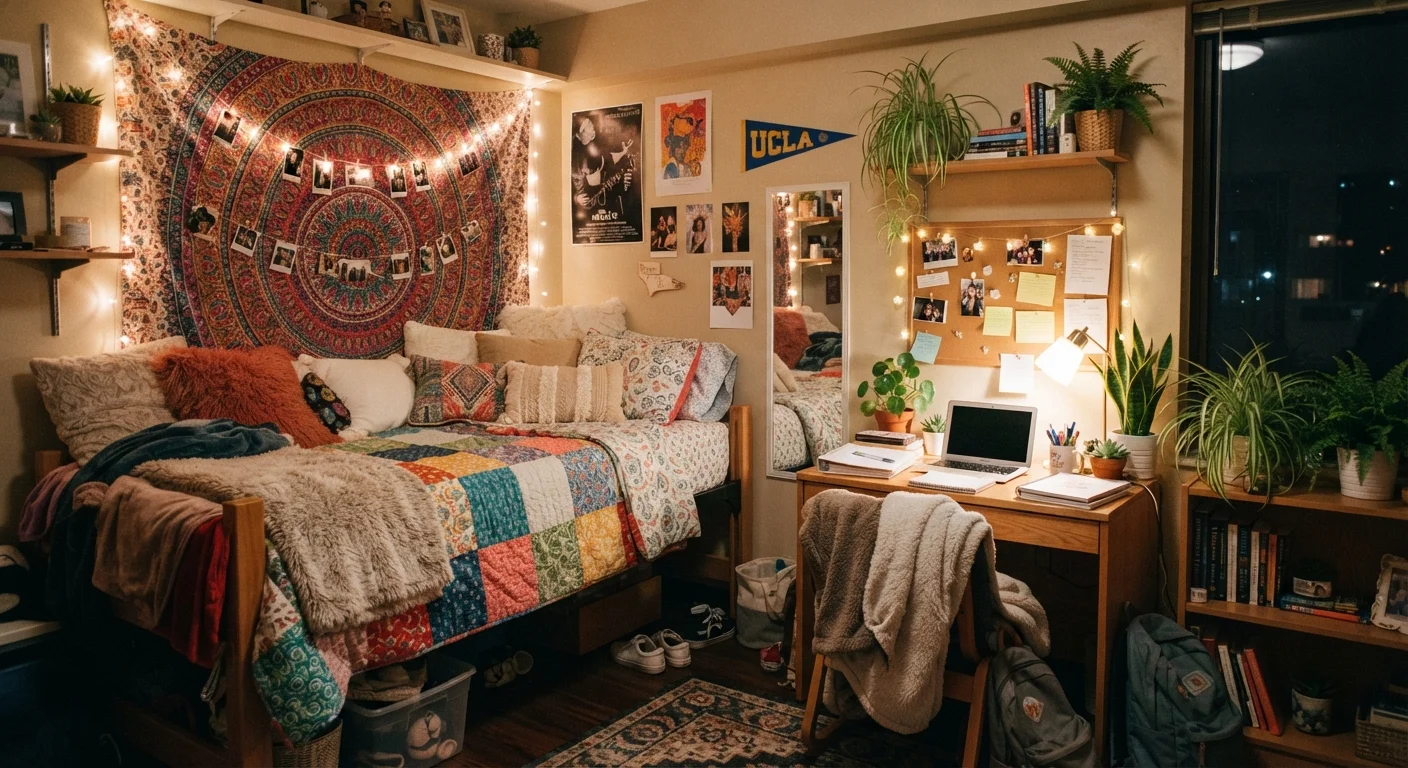
Why Dorm Decorating Rules Exist
Walking into a bare, cinder-block dorm room can feel deflating — but before you start hammering nails or draping every wall, it pays to understand why restrictions exist. Universities rent out these rooms year after year to thousands of students. Damage policies protect the room for future occupants and help the school control maintenance costs. What feels like a small nail hole to you may mean a repair charge and a repaint for housing staff.
Before you unpack a single decoration, locate your residence hall's housing contract or community standards document. This is the authoritative source for your specific campus — general patterns described in this article are common across many US institutions, but policies vary. When in doubt, email your Resident Advisor (RA) or housing office directly. Get familiar with what a typical dorm room includes before you start planning your décor so you know exactly what you're working with.
| Policy source to check first | Your housing contract or residence life handbook |
| Most commonly permitted adhesive | Removable adhesive strips (e.g., Command-style products) |
| Open flames allowed? | No — candles and incense are banned at most US dorms (National Fire Protection Association guidance on college housing) |
| Required power strip type | Surge protector with built-in circuit breaker |
| Best first step before decorating | Read your housing contract and ask your RA |
| Deposit protection tip | Photo-document the room on move-in day and email to housing |
What Most Dorms Permit
Most residence halls allow a reasonable range of personal touches, especially when no permanent damage is involved. Here's what is broadly permitted at many schools:
- Removable adhesive strips and hooks — Products designed to peel off without leaving residue are widely accepted. Follow weight limits on the packaging and remove them carefully at move-out.
- Tapestries and fabric wall hangings — Fabric décor is generally fine as long as it's hung using approved methods (adhesive strips, not tacks) and meets fire safety requirements. Avoid hanging anything over electrical outlets or heating vents.
- String lights (LED) — Low-heat LED string lights are permitted at many schools, though rules about covering them with fabric or placing them near flammable materials are common. Check that lights bear a UL safety listing.
- Bedding, rugs, and soft furnishings — Personalizing your bed and floor space with your own linens and an area rug is almost universally allowed.
- Plants — Small, non-soil-spill-risk plants (like succulents or plants in sealed containers) are permitted at most schools, though some restrict them due to mold or pest concerns.
- Removable wallpaper or peel-and-stick decals — Increasingly accepted, though you should confirm the specific adhesive won't damage painted cinder block or drywall.
Renter-friendly storage solutions can also double as décor — think fabric cube organizers and over-door hooks.
Removable adhesive strips
Adhesive-backed fasteners designed to hold items on walls without nails and peel away cleanly when removed correctly. They come in various weight capacities for different items.
UL listing
A certification mark from Underwriters Laboratories indicating a product has been tested for safety. Look for this on string lights and power strips to confirm they meet recognized safety standards.
Surge protector
A power strip that includes a built-in circuit to absorb voltage spikes and protect connected devices. Most dorms require this instead of a basic extension cord.
Resident Advisor (RA)
A student staff member who lives in the residence hall and serves as a resource for community standards, policy questions, and resident support.
Housing deposit
A fee paid at the start of your housing agreement, held by the university to cover any damage beyond normal wear and tear. It is returned (partially or fully) at move-out if the room is in acceptable condition.
What Most Dorms Prohibit
Certain items appear on prohibited lists at nearly every institution, usually for safety or damage reasons:
- Nails, screws, and permanent hooks — Penetrating the wall in any way almost always violates housing policy and will cost you part of your deposit.
- Painting the walls — Even with removable chalk paint or wallpaper, always confirm first. Many schools explicitly ban any wall color changes.
- Candles and open-flame items — Fire codes prohibit open flames in most dormitories, including candles, incense, and wax warmers with exposed heating elements.
- Halogen lamps and older incandescent torchieres — These generate significant heat and are banned at many schools due to fire risk.
- Extension cords without surge protection — Most schools require power strips with a surge protector and built-in circuit breaker. Basic extension cords are often prohibited.
- Dartboards and adhesive hooks that damage surfaces — Anything that requires puncturing the wall, door, or furniture is typically off-limits.
Policies Vary — Always Verify
The rules described here reflect common patterns across US college residence halls, but every institution writes its own housing policy. Some schools are stricter about tapestries due to fire code interpretations; others permit LED candles or specific types of removable wallpaper. Never assume what was allowed at a friend's school applies to yours. Your housing contract and RA are the definitive sources.
If you share your space, coordinate decoration plans early. Setting ground rules before conflict arises makes a real difference in a room this size.
Protecting Your Deposit and Avoiding Surprises
Even permitted items can cost you money if you remove them carelessly. Here are practical habits that protect you at move-out:
- Photograph the room thoroughly on move-in day, including any pre-existing scuffs or damage, and email those photos to housing as a date-stamped record.
- Remove adhesive strips slowly and at a low angle as directed — rushing causes paint peel.
- Keep product packaging for adhesive strips so you can reference removal instructions later in the semester.
- Do a test patch: apply any adhesive product to a small, hidden area first and check for damage after 24 hours.
Small organizational habits also reduce the chance of accidental damage in a cramped shared space. And if you're already thinking ahead to apartment life, the same renter-friendly mindset applies — see our apartment basics hub for what comes next.
~$150–$500
Typical range of dorm damage charges for wall repairs
Figures vary widely by institution; check your housing contract for your school's specific fee schedule.
2,600+
Campus fires reported annually in US college housing
According to the National Fire Protection Association, most campus fires involve cooking equipment or open flames — a key reason dorms restrict candles.
The content provided on our blog site traverses numerous categories, offering readers valuable and practical information. Readers can use the editorial team’s research and data to gain more insights into their topics of interest. However, they are requested not to treat the articles as conclusive. The website team cannot be held responsible for differences in data or inaccuracies found across other platforms. Please also note that the site might also miss out on various schemes and offers available that the readers may find more beneficial than the ones we cover.