

Why Drill-Free Storage Matters in a Dorm
Most college residence halls prohibit residents from drilling holes in walls, ceilings, or furniture — and for good reason. Damage fees at move-out can run anywhere from a small deduction to a significant charge depending on your school's policy. Before you unpack a single box, it pays to know the rules. Our guide on what dorms typically allow and prohibit for decorating is a useful starting point.
The good news: a well-planned drill-free setup can be surprisingly effective. The strategies below work within standard dorm restrictions, require no special tools, and are fully reversible when you move out. If you haven't already thought through how your furniture fits the floor plan, check out our space-planning basics for dorm rooms before you start shopping for organizers.
Bed Risers to Unlock Under-Bed Storage
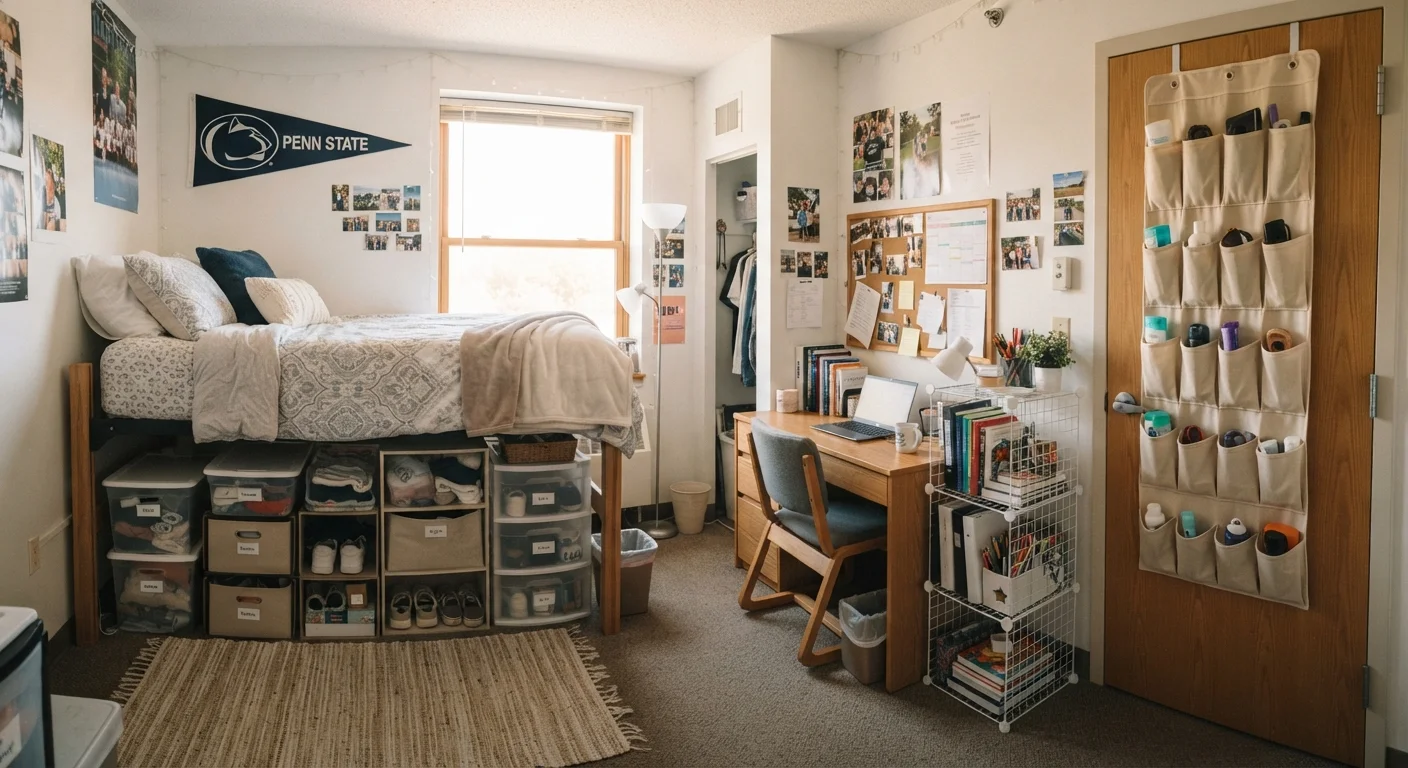
Standard dorm beds sit relatively low to the ground, which wastes the largest open zone in the room. Sturdy plastic or metal bed risers — typically 6 to 8 inches tall — lift the bed frame enough to slide in flat storage bins, suitcases, or rolling drawers underneath. Look for risers rated to support the combined weight of the mattress, frame, and any bedding before purchasing.
Once raised, maximize the space with flat, lidded bins. Clear containers let you see contents at a glance, which cuts down on rummaging. Use this zone for out-of-season clothing, extra bedding, or bulky items you need infrequently.
Under-bed space is often the largest single storage zone in any dorm room.
Over-Door Organizers for Instant Vertical Storage
Over-door organizers hang from the top edge of any standard door and require zero hardware. They come in pocket-style fabric versions — great for shoes, toiletries, or school supplies — and wire or metal versions better suited for heavier items like hair tools or cleaning products.
The back of your room door, closet door, and bathroom door (in suite-style dorms) are all candidates. Assign each door a specific category of items so the system stays logical and easy to maintain. For more ideas on making doors and walls work harder, see our guide to vertical space in small dorms.
Every door in your dorm is a potential storage panel — no hardware required.
Tension Rods as Dividers and Hanging Rails
Tension rods wedge between two surfaces using spring pressure — no screws, no adhesive. Inside a closet, a second tension rod hung below the existing rail effectively doubles your hanging space for shorter items like shirts and jackets. Inside a cabinet or on a shelf, a vertical tension rod divides the space into slots, keeping cutting boards, notebooks, or baking sheets upright and separated.
They also work horizontally across a cabinet interior to hang spray bottles by their triggers, freeing up shelf space below. The key is sizing: measure the span carefully before selecting a rod, and choose one with a weight rating appropriate for what you plan to hang.
A second tension rod in the closet can double your hanging capacity overnight.
Adhesive Hooks for Lightweight Items
Adhesive hooks — the type that use a removable strip backing — are widely accepted in dorms because they peel off cleanly when removed correctly. They work on painted drywall, tile, and most smooth surfaces. Use them on walls for bags, headphones, and lanyards; on the side of a desk or wardrobe for cords and chargers; or inside cabinet doors for small items.
Follow the manufacturer's instructions precisely: press firmly for the recommended time, wait the full curing period before hanging anything, and never exceed the stated weight limit. Overloading or removing them incorrectly is the most common cause of wall damage, so take those instructions seriously.
Properly applied and removed, adhesive hooks leave walls damage-free.
Stackable Storage Cubes and Collapsible Bins
Modular cube organizers — the kind made from interlocking wire or fabric-covered cardboard frames — require no tools and can be assembled and disassembled in minutes. They work as freestanding drawer units, bookcase-style shelving, or bedside tables. Because they're modular, you can reconfigure them if your needs or layout change mid-year.
Collapsible fabric bins slot into cube frames and hold clothing, linens, or bulky supplies. When you move out, the entire system flattens for transport. If you're still deciding between open and closed storage formats, our article on open shelving vs. closed storage in a dorm walks through the practical trade-offs for shared spaces.
Modular cube systems reconfigure easily and collapse flat when you move out.
Rolling Carts for Flexible, Movable Storage
A narrow rolling cart on casters can tuck beside a desk, slide into a closet gap, or move to wherever you're working. They're especially useful for art supplies, lab notebooks, snacks, or bathroom essentials in suite-style dorms. Because they roll, you're not committing to a fixed layout — useful if you and your roommate need to renegotiate the room arrangement as the semester progresses.
Choose a cart that fits the gap you have in mind before purchasing. Measure the width and height of the intended space, accounting for the casters adding an inch or two in height. Carts with locking wheels prevent unwanted rolling once you've found the right spot.
Rolling carts adapt to your changing layout without any commitment to a fixed spot.
Putting It All Together
The most effective dorm storage systems layer several of these solutions rather than relying on any single one. Pair bed risers with flat bins, hang an over-door organizer on your closet, and use a tension rod inside to double hanging capacity — and suddenly a room that felt impossible becomes manageable.
Read Your Housing Agreement First
Storage policies vary significantly from school to school and even between residence halls on the same campus. Some housing agreements prohibit adhesive products beyond a certain size; others restrict the use of risers if they affect bed height limits. Download or request a copy of your specific housing contract and read the damage and modification clauses before you install anything. When in doubt, contact your Resident Advisor (RA) or housing office directly — it's much easier to ask beforehand than to dispute a charge at move-out.
Keep in mind that storage and tidiness go hand in hand. Even the cleverest system breaks down without small daily habits — our article on keeping a dorm room tidy when you share floor space covers the routines that make shared spaces actually work. And if you want to go further with wall and door space, vertical space strategies for small dorms expands on everything above with additional no-damage options.
The content provided on our blog site traverses numerous categories, offering readers valuable and practical information. Readers can use the editorial team’s research and data to gain more insights into their topics of interest. However, they are requested not to treat the articles as conclusive. The website team cannot be held responsible for differences in data or inaccuracies found across other platforms. Please also note that the site might also miss out on various schemes and offers available that the readers may find more beneficial than the ones we cover.