

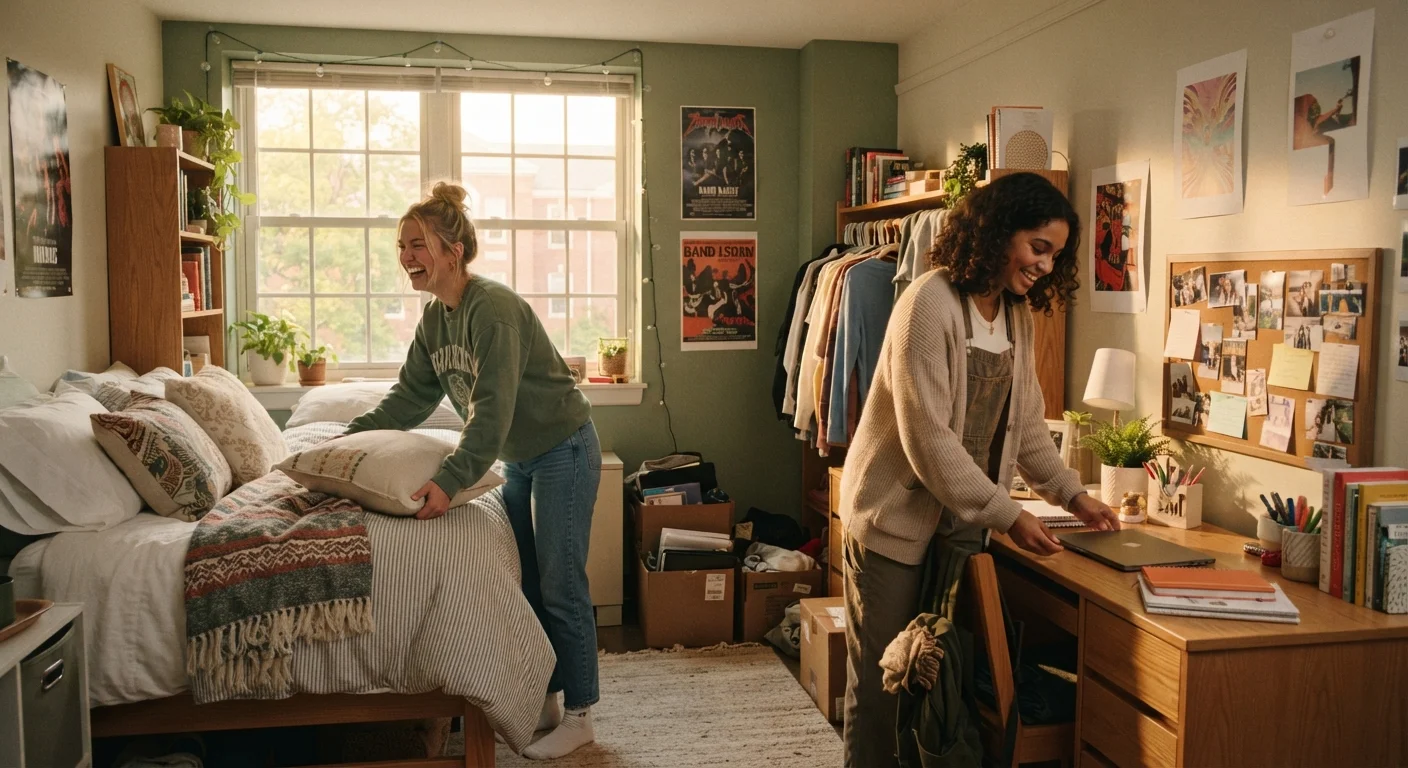
Why the First Conversation Matters More Than the Furniture
Most dorm conflicts don't start with a dirty dish or a loud alarm — they start with two people who never aligned on expectations. Before you drag a single box through the door, reach out to your roommate. A quick text exchange about sleep schedules, study habits, and morning routines saves weeks of passive tension later.
Ask each other three basic questions: When do you typically go to sleep and wake up? Do you need quiet to study, or can you work with background noise? Are you comfortable with guests in the room on weeknights? The answers shape every physical decision you'll make about the space — from where to position desks to whether you need a privacy curtain. For a full walkthrough of how layout decisions connect to daily routine, see the complete dorm setup guide.
Best Practices for Setting Up a Shared Dorm Room
The following practices address the physical and interpersonal dimensions of shared dorm life. Each one is designed to prevent a specific, common friction point before it starts.
Agree on a furniture layout before either of you arrives on campus.
Whoever arrives first tends to claim the better spot by default, which creates immediate resentment. Coordinating in advance means both roommates feel the arrangement was fair and mutual.
Treat each side of the room as its own personal zone with clear, respected boundaries.
Ambiguous territory leads to borrowed items, misplaced belongings, and low-grade ongoing irritation. Clear zones reduce the number of small decisions you have to negotiate each day.
Consider lofting or bunking beds to free up shared floor space.
In a standard dorm room, beds consume the most floor area. Raising them — either individually lofted or stacked as a bunk — can convert that square footage into a study area, a seating zone, or simply a walkable path. This decision affects both roommates equally, so it requires mutual buy-in.
Establish explicit quiet hours and stick to them consistently.
Sleep disruption compounds over a semester. Even small, repeated interruptions — alarms, keyboard noise, phone calls — erode goodwill faster than larger, single incidents. Agreeing to quiet hours upfront makes the expectation structural rather than personal.
Designate separate storage zones for shared supplies versus personal belongings.
Shared items — a mini-fridge, a power strip, cleaning supplies — generate confusion when ownership and use aren't defined. A quick verbal agreement prevents the frustration of discovering your roommate used the last of the dish soap without replacing it.
Check decorating rules before hanging anything on walls or doors.
Many residence halls have specific rules about adhesives, tapestries, and wall coverings that affect both roommates — damage charges are often shared. Knowing the rules in advance prevents a situation where one person's decor choices cost the other money at move-out.
Handling Lighting Without Waking Each Other Up
The single overhead fixture found in most dorm rooms is almost always inadequate for two people with different schedules. One person going to bed at 10 p.m. while the other needs to read until midnight is a recipe for resentment — unless you plan for it.
The solution is layered, directional lighting: each roommate controls their own desk lamp or clip light, angled toward their workspace and away from the other person's sleeping area. For a deeper look at why dorm lighting requires deliberate planning, the article Dorm Lighting Explained covers the specifics in detail.
Use a Clip Light Instead of the Overhead
A simple clip-on LED lamp attached to your headboard or desk edge gives you focused light exactly where you need it — without flooding the whole room. They're inexpensive, adjustable, and won't disturb a sleeping roommate when aimed correctly. Look for one with a warm color temperature setting for nighttime reading.
Before buying any lighting, check your school's residence hall rules. Many prohibit halogen lamps, open-coil bulbs, or certain wattages for fire-safety reasons.
Quick Wins You Can Act on Before Move-In Day
Some coordination steps take five minutes but prevent months of friction. Start here.
When Disagreements Come Up Anyway
Even well-planned setups hit friction points. When they do, address the specific behavior rather than making a character judgment. "The desk lamp stays on until 2 a.m. and it wakes me up" is easier to resolve than "you're always inconsiderate."
Most residence halls have a formal roommate agreement form — typically facilitated by your Resident Advisor (RA) — that covers noise hours, guest policies, and cleanliness standards. Using it isn't a sign of distrust; it's a practical tool. If you're managing ongoing tidiness as a shared challenge, the article Keeping a Dorm Room Tidy offers systems that work in small shared spaces.
Your RA Is a Resource, Not a Last Resort
Resident Advisors are trained specifically to help roommates navigate disagreements — it's a core part of their role. Reaching out to your RA early, before a situation escalates, is a sign of maturity, not weakness. They can facilitate a formal roommate agreement that gives both parties a written framework to refer back to.
The content provided on our blog site traverses numerous categories, offering readers valuable and practical information. Readers can use the editorial team’s research and data to gain more insights into their topics of interest. However, they are requested not to treat the articles as conclusive. The website team cannot be held responsible for differences in data or inaccuracies found across other platforms. Please also note that the site might also miss out on various schemes and offers available that the readers may find more beneficial than the ones we cover.