

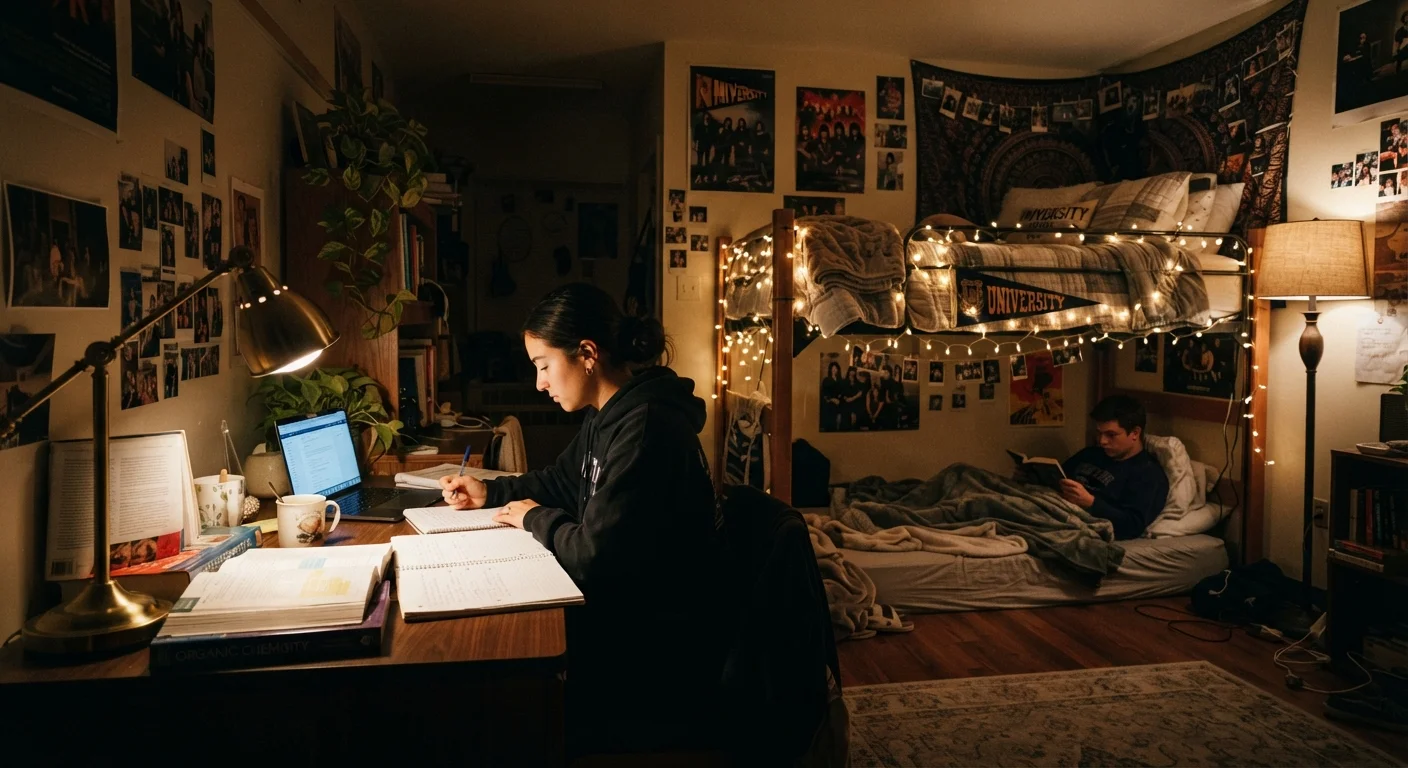
The Problem With One Ceiling Fixture
Walk into almost any dorm room and you'll find the same thing overhead: a single fluorescent or LED panel, usually centered on the ceiling, that floods the entire room with flat, uniform light. It's designed for visibility — not for living. That one fixture cannot simultaneously serve someone studying at a desk, someone watching a video in bed, and someone trying to fall asleep. Using it as your only light source means it's always the wrong tool for at least one of those tasks.
Harsh overhead light also tends to cast unflattering shadows and creates a visual monotony that makes a small room feel institutional rather than personal. As part of planning your dorm layout, lighting deserves the same strategic attention as furniture placement — because it directly shapes how the space feels to live in.
You Probably Can't Change the Ceiling Fixture
Most residence halls prohibit students from replacing or modifying installed fixtures. The goal of layered lighting isn't to remove the overhead light — it's to build around it so you're not dependent on it. Think of the ceiling fixture as a baseline you supplement, not a problem you solve by unplugging it.
The Three Layers Every Dorm Room Needs
Interior designers break lighting into three functional categories. Understanding each one helps you make intentional choices rather than just buying whatever's on the shelf.
1. Ambient Light
This is your general, room-filling light — what the ceiling fixture provides. In a dorm, you usually can't change or remove this layer, but you can supplement it. A floor lamp pointed toward the ceiling can bounce soft light around the room and reduce the harshness of working under the overhead panel alone.
2. Task Light
Task lighting is directed, focused illumination for specific activities — reading, writing, working on a laptop, or crafting. A desk lamp is the quintessential example. This is the layer most students underestimate. Studying under only the overhead light means your eyes constantly adjust between your bright screen or white paper and shadowy surroundings, which increases eye strain over long sessions.
3. Accent Light
Accent lighting adds warmth and atmosphere without flooding the room with brightness. String lights along a bed frame, a small bedside lamp, or a low-wattage bulb in a clip light all qualify. This layer is what transforms a dorm room from a utility space into somewhere you actually want to spend time.
~150 sq ft
Typical US dorm room size
The National Center for Education Statistics reports that many double-occupancy dorm rooms fall in the 150–200 square foot range, making every lighting choice highly visible.
2700–3000K
Warm bulb range for evening use
Lighting researchers and sleep scientists generally recommend this Kelvin range for residential evening environments to minimize blue-light disruption to sleep.
1 in 5
College students reporting poor sleep quality
Multiple American College Health Association surveys have found significant proportions of college students report inadequate sleep, with environmental factors including light exposure cited among contributors.
Why Light Temperature Matters for Sleep
Beyond brightness, the color of light has measurable effects on alertness and sleep. Light is measured in Kelvins (K): lower numbers (2700–3000K) produce warm, yellowish light; higher numbers (4000–5000K) produce cooler, bluish-white light. Research in circadian biology consistently shows that blue-spectrum light in the evening suppresses melatonin — the hormone that signals to your body that it's time to sleep.
The practical takeaway: use cooler, brighter light while studying during daylight hours, and switch to warm-toned lamps in the hour or two before bed. Many modern LED bulbs and smart bulbs allow you to adjust color temperature throughout the day without buying multiple fixtures.
Make Your Desk Lamp the First Priority
If you're working with a limited budget, a quality adjustable desk lamp delivers the most noticeable improvement over the default ceiling fixture. Look for one with adjustable brightness levels and, if possible, adjustable color temperature. Positioning it to the side of your non-dominant hand reduces shadow on your work surface.
Dorm Safety Rules You Must Know First
Before purchasing any lamp or lighting accessory, check your residence hall's fire safety policy. This step isn't optional — violations can result in fines or confiscation of your equipment on move-in day. Common restrictions include:
- Halogen lamps — banned on many campuses due to high heat output and historical fire incidents
- Open-coil or exposed-bulb lamps — frequently prohibited
- Extension cords — most schools require UL-listed surge protectors instead
- Adhesive hooks and strips — relevant when mounting string lights or clip lamps to walls
If you're sharing a room, it's worth coordinating lighting preferences with your roommate before either of you buys anything. The shared dorm etiquette guide walks through how to set expectations about brightness, late-night study habits, and sleep schedules before friction develops.
For a broader overview of everything involved in getting your room ready, the complete dorm setup walkthrough covers lighting alongside furniture, storage, and cable management as part of a full room plan.
This article is for general informational purposes only. Always refer to your specific institution's housing policies for rules governing electrical appliances in residence halls.
Frequently Asked Questions
Policies vary by institution and even by residence hall. Many schools permit low-voltage LED strips but ban those with open bulbs or adhesive that damages walls. Check your housing handbook or email your RA before purchasing anything.
A cooler white light in the 4000–5000K range is generally considered more alerting and suitable for focused study. Save warmer tones (2700–3000K) for evenings when you want to wind down. Many LED bulbs now let you switch between both.
Many campuses ban halogen torchiere lamps because they generate significant heat and have historically caused fires in residence halls. LED torchieres are a safer alternative, but confirm with your housing office first.
A battery-powered or rechargeable USB desk lamp is a practical solution when outlets are far away. Extension cords are another option, but check that your school allows them — many require surge-protected power strips instead.
A directional desk lamp that illuminates only your work surface is ideal — it keeps light away from your roommate's sleep zone. Clip-on book lights are another low-profile option for late-night reading.
The content provided on our blog site traverses numerous categories, offering readers valuable and practical information. Readers can use the editorial team’s research and data to gain more insights into their topics of interest. However, they are requested not to treat the articles as conclusive. The website team cannot be held responsible for differences in data or inaccuracies found across other platforms. Please also note that the site might also miss out on various schemes and offers available that the readers may find more beneficial than the ones we cover.