

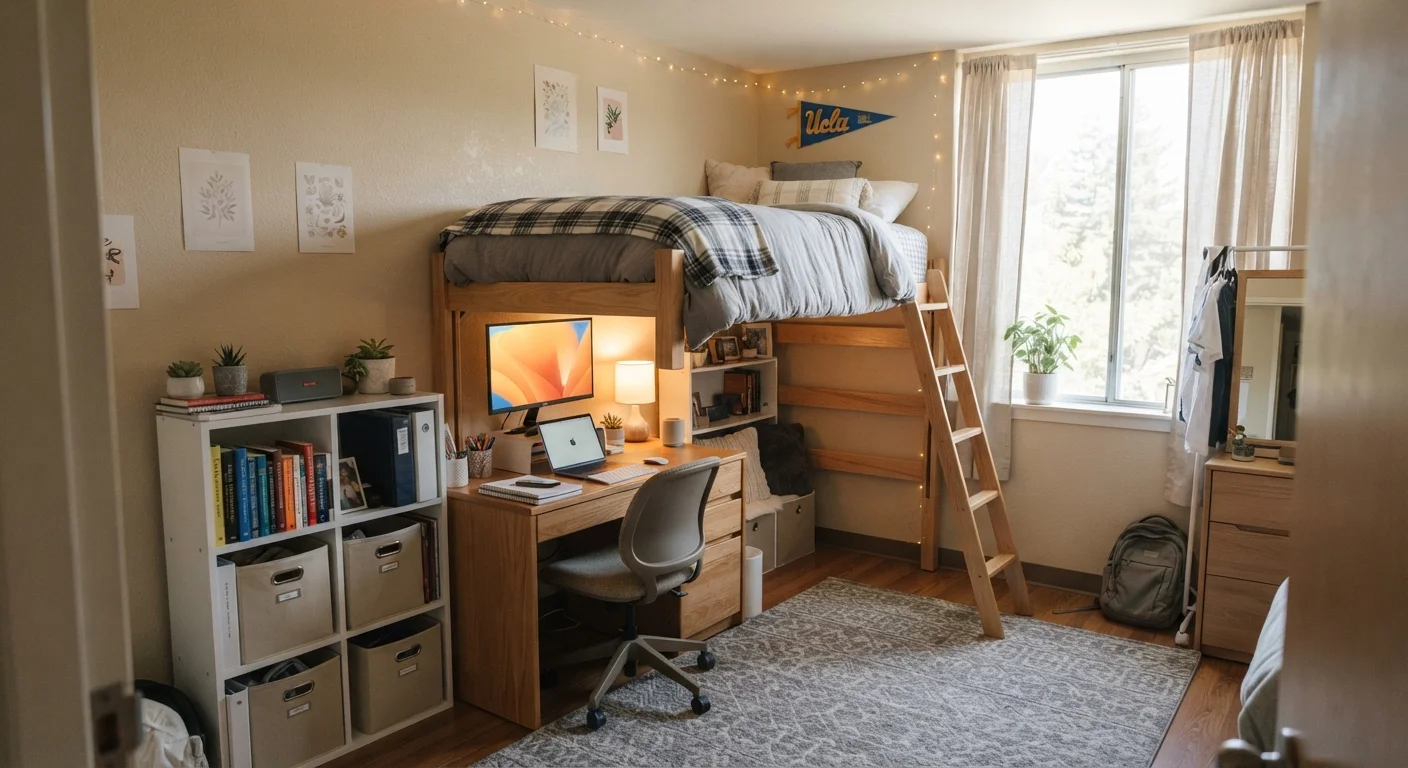
Before You Arrive: Research and Measurements
The biggest setup mistakes happen before a single box is carried in. Most students pack for an imagined room rather than the actual one — and end up with furniture that doesn't fit or duplicates of items their roommate already owns.
Start by contacting your housing office to request the exact room dimensions, window placement, door swing direction, and a list of what furniture is already provided. Most schools supply a bed frame, mattress, desk, desk chair, and dresser. Some include a wardrobe or closet; others don't. Confirm before purchasing anything large.
Once you have dimensions, sketch a rough floor plan on graph paper or use a free room-layout tool online. Note where outlets are located — outlet placement will determine where your desk and charging station go. See our space-planning guide for dorm rooms for a step-by-step approach to mapping a small floor plan accurately.
Also coordinate with your assigned roommate. A quick conversation can eliminate redundant purchases (two mini-fridges, two full-length mirrors) and help you agree on a rough layout before move-in day chaos begins. For a broader picture of what to expect when you first arrive, see What to Expect Before Move-In Day.
Measure Your Mattress Before Buying Bedding
Dorm mattresses are often Twin XL (80 inches long rather than the standard 75), and standard twin sheets won't fit properly. Confirm your bed size with the housing office before purchasing any bedding. Ill-fitting sheets come untucked constantly and disrupt sleep — a small detail with a real daily impact.
Move-In Day: Order of Operations
Move-in day is loud, crowded, and time-pressured. Having a clear sequence keeps you from having to disassemble half your setup by 9 p.m.
- Protect the room first. Lay a moving blanket or old sheet on the floor to prevent scratches when sliding furniture.
- Place the largest furniture immediately. Bed, desk, and dresser positions determine everything else. Make these calls with the room empty.
- Build upward before filling drawers. Assemble any bed risers, lofting hardware, or shelving units before loading them with items — it's much harder to lift a loaded shelf.
- Run cables and power strips before pushing furniture against walls. Fishing a power strip behind a desk that's already against the wall is a frustrating half-hour you don't need.
- Unpack in categories, not boxes. Rather than emptying each box in sequence, sort as you go: clothes to the wardrobe zone, desk items to the desk, bedding to the bed.
If you have a helper, designate one person as the room decision-maker while the other ferries boxes. Conflicting opinions about furniture placement slow everything down.
Don't Commit to a Layout Before Seeing the Room
Floor plans from housing offices are useful but not always perfectly accurate — door swings, radiator positions, and closet depths may differ from what's shown. Make preliminary furniture decisions, but stay flexible until you're actually standing in the empty room. Committing too firmly before arrival often means disassembling furniture on a packed move-in day.
Furniture Arrangement and Space Planning
In a room that may be as small as 10 by 12 feet for two people, furniture arrangement is genuinely consequential. A few principles make the biggest difference:
- Loft or bunk beds free the most floor space. If your housing allows lofting, it effectively doubles your usable floor area. Check your housing contract — some schools restrict lofting to approved equipment only.
- Keep a clear 30-inch walkway. Building codes for public spaces use this figure; it's a useful minimum for avoiding a room that feels like an obstacle course.
- Desks near natural light reduce eyestrain. If window placement allows it, position your primary study area within a few feet of a window.
- Divide the room conceptually, not just physically. With a roommate, each person should have a clear sleeping zone, study zone, and personal storage zone — even if the boundaries are informal.
~150 sq ft
Typical double dorm room size
Most US university double-occupancy rooms fall between 130 and 180 square feet, according to commonly published housing specifications.
30 inches
Recommended minimum walkway clearance
Interior accessibility guidelines generally treat 30 inches as a functional minimum passage width in residential settings.
70%
Students who report desk clutter affecting focus
Research on workspace organization consistently finds that visual clutter competes for attention, reducing the ability to sustain concentration on tasks.
For ongoing strategies once you're settled in, our guide on keeping a shared dorm room tidy covers the habits that prevent clutter from accumulating mid-semester.
Storage Solutions That Actually Work
Horizontal floor space is your scarcest resource. The solution is almost always to go vertical.
- Over-door organizers work for shoes, snacks, cleaning supplies, or school supplies. Each door in your room is a storage surface you probably aren't using.
- Under-bed storage bins (especially flat, wheeled ones) are ideal for out-of-season clothing, extra bedding, or bulky items used infrequently. Bed risers — typically adding 6 to 8 inches of clearance — significantly expand this space.
- Stackable cube shelving is versatile and inexpensive. It can function as a bookshelf, wardrobe extension, or bedside table depending on orientation.
- Pegboards or adhesive wall strips let you hang items without drilling. Confirm with your housing office what wall-mounting methods are permitted.
- Multi-use furniture pays dividends in small rooms. An ottoman with interior storage, or a desktop organizer that also holds a small lamp, reclaims surface area.
Before packing your storage bins, take photos of everything you're bringing and share them with your roommate. This one step eliminates the most common move-in duplicates and keeps both sides of the room from feeling overcrowded.
Duplicate large items — fans, mini-fridges, floor lamps — are among the most common and easiest-to-avoid sources of wasted space and money in dorm rooms.
Invest in a 6-foot power strip with at least 6 outlets and USB ports, and mount it under your desk with velcro or cable clips. You'll never fight for a wall outlet again.
Dorm rooms typically have two to four outlets for two people and all of their devices. A well-positioned power strip solves this constraint permanently and reduces cord clutter.
Label storage bins clearly. The few seconds this takes prevents the 20-minute rummage sessions that interrupt study time.
Desk and Study Zone Setup
Your desk is one of the highest-leverage areas in your dorm. A well-organized study zone makes it easier to sit down and focus; a cluttered one becomes a reason to work in the dining hall instead.
Essentials for an effective desk setup:
- Adjustable task lighting. Overhead dorm lighting is typically dim and poorly positioned. A desk lamp with adjustable brightness (look for one with a color temperature setting) reduces eye fatigue during long study sessions.
- Vertical desk organizer. Keeps pens, notebooks, and chargers within reach without spreading across the surface.
- Monitor riser or laptop stand. Raising a screen to eye level reduces neck strain — a concern for students who spend several hours daily at their desks.
- Power strip with surge protection. Centralizes charging for laptop, phone, and other devices. Position it so cords run behind or underneath the desk rather than across the floor.
- Minimal visual clutter. A clear desk surface — even an imperfect one — signals to your brain that this is a work space. Reserve one drawer or bin for items that accumulate on the desktop.
For broader independent-living skills beyond the dorm, the Apartment Basics hub covers what to expect when you eventually move off campus.
“The physical environment of a study space — its organization, lighting, and freedom from distraction — is one of the most controllable variables affecting a student's ability to concentrate and retain information.”
— Dr. Robert Gifford, Environmental psychologist and professor, author of research on person-environment interaction
Final Touches: Cables, Comfort, and Coordination
Once the major furniture is placed and storage is loaded, a final walk-through catches the details that make day-to-day living smoother.
Cable Management
Loose cables are a trip hazard and make a room feel messier than it is. Adhesive cable clips (available at most hardware or office supply stores) route cables along desk edges and baseboards. Velcro ties bundle cords at the power strip. This takes under 30 minutes and has an outsized visual impact.
Comfort Layers
Most dorm mattresses are thin and firm. A mattress topper — typically 2 to 3 inches of foam or fiber fill — improves sleep quality without major cost. Add a rug if your floor is hard — it dampens noise and makes the room warmer underfoot, particularly important in winter months.
Personalization Without Damage
Command strips, removable wallpaper, and string lights (LED, low heat) let you personalize the space without violating housing policies. Always read the mounting instructions; weight limits on adhesive strips are real, and overloading them causes wall damage that may result in a charge at checkout.
Coordinate Shared Spaces
If you share the room, establish informal agreements about lights-out times, guest policies, and cleaning responsibilities during the first week. Early conversations are far easier than mid-semester renegotiations. The Home Maintenance 101 hub has practical upkeep skills that translate well even to a dorm context.
Once your room is set up, the final test is simple: can you find what you need quickly, sit comfortably at your desk, and sleep without disruption? If yes, you're done.
The content provided on our blog site traverses numerous categories, offering readers valuable and practical information. Readers can use the editorial team’s research and data to gain more insights into their topics of interest. However, they are requested not to treat the articles as conclusive. The website team cannot be held responsible for differences in data or inaccuracies found across other platforms. Please also note that the site might also miss out on various schemes and offers available that the readers may find more beneficial than the ones we cover.