

Option A
Authorized User
The low-risk entry point to someone else's credit history.
Best for: Students who want to begin building credit without taking on full financial responsibility for an account.
Option B
Primary Cardholder
The accountable owner who carries full legal and financial responsibility.
Best for: Students ready to independently manage a credit account and build credit entirely in their own name.
What Each Status Actually Means
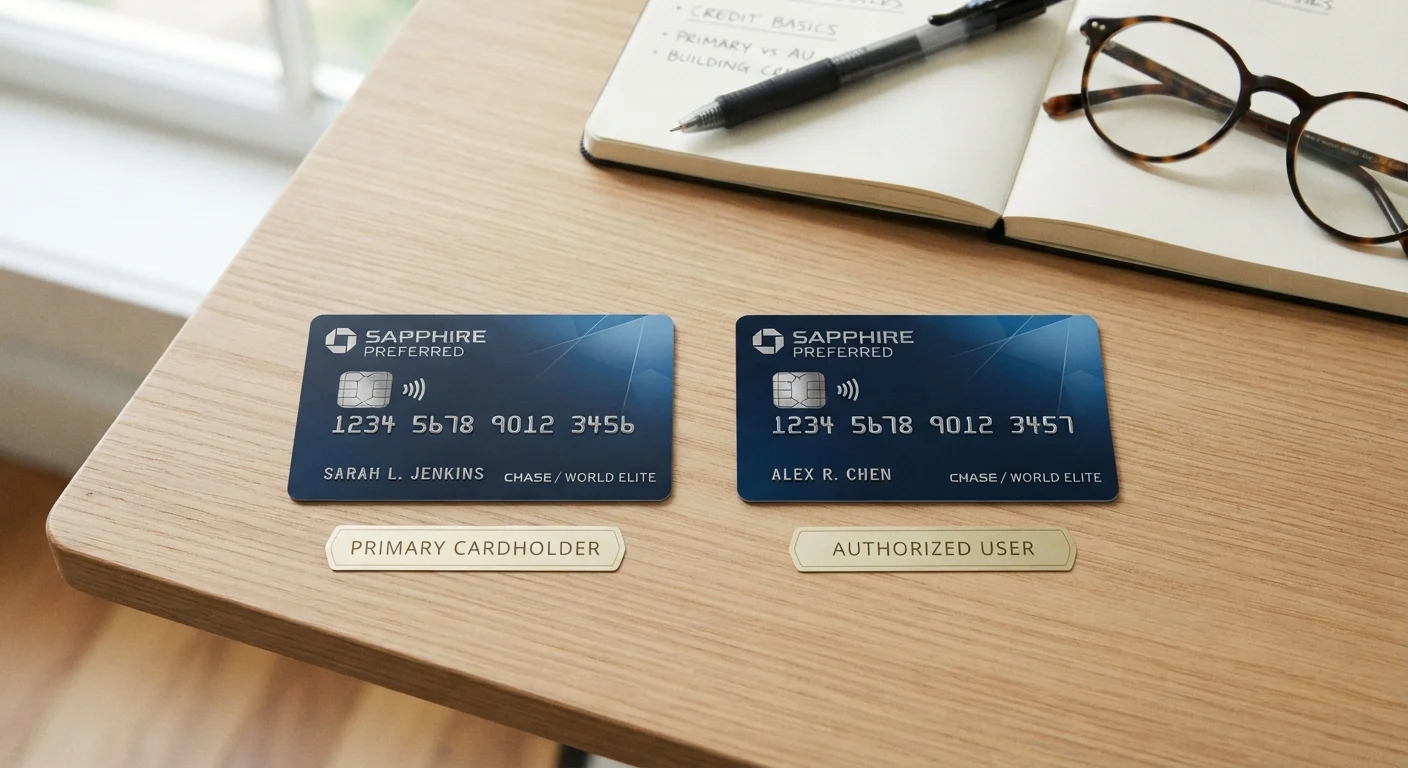
When someone is named the primary cardholder on a credit card account, they are the individual who applied for and legally owns the account. They are contractually responsible for every charge made — regardless of who made it — and all payment history on that account reports directly to their credit file under their name.
An authorized user is someone the primary cardholder adds to the account, granting them permission to use the card. The authorized user does not sign an agreement with the card issuer and has no legal obligation to repay any balance. However, in most cases, the account's payment history is reported to the authorized user's credit report as well, which is precisely why this arrangement can be such an effective credit-building tool for students.
It's worth noting that card issuers handle authorized user reporting differently. Most major issuers report the account to all three major credit bureaus (Equifax, Experian, and TransUnion), but a few do not report authorized user status at all. Before relying on this strategy, confirm the policy with the issuer.
A Note on Credit Score Models
Not all credit scoring models treat authorized user accounts the same way. The FICO Score, widely used by lenders, does factor in authorized user accounts in most versions. However, some newer scoring models or lenders may weigh independent account history more heavily. This means authorized user status is a helpful stepping stone, but is generally not a substitute for establishing your own credit accounts over time.
How Each Status Affects Your Credit Score
Credit scores are calculated using several factors: payment history, amounts owed (utilization), length of credit history, new credit, and credit mix. The status you hold on a card affects how — and whether — it feeds into these factors.
As an authorized user, the account's age, credit limit, and payment history typically appear on your report. If the primary cardholder maintains low balances and pays on time, your score can improve meaningfully. See our guide to credit utilization to understand how the account's balance-to-limit ratio may influence your score specifically.
As a primary cardholder, every action you take — every on-time payment and every missed one — is fully yours. This gives you direct, powerful control over your credit-building trajectory, but also places the entire risk on your shoulders.
| Criterion | Authorized User | Primary Cardholder |
|---|---|---|
| Legal repayment obligation | None | Full responsibility |
| Credit history reported | Usually yes (varies by issuer) | Always yes |
| Impact of missed payments | Can hurt your score too | Directly harms your score |
| Who controls the account | Primary cardholder | You |
| Credit independence built | Limited — tied to another | Full — entirely your own |
| Ease of access for students | Easy — no application needed | Requires application & approval |
One important caveat: if the primary cardholder begins missing payments or maxes out the card, the authorized user's credit score can decline just as if it were their own account. This risk is one reason students should carefully consider common mistakes that quietly damage credit before relying entirely on someone else's account.
Making the Transition From User to Owner
Being an authorized user is rarely a permanent solution. Lenders evaluating a future car loan or apartment application will want to see credit history that you own and control. A thin file composed only of authorized user accounts may not satisfy that standard.
The practical path for most students is to start as an authorized user to establish some history, then open an independent account — such as a student credit card or a secured card — to begin building credit in your own name. Our comparison of secured cards vs. student credit cards can help you decide which type fits your situation.
If you're weighing other options entirely, credit-builder loans offer a different path that doesn't require a card at all. And if you eventually open multiple accounts, review the trade-offs of managing multiple credit accounts before applying broadly.
This article is for general informational and educational purposes only and does not constitute personalized financial or legal advice. Credit products, issuer policies, and credit scoring models vary. Consult a qualified financial professional for guidance specific to your situation.
The content provided on our blog site traverses numerous categories, offering readers valuable and practical information. Readers can use the editorial team’s research and data to gain more insights into their topics of interest. However, they are requested not to treat the articles as conclusive. The website team cannot be held responsible for differences in data or inaccuracies found across other platforms. Please also note that the site might also miss out on various schemes and offers available that the readers may find more beneficial than the ones we cover.