

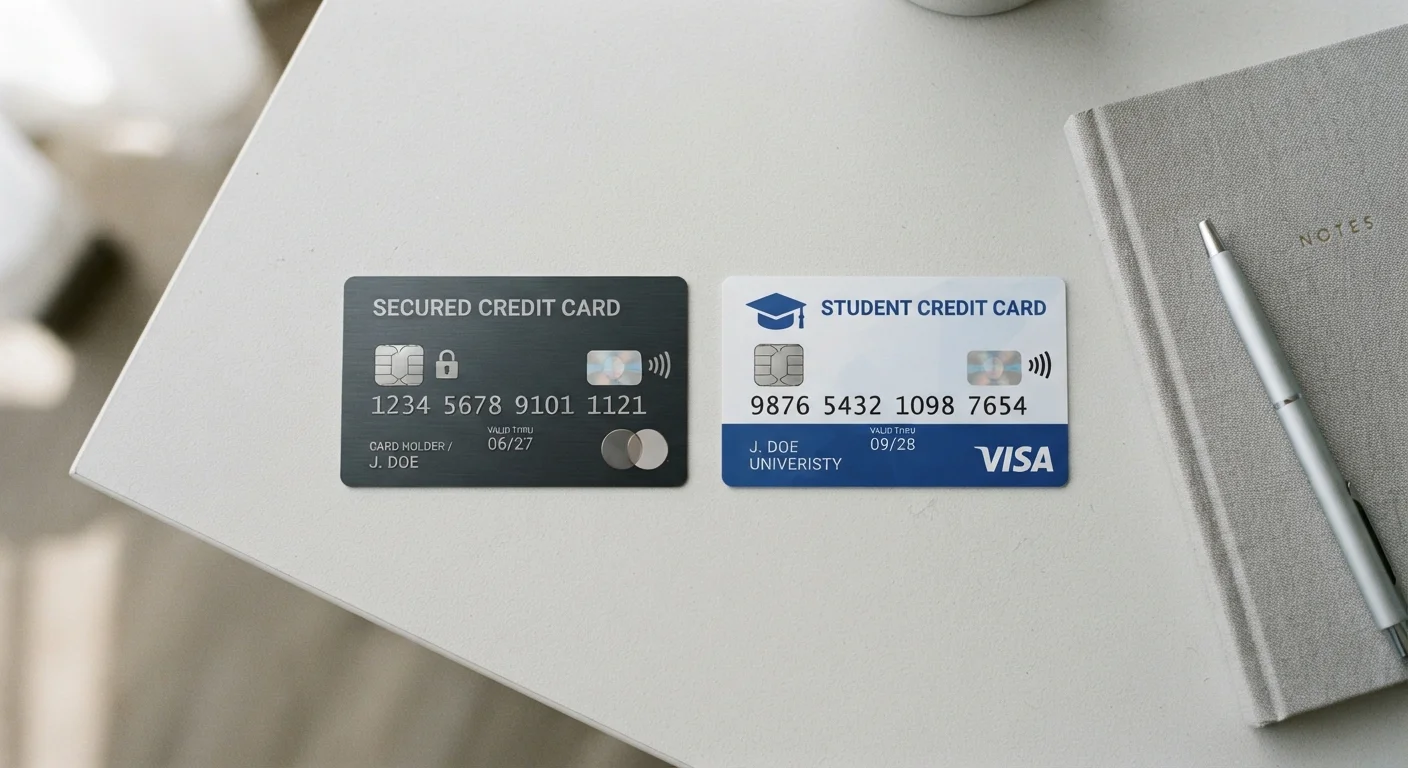
Option A
Secured Credit Card
The deposit-backed, widely accessible credit-builder.
Best for: Students with no credit history or those who don't meet income or enrollment requirements for student-specific cards.
Option B
Student Credit Card
The enrollment-based card designed for campus life.
Best for: Enrolled college students with some income who want a card with no deposit requirement and student-friendly features.
How Each Card Works — and Why the Mechanism Matters
Before comparing outcomes, it helps to understand what makes these two card types structurally different. A secured credit card requires you to place a refundable cash deposit with the issuer — commonly between $200 and $500 — which typically becomes your credit limit. You then borrow against that limit just like any credit card, and the issuer reports your payment behavior to the three major credit bureaus (Equifax, Experian, and TransUnion). Because the deposit reduces the issuer's risk, approval is generally available to applicants with no credit history at all.
A student credit card is an unsecured product — no deposit required — but it comes with eligibility conditions. Issuers typically require proof of current college enrollment and some form of verifiable income (including part-time work, scholarships, or allowances that meet federal disclosure requirements established under the CARD Act of 2009). Student cards also report to all three major bureaus and function identically to standard credit cards in terms of how they affect your score.
If you're starting entirely from scratch, see our guide to building credit as a college student for a broader roadmap before choosing between these two options.
| Criterion | Secured Card | Student Card |
|---|---|---|
| Deposit required | Yes — typically $200–$500 | No deposit required |
| Enrollment required | No | Yes — active college enrollment |
| Income requirement | Varies; often minimal | Required under CARD Act |
| Credit limit basis | Equal to deposit amount | Set by issuer underwriting |
| Reports to credit bureaus | Yes — all three major bureaus | Yes — all three major bureaus |
| Upgrade path | May graduate to unsecured | Typically upgrades post-graduation |
| Best access point | No credit history at all | Enrolled student with income |
What Actually Drives Credit Score Growth
The type of card you hold is largely irrelevant to how quickly your score grows. Credit scoring models like FICO and VantageScore weigh the same factors regardless of whether your card required a deposit. The two most heavily weighted factors are payment history (approximately 35% of a FICO score) and credit utilization — the ratio of your balance to your credit limit (approximately 30%).
This means a student who makes every payment on time and keeps their balance below 30% of their limit will see similar score growth whether they hold a secured or a student card. The critical variable is behavior, not card category. Where differences can emerge is in credit limit size: a low secured card deposit (say, $200) creates a very small limit, which makes it easier to accidentally show high utilization even with modest spending. A student card with a higher limit may give slightly more utilization buffer, though issuers typically keep limits conservative for new cardholders in either category.
35%
FICO score weight: payment history
According to FICO's publicly documented scoring model, payment history is the single largest factor in a standard FICO score.
30%
FICO score weight: credit utilization
Keeping your balance-to-limit ratio low is the second most influential factor, regardless of whether your card is secured or unsecured.
~6 months
Minimum history to generate a FICO score
FICO requires at least one account open for six months and reported within the last six months before it can produce a score.
For a longer-term perspective on maintaining a healthy score after establishing it, review habits that protect a young credit profile over time.
Eligibility, Costs, and Practical Considerations
Choosing between these two cards often comes down to eligibility before it comes down to preference. If you don't have verifiable income or aren't currently enrolled, a student card simply may not be available to you — making the secured card the practical default. Conversely, if you don't have $200–$500 in liquid savings to tie up as a deposit, a student card's no-deposit structure may be more manageable.
On the cost side, both card types may carry annual fees and interest charges, though terms vary widely among issuers. Because this is general educational content and not a product recommendation, always review a card's Schumer Box (the standardized fee disclosure table required by federal law) before applying. Pay particular attention to the annual percentage rate (APR), any annual fee, and penalty fee structures.
One important consideration: opening multiple accounts in a short period can affect your score through hard inquiries and average account age. Before adding any card, weigh the trade-offs of opening multiple credit accounts as a student.
Secured Cards and Your Deposit
When you close a secured card account in good standing, your deposit is refunded — but closing an account can affect your credit utilization ratio and reduce your average account age, both of which influence your score. Before closing any account, consider the potential impact on your credit profile. For more context, see our complete student credit roadmap.
This article is for general informational and educational purposes only and does not constitute personalized financial advice. Consult a qualified financial professional for guidance specific to your situation.
The content provided on our blog site traverses numerous categories, offering readers valuable and practical information. Readers can use the editorial team’s research and data to gain more insights into their topics of interest. However, they are requested not to treat the articles as conclusive. The website team cannot be held responsible for differences in data or inaccuracies found across other platforms. Please also note that the site might also miss out on various schemes and offers available that the readers may find more beneficial than the ones we cover.