

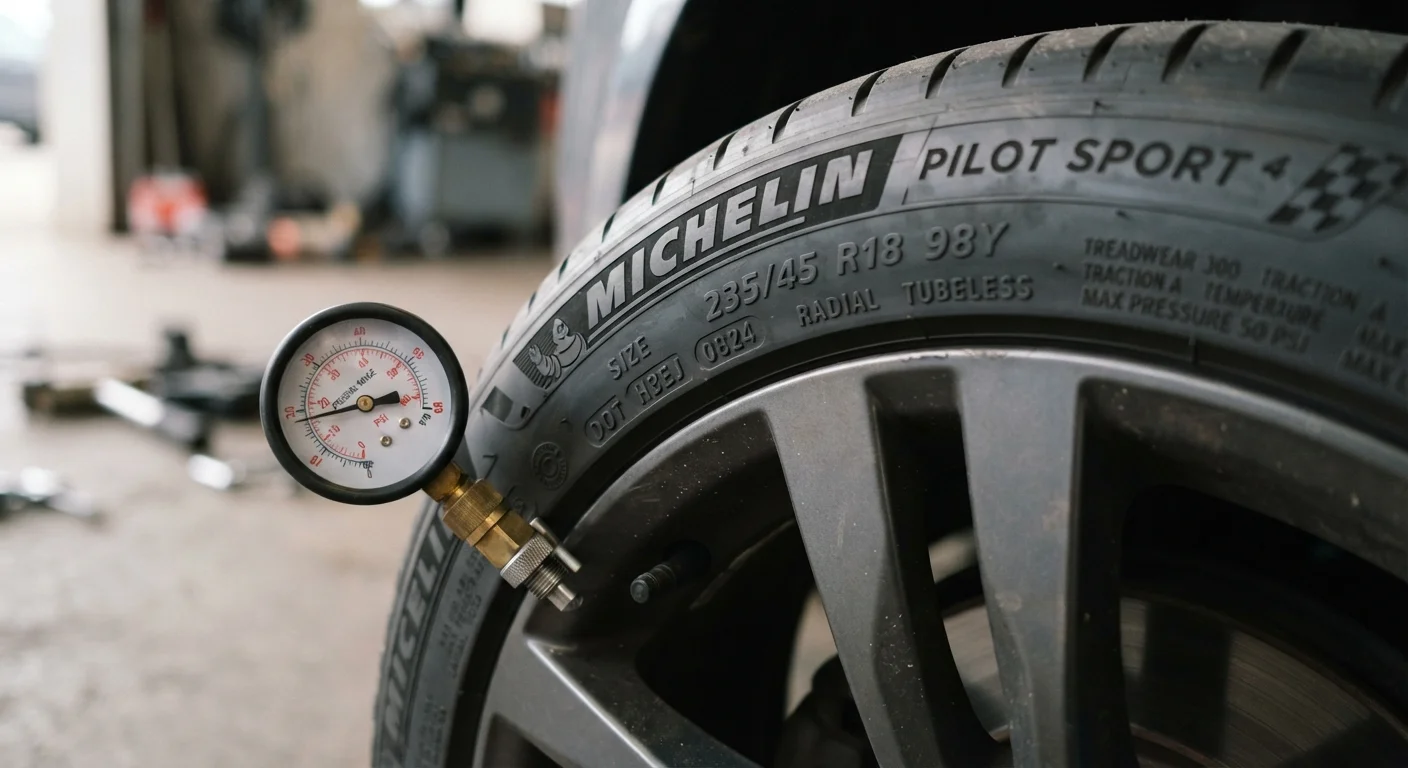
Reading the Sidewall Code
Every tyre has a string of letters and numbers moulded into its sidewall. It looks complex at first, but each segment has a specific meaning. Take the example code 205/55R16 91V:
- 205 — Tyre width in millimeters
- 55 — Aspect ratio: the sidewall height is 55% of the tyre's width
- R — Radial construction (standard on most passenger vehicles)
- 16 — Rim diameter in inches
- 91 — Load index (the maximum weight each tyre can carry)
- V — Speed rating (the maximum safe sustained speed)
You don't need to memorize what every load index or speed rating number means. What matters is that your replacement tyres match the specification listed on your door jamb sticker — using a mismatched size or rating can affect handling and safety.
The sidewall also contains a DOT code ending in a four-digit number. This is the manufacture date: the first two digits are the week and the last two are the year. If your tyres show "3521," they were made in the 35th week of 2021. This matters because rubber degrades with age, even when tread looks fine. See the FAQ below for guidance on tyre age limits.
For a broader look at how your car's systems connect, check out our plain-language guide to how cars work.
Check All Four Tyres — Including the Spare
It's easy to check pressure on one tyre and assume the rest are fine. Pressure can vary significantly between tyres on the same car. While you're at it, check the spare tyre in your trunk — a flat spare is useless in an emergency. Many compact spares require around 60 PSI, so check the spare's sidewall for its specific recommendation.
Tyre Pressure: The Check You Should Do Every Month
Tyre pressure is measured in PSI. Driving on underinflated tyres increases the contact area between the tyre and the road, generating excess heat — one of the primary causes of blowouts. Overinflated tyres, on the other hand, reduce grip and wear unevenly down the centre of the tread.
To check pressure correctly:
- Check when tyres are cold — before driving or after less than one mile.
- Find the recommended PSI on the sticker inside your driver's door jamb.
- Remove the valve cap from each tyre's stem.
- Press a tyre pressure gauge firmly onto the valve stem and read the result.
- Add air if needed using an air compressor (available at most gas stations).
- Replace valve caps securely when done.
Cold weather is a common culprit for pressure drops. For every 10°F the temperature falls, tyre pressure decreases by roughly 1 PSI. Students in northern states should check pressure more frequently during fall and winter. Tyre pressure habits also connect directly to mistakes new drivers frequently make with car care.
~11,000
U.S. crashes linked to tyre-related issues annually
According to NHTSA data, tyre problems including blowouts and tread separation contribute to thousands of crashes each year in the United States.
1 PSI
Pressure lost per 10°F temperature drop
The U.S. Department of Energy notes that tyre pressure decreases by approximately 1 PSI for every 10-degree Fahrenheit drop in ambient temperature.
25%
Of cars have at least one significantly underinflated tyre
NHTSA vehicle surveys have found that a substantial proportion of passenger vehicles on U.S. roads are operated with at least one tyre below the recommended pressure threshold.
Tread Depth and When to Replace
Tread channels water away from the contact patch between the tyre and the road. When tread wears down, a wet road becomes significantly more dangerous because water has nowhere to go — the result is hydroplaning, where the tyre skims across water rather than gripping the surface beneath it.
In most U.S. states, the legal minimum tread depth is 2/32 of an inch. Safety experts generally recommend replacing tyres before they reach this point. The easiest way to check:
- Penny test: Insert a penny with Lincoln's head down into a tread groove. If the top of his head is visible, the tread is dangerously low.
- Quarter test: Use a quarter the same way. Seeing the top of Washington's head means you're at about 4/32 — still legal, but time to plan for replacement soon.
- Tread wear indicators: Most tyres have small raised bars moulded into the tread grooves. When the tyre surface becomes flush with these bars, you're at the legal minimum.
Check multiple spots across the width of each tyre — uneven wear can signal alignment or inflation problems that a mechanic should assess. Good tyre condition is especially important in wet conditions. Driving in bad weather near campus covers how worn tyres increase risk in rain and ice.
Make tyre checks part of a regular habit alongside your other vehicle checks — the pre-journey checklist for first-time owners is a useful starting point.
This article is for general informational purposes. For tyre replacement, installation, or any concerns about your vehicle's safety, consult a qualified mechanic.
Frequently Asked Questions
Insert a penny into any tread groove with Lincoln's head pointing down. If you can see the top of his head, the tread is too worn and the tyre should be replaced. A quarter works similarly — if the top of Washington's head is visible, you're approaching the replacement threshold. Check multiple spots across the tyre, not just one location.
Check tyre pressure at least once a month and before any long trip. Pressure drops naturally over time and falls faster in cold weather — roughly 1 PSI for every 10°F drop in temperature. Always check when tyres are cold (driven less than a mile), as driving heats the air inside and gives a falsely high reading.
The recommended pressure is printed on a sticker inside the driver's door jamb, and also in your owner's manual. Do not use the maximum pressure number printed on the tyre sidewall — that is the tyre's maximum limit, not the recommended operating pressure for your vehicle.
Most manufacturers and safety organisations recommend inspecting tyres once they reach six years old and replacing them by ten years, regardless of visible wear. The four-digit DOT date code on the sidewall tells you the week and year of manufacture — for example, "2319" means the 23rd week of 2019.
Compact spare tyres (the smaller "donut" spare) are not designed for long distances or high speeds — typically limited to 50 mph and around 50–70 miles. Check your owner's manual for your specific vehicle's spare tyre limits, and arrange to replace the damaged tyre as soon as possible.
A code like 205/55R16 91V tells you: 205 is the tyre width in millimeters, 55 is the aspect ratio (sidewall height as a percentage of width), R means radial construction, 16 is the rim diameter in inches, 91 is the load index, and V is the speed rating. Your vehicle's door sticker specifies which combination is correct for your car.
The content provided on our blog site traverses numerous categories, offering readers valuable and practical information. Readers can use the editorial team’s research and data to gain more insights into their topics of interest. However, they are requested not to treat the articles as conclusive. The website team cannot be held responsible for differences in data or inaccuracies found across other platforms. Please also note that the site might also miss out on various schemes and offers available that the readers may find more beneficial than the ones we cover.