

Our Verdict
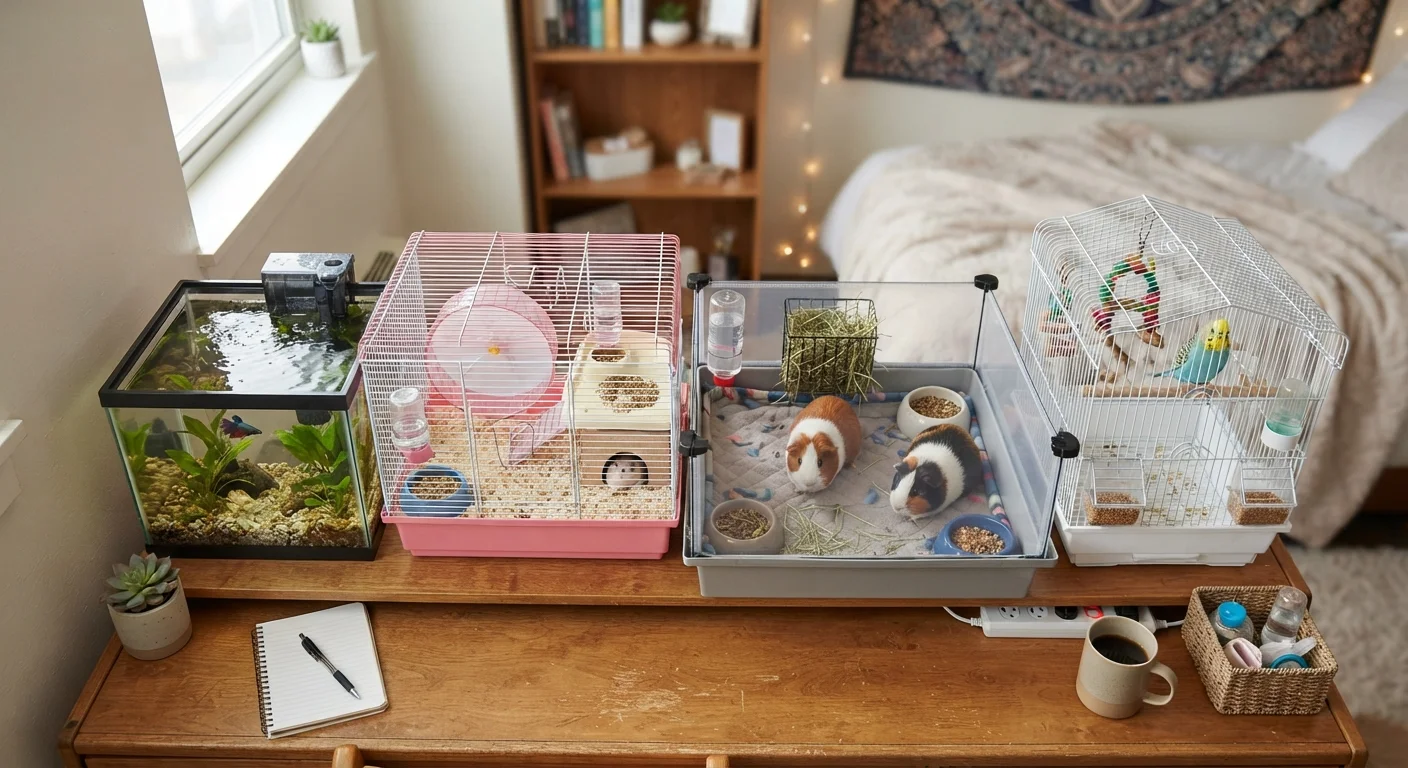
No single pet is universally the right fit for dorm life - the best choice depends on your schedule, living arrangement, and the care level you can genuinely commit to. Fish suit students who want low daily interaction but can maintain a habitat consistently. Hamsters offer hands-on companionship at a lower space cost, while guinea pigs and budgies reward students who have real time and energy to invest.
| Best for | Recommended |
|---|---|
| Students with minimal time for daily interaction | Fish |
| Students wanting a tactile, compact companion on a budget | Hamster |
| Students who can commit to daily feeding, socializing, and cleaning | Guinea pig |
| Students in pet-permissive housing who want an interactive, vocal pet | Budgie |
Why Comparing Care Demands Actually Matters
Choosing a small pet for college feels straightforward - until midterms arrive and you realize your new companion needs feeding, cleaning, or social time you haven't budgeted for. The gap between what a pet seems to need and what it actually needs is where most student pet owners struggle.
This comparison breaks down four commonly permitted small pets - fish, hamsters, guinea pigs, and budgies (parakeets) - across the dimensions that matter most in a dorm context: daily time investment, weekly upkeep, startup and ongoing costs, space requirements, and noise level. For a deeper look at what these pets cost over time, see our honest breakdown of small pet expenses.
| Fish | Hamster | Guinea Pig | Budgie | |
|---|---|---|---|---|
| Daily time required | ~5 minutes | ~10 minutes | 20-30 minutes | 60-90 minutes |
| Weekly time required | 30-45 minutes | 20-30 minutes | 45-60 minutes | 30-40 minutes |
| Startup cost (approx.) | $50-$150 | $60-$120 | $100-$200+ | $80-$180 |
| Monthly ongoing cost | $10-$20 | $15-$25 | $40-$70 (pair) | $20-$40 |
| Noise level | Silent | Low (wheel noise) | Moderate (vocalizes) | High (chirps daily) |
| Space footprint | Small (tank) | Medium (large enclosure) | Large (pair enclosure) | Medium (cage + fly time) |
| Social/handling needs | None | Low-moderate | High (pair recommended) | Very high |
| Commonly dorm-permitted | Often yes | Often yes | Varies by school | Often restricted |
Fish: Low Interaction, High Habitat Discipline
Fish - especially bettas - are among the most widely permitted dorm pets. They don't make noise, don't require handling, and occupy a compact footprint. However, they are not zero-maintenance. A healthy aquarium requires cycling the tank before introducing fish (a process that can take two to four weeks), weekly partial water changes of roughly 25-30%, and consistent temperature monitoring.
Skipping water changes leads to ammonia buildup, which stresses or kills fish quickly. Equipment failures - heaters, filters - need prompt attention. The care is infrequent but non-negotiable.
Daily time: ~5 minutes (feeding, visual check)
Weekly time: 30-45 minutes (water change, glass wipe)
Startup cost: $50-$150 depending on tank size and filtration
Ongoing monthly cost: $10-$20
Comparing fish and hamsters head to head can help if you're deciding between the two most common first dorm pets.
Hamsters: Nocturnal Habits That Can Surprise Light Sleepers
Hamsters are popular for good reason - they're small, self-contained, and relatively affordable. A single Syrian hamster needs a minimum of 40 gallons of usable floor space in its enclosure (though larger is always better), daily feeding, and weekly spot-cleaning with a full cage clean every two to four weeks.
The critical detail most students overlook: hamsters are nocturnal. Wheel running, digging, and chewing happen between roughly 9 p.m. and 3 a.m. A squeaky wheel in a small dorm room can meaningfully affect sleep quality.
Choose a Silent Wheel Before Bringing Home a Hamster
A solid-surface, ball-bearing wheel (rather than a barred metal one) significantly reduces nighttime noise. Placing the cage away from your bed and on a vibration-dampening mat can also help. If you're a light sleeper sharing a small room, test these setups before assuming they'll be sufficient - nocturnal activity is consistent and predictable, not occasional.
Daily time: ~10 minutes (feeding, water check, brief handling)
Weekly time: 20-30 minutes (spot-clean, enrichment swap)
Startup cost: $60-$120
Ongoing monthly cost: $15-$25
Guinea Pigs: Social Animals With Real Space and Time Needs
Guinea pigs are rewarding companions, but they carry the highest care commitment of the four options here. They are social animals - keeping a single guinea pig long-term is generally considered poor practice by animal welfare organizations, as they thrive in pairs. That doubles space, food, and bedding requirements.
They need a minimum of 7.5 square feet of floor space per pair, daily fresh vegetables alongside pellets and unlimited hay, and spot-cleaning every day or two due to high waste output. They also vocalize - wheeking and rumbling are normal communication - which may conflict with quiet-hours policies.
Daily time: 20-30 minutes (feeding, spot clean, handling)
Weekly time: 45-60 minutes (full clean, veggie prep, enrichment)
Startup cost: $100-$200+
Ongoing monthly cost: $40-$70 for a pair
For a realistic picture of what these figures look like month to month, our monthly cost breakdown for small dorm pets goes deeper on the numbers.
Budgies: Interactive and Intelligent - If Your Housing Allows Them
Budgerigars (budgies) are small parrots that are highly intelligent and social. A well-kept budgie needs daily out-of-cage time (at least one to two hours), mental stimulation, and ideally a companion bird. They can learn words and respond to interaction - which makes them genuinely engaging but also the most time-intensive pet in this comparison.
Before considering a budgie, check your residence hall policy carefully. Birds are frequently excluded from campus pet permissions even when other small animals are allowed. Noise is a real factor: budgies chirp and vocalize throughout the day.
Daily time: 60-90 minutes (out-of-cage, interaction, feeding)
Weekly time: 30-40 minutes (cage clean, perch wipe)
Startup cost: $80-$180
Ongoing monthly cost: $20-$40
Exploring which small pets genuinely fit dorm life can help you weigh options beyond these four if none feel right.
This article is for general informational purposes only. Always verify your specific residence hall's pet policy before acquiring any animal, and consult a licensed veterinarian for guidance on your pet's individual health needs.
The content provided on our blog site traverses numerous categories, offering readers valuable and practical information. Readers can use the editorial team’s research and data to gain more insights into their topics of interest. However, they are requested not to treat the articles as conclusive. The website team cannot be held responsible for differences in data or inaccuracies found across other platforms. Please also note that the site might also miss out on various schemes and offers available that the readers may find more beneficial than the ones we cover.