

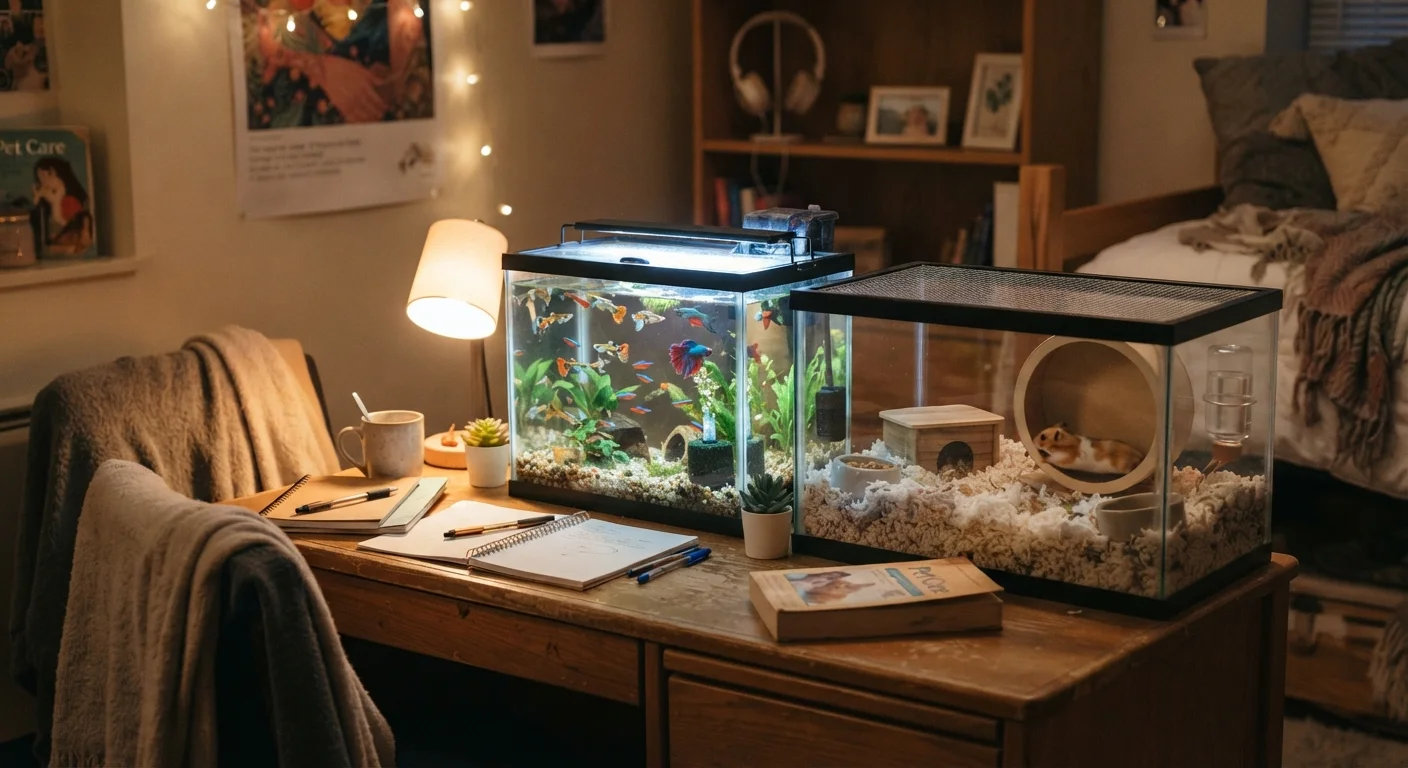
Option A
Aquarium Fish
The low-interaction, visually calming choice.
Best for: Students who want a stress-relieving presence without hands-on daily interaction.
Option B
Hamster
The hands-on, personality-driven small companion.
Best for: Students who want occasional interaction and a pet with visible behaviors and routines.
Policy and Permissions: What Most Dorms Actually Allow
Before choosing between a fish and a hamster, the most important step is checking your specific residence hall's pet policy. Many colleges permit small, caged, or aquatic animals while banning cats, dogs, and reptiles - but the details vary widely. See which pets are typically allowed in dorms for a broader look at how these policies are structured.
Fish are permitted in a majority of dorms that allow any pets at all, often with a tank size cap - commonly 10 gallons or under. Hamsters fall into a grayer area: some halls allow them explicitly, others ban all mammals. Never assume; request written confirmation from your Resident Advisor or housing office before bringing any animal to campus. Violating pet policies can result in fines or being required to rehome the animal immediately, which is stressful for both you and the pet.
| Criterion | Aquarium Fish | Hamster |
|---|---|---|
| Dorm policy acceptance | Widely permitted (tank size limits apply) | Permitted in some dorms; varies by school |
| Setup complexity | High - tank cycling required | Low to moderate - habitat assembly |
| Typical setup cost | Moderate to high | Low to moderate |
| Daily time commitment | Very low (feeding + observation) | Low to moderate (feeding, cleaning, enrichment) |
| Noise level | Silent | Audible at night (wheel, activity) |
| Interaction / handling | None | Possible with gradual taming |
| Typical lifespan | 2-4+ years (species-dependent) | 1.5-3 years |
| Vacation / travel flexibility | Better with auto-feeder | Needs regular check-ins |
Daily Care Realities: Time and Effort Compared
Fish care is front-loaded. Setting up a proper aquarium - cycling the tank to establish beneficial bacteria, calibrating filtration, and stabilizing water parameters - takes one to two weeks before a fish can safely be introduced. Once established, however, daily maintenance is light: feeding once or twice per day and monitoring water clarity. Weekly partial water changes (typically 20-30% of tank volume) and occasional filter maintenance make up the bulk of ongoing effort. For a deeper look at what this actually involves day to day, betta fish care in dorms covers the practical realities well.
Hamsters require daily feeding, fresh water, and spot-cleaning of their habitat to remove soiled bedding. A full cage clean is recommended roughly once a week. They also need enrichment - a properly sized wheel, chew toys, and occasional supervised exploration time outside their enclosure. One important consideration: hamsters are nocturnal. Their peak activity window runs from roughly dusk to early morning, meaning wheel-running and cage activity happen while many students are trying to sleep.
~10 gal
Common dorm fish tank size limit
Many university housing policies cap aquarium size at 10 gallons, though limits vary by institution.
1.5-3 yrs
Typical hamster lifespan
Syrian and common dwarf hamsters generally live between one and a half and three years under proper care conditions.
1-2 weeks
Time to cycle a new fish tank
Establishing beneficial bacteria in a new aquarium typically takes one to two weeks before fish can safely be introduced.
Costs, Lifespan, and What to Expect Over Time
Setup costs differ meaningfully between the two. A basic hamster habitat - cage, wheel, water bottle, bedding, hide, and food - can often be assembled for less than a properly filtered aquarium setup, which requires a tank, heater (for tropical species), filter, water conditioner, test kit, and décor. Ongoing costs for both are modest, though veterinary care for hamsters - if needed - can be proportionally expensive relative to the animal's cost, since exotic-animal vets charge similarly to standard veterinary rates.
Lifespan is another practical factor. Common pet hamsters (Syrian and dwarf varieties) typically live one and a half to three years. Aquarium fish lifespans vary significantly by species: bettas commonly live two to four years under proper conditions, while some community fish species live longer. A shorter lifespan can mean facing the loss of a pet during your college years, which is worth thinking through honestly before committing. For a fuller cost comparison across popular student pets, see comparing the true cost of common dorm-friendly pets.
Making the Right Call for Your Lifestyle
Neither fish nor hamsters are the right fit for every student. The best choice depends on your schedule, sleep patterns, living situation, and what you genuinely want from pet ownership. If you're drawn to the calming, observational quality of watching fish and don't need an animal that responds to you, a well-kept aquarium can be genuinely rewarding. If you want a creature with individual personality and the possibility of a tactile bond, a hamster may suit you better - provided you can accommodate its nocturnal schedule and daily care needs.
Either way, both animals depend on consistent, informed care. basic pet care routines for student pet owners is a useful starting point for building sustainable habits. And if you want to compare even more options before deciding, how small pets compare across time, cost, and daily effort offers a broader side-by-side look. Whichever you choose, go in with realistic expectations - and a genuine commitment to the animal's welfare, not just the novelty of having a pet.
The content provided on our blog site traverses numerous categories, offering readers valuable and practical information. Readers can use the editorial team’s research and data to gain more insights into their topics of interest. However, they are requested not to treat the articles as conclusive. The website team cannot be held responsible for differences in data or inaccuracies found across other platforms. Please also note that the site might also miss out on various schemes and offers available that the readers may find more beneficial than the ones we cover.