

The Rate You See Online Is a Benchmark, Not a Promise
When you search for today's USD to EUR rate and see a number like 0.92, that figure comes from the mid-market rate — also called the interbank rate. It reflects the midpoint between global buyers and sellers of currency on the wholesale foreign exchange market. Think of it like the suggested retail price before any retailer marks things up.
This rate fluctuates continuously during market hours, driven by trade flows, interest rate expectations, inflation data, and broader investor sentiment. The number you see on a financial site at 9 a.m. may be meaningfully different by noon.
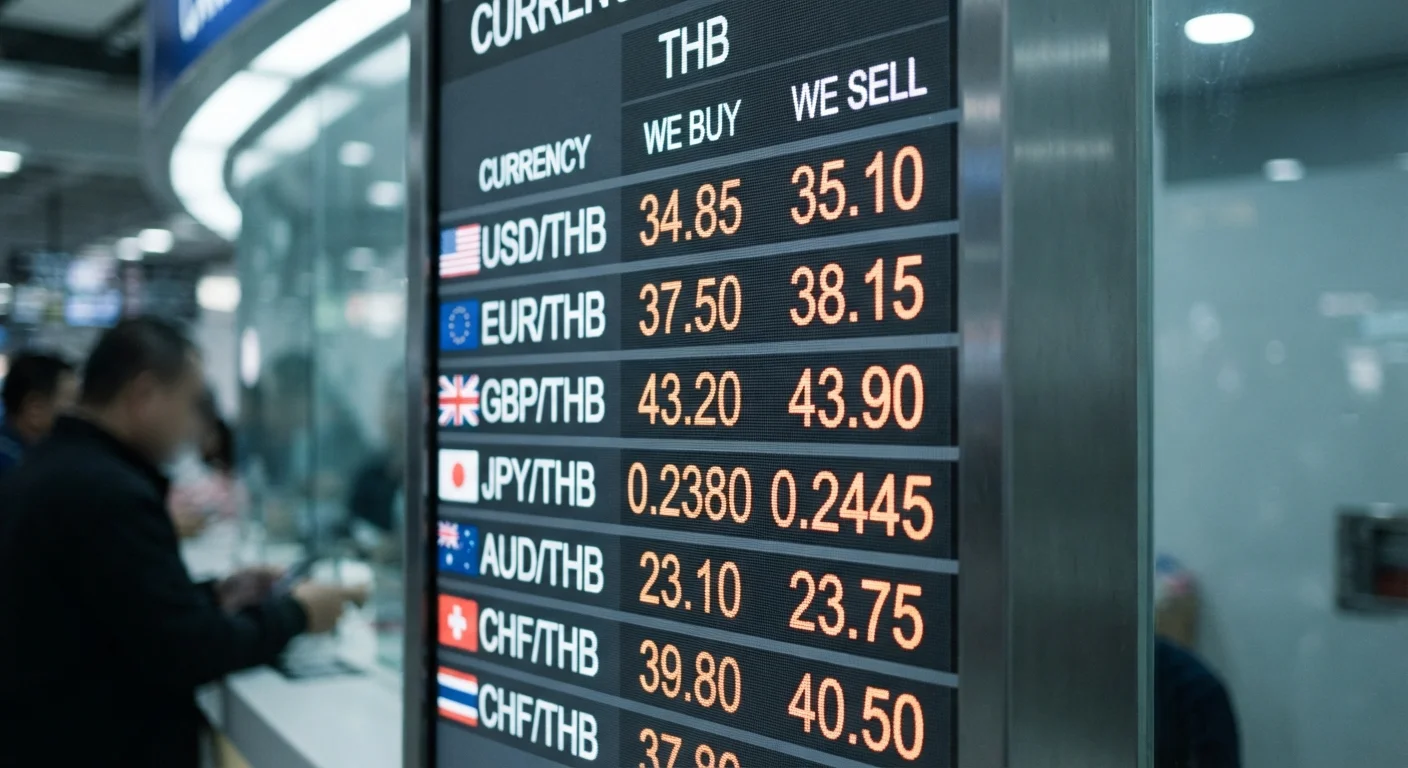
What that rate is not is a quote for your transaction. No bank, ATM, or currency kiosk is obligated to give you the mid-market rate. Every provider sets its own retail rate, and the gap between the mid-market rate and what you actually receive is called the spread.
For a broader orientation to travel money concepts, see our travel money primer which covers currency, cards, and fees from scratch.
How the Spread Works — and What It Costs You
The spread is the provider's built-in margin. If the mid-market rate is 0.92 euros per dollar but your bank's rate is 0.88 euros per dollar, that 0.04 difference represents the spread — roughly a 4.3% cost on the exchange.
Spreads vary widely by channel. Airport kiosks in high-traffic locations have historically offered some of the widest spreads. Bank branches and ATMs typically offer something closer to market rates, though this varies by institution. Card networks such as Visa and Mastercard convert at rates generally close to mid-market, but your card issuer often adds a foreign transaction fee — commonly between 1% and 3% — layered on top.
1–3%
Typical foreign transaction fee on US cards
Most major US bank and credit card issuers charge between 1% and 3% as a foreign transaction fee on international purchases, according to general consumer finance guidance.
2–8%+
Typical spread range across exchange channels
Exchange rate margins vary widely by provider type; airport kiosks and hotel desks tend toward the wider end, while bank ATMs and certain card accounts tend toward the narrower end.
24/5
Hours the forex market operates each week
The global foreign exchange market runs continuously from Sunday evening through Friday evening US Eastern Time, meaning mid-market rates shift throughout the day.
Beyond the spread, watch for:
- Flat transaction fees — a fixed dollar amount per exchange, which hurts more on small transactions
- ATM withdrawal fees — charged by both your home bank and sometimes the foreign ATM operator
- 'No commission' claims — these mean no flat fee, but a wide spread is still embedded in the rate
The only reliable way to compare providers is to calculate the effective rate: divide the foreign currency amount you'd receive by the home currency amount you'd spend, including all fees. That number tells you the true cost.
Why the Same Transaction Can Cost You Different Amounts
Consider a student converting $500 USD to euros. At a mid-market rate of 0.92, the theoretical maximum is €460. At a provider offering 0.88 with no fee, they get €440 — a €20 difference. At a provider offering 0.91 but with a $5 flat fee, they get €450.50 after the fee's effect. The headline rate alone doesn't determine which is better.
There's also a less obvious cost trigger: dynamic currency conversion (DCC). This occurs when a foreign card terminal asks whether you'd like to pay in US dollars rather than the local currency. The rate applied in those cases is set by the merchant's payment processor, not your card network, and is often substantially worse. For a full breakdown of why that offer usually works against you, see our article on dynamic currency conversion.
When deciding where to actually exchange currency, the channel matters as much as the quoted rate. Our guide on where to exchange currency abroad walks through the main options and their typical cost structures.
Calculate the Effective Rate Before You Exchange
Before committing to any currency exchange, ask for the exact amount of foreign currency you'd receive for a specific home currency amount — including all fees. Divide the foreign amount by the home amount to get your effective rate, then compare it to the current mid-market rate. That gap is your real cost.
This article provides general financial education and is not personalised financial advice. For decisions specific to your circumstances, consider consulting a qualified financial professional.
Frequently Asked Questions
The mid-market rate (also called the interbank rate) is the midpoint between the buy and sell prices of two currencies on the wholesale foreign exchange market. It's the benchmark used by financial data sites. Consumers typically don't access this rate directly — providers add a margin on top.
Google and most financial sites display the mid-market rate, which is a wholesale benchmark. Banks, card networks, and exchange services apply their own markup — called a spread — before passing a rate to you. Flat transaction fees can add further cost on top.
A spread is the difference between the mid-market rate and the rate an exchange provider actually offers you. It's how most providers build in their profit. A wider spread means a worse deal for the traveler, even if no separate fee is charged.
Not necessarily. 'No commission' means no separate flat fee, but the provider almost always recoups revenue through a wider spread embedded in the rate itself. Always compare the effective rate you'll receive, not just whether a commission is advertised.
Card networks such as Visa and Mastercard typically convert at rates close to the mid-market rate, but your card issuer may add a foreign transaction fee (commonly 1–3%) on top. Check your card's terms for the exact fee structure before traveling.
Dynamic currency conversion (DCC) is when a foreign payment terminal offers to charge you in your home currency instead of the local one. The rate used is typically worse than your card's standard conversion rate. Choosing to pay in the local currency is generally the better approach — see our detailed explainer for more context.
The content provided on our blog site traverses numerous categories, offering readers valuable and practical information. Readers can use the editorial team’s research and data to gain more insights into their topics of interest. However, they are requested not to treat the articles as conclusive. The website team cannot be held responsible for differences in data or inaccuracies found across other platforms. Please also note that the site might also miss out on various schemes and offers available that the readers may find more beneficial than the ones we cover.