

Our Verdict
For most student travelers, withdrawing local currency from a reputable bank-affiliated ATM abroad — using a debit card with low or no foreign transaction fees — tends to offer a reasonable rate with manageable fees. Airport exchanges work as a short-term fallback for small amounts when you land with nothing local. Bureaux de change in city centers can occasionally beat ATM rates, but require comparison shopping. Always verify current fees and exchange policies before traveling.
| Best for | Recommended |
|---|---|
| Students who want a straightforward, low-effort approach | Bank-affiliated ATM abroad |
| Travelers who land with zero local cash and need immediate funds | Airport exchange counter (small amount only) |
| Longer trips where you can plan ahead and visit a branch | Local bank or home bank with international partnership |
| Travelers in major cities with time to compare options | City-center bureau de change |
Why Your Exchange Method Matters More Than You Think
Changing $500 USD into euros sounds simple — until you realize that the difference between a 2% and a 6% effective fee is roughly $20 gone before you've bought a single meal. Multiply that across a two-week trip with multiple withdrawals, and the gap becomes significant on a student budget.
Every exchange channel — airport kiosk, overseas ATM, bank branch, or bureau de change — has its own fee structure, exchange rate markup, and convenience trade-offs. Before your first international trip, it's worth understanding each so you don't default to the most expensive option by accident. If you're new to travel money concepts entirely, this foundational guide to travel money explains exchange rates and fees from scratch.
| Airport Counter | ATM Abroad | Bank Branch | Bureau de Change | |
|---|---|---|---|---|
| Typical rate quality | Below mid-market | Near mid-market | Variable, often fair | Highly variable |
| Fee transparency | Often opaque | Layered, needs research | Generally clear | Varies by operator |
| Convenience | Very high (on arrival) | High (widespread) | Low (limited hours) | Medium (city centers) |
| Advance planning needed | None | Some (card setup) | Yes (hours, partners) | Some (comparison) |
| Risk of unfavorable conversion | High | Medium (DCC risk) | Low to medium | Medium to high |
| Best use case | Emergency small amount | Primary cash source | Planned large exchange | Spot comparison shopping |
Airport Exchange Counters: Convenient but Costly
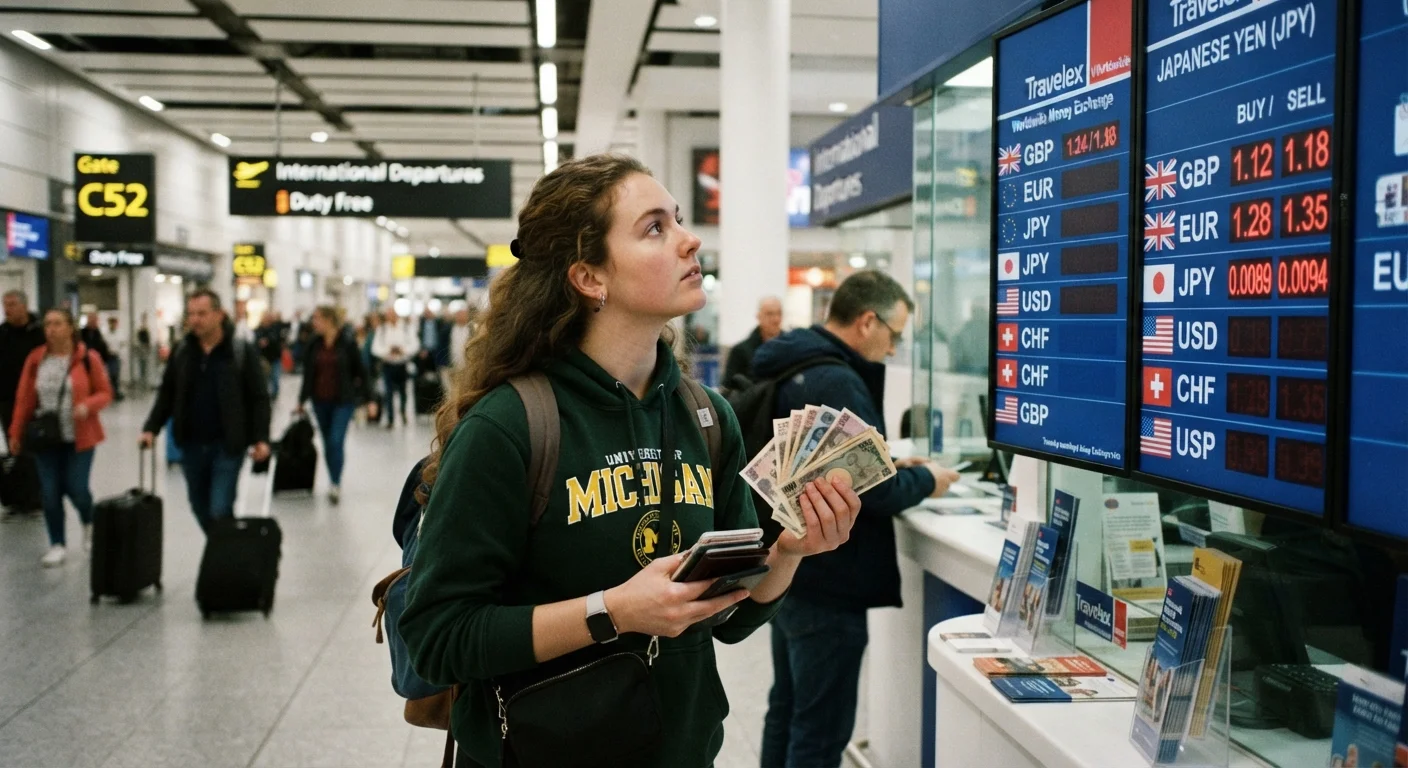
Airport currency exchange counters are almost always the most accessible option — and often the least favorable. Operators in airports pay high rents and face captive customers, which tends to translate into wide spreads between the buy and sell rate, plus flat service fees.
That said, they're not always a complete disaster in every situation. If you land somewhere and need a small amount of local cash immediately for a taxi or transit card, exchanging a modest sum at the airport is a reasonable fallback. The key is limiting how much you exchange there — treat it as a bridge, not your main strategy.
Watch for Dynamic Currency Conversion
At ATMs and card payment terminals abroad, you may be asked whether to pay in your home currency (USD) or the local currency. Always choose local currency. Paying in USD via Dynamic Currency Conversion (DCC) lets the merchant or ATM operator set the exchange rate, which is typically less favorable than your card network's rate. This applies at restaurants, shops, and ATMs alike.
Some airport counters advertise "0% commission" but compensate with a worse exchange rate. Compare the displayed rate against the mid-market rate (available from sources like financial data providers or currency converter tools) to understand the real cost.
ATMs Abroad: Often Competitive, But Fees Stack Up
Withdrawing cash from a local ATM abroad is one of the more reliable ways to access currency at rates close to the interbank (mid-market) rate. The ATM network your card is linked to — typically Visa or Mastercard — generally applies a wholesale rate that's difficult for manual exchange counters to match.
The catch is fees, which can layer in ways that aren't obvious at the machine. You may face: a foreign transaction fee from your US bank (often 1–3%), a flat out-of-network ATM fee from your bank, and a fee from the foreign bank operating the ATM. Some ATMs also prompt you to pay in USD via a process called Dynamic Currency Conversion (DCC) — always decline this and choose to pay in the local currency instead, as DCC rates are typically unfavorable.
For a detailed breakdown of how these fees compound, see ATM withdrawals abroad: fees, limits, and what to watch for.
Set Up Your Card Before You Fly
Before departure, contact your bank to confirm international ATM access, understand any foreign transaction fees, and ask about partner networks abroad. Some accounts designed for travelers waive foreign ATM fees entirely. Knowing your card's terms in advance means you won't be caught off guard by a fee notice on a foreign ATM screen.
Bank Branches: Reliable, but Know the Limitations
Exchanging currency through a bank — either your home bank before departure or a local bank branch at your destination — can offer transparent rates and lower fees than airport counters. Some US banks have international partner networks that reduce or eliminate ATM fees abroad; check with your bank before you travel.
The drawback is practicality. Bank branches keep business hours, may have limited foreign currency stock at smaller locations, and sometimes charge their own exchange fees. In many countries, local bank ATMs (not the branch desk) are actually the easier access point. If you're planning a multi-country itinerary, managing money across multiple currencies is worth reading before you go.
Bureaux de Change: Variable, Worth Comparing in Cities
Independent bureaux de change (dedicated currency exchange shops) range from genuinely competitive to worse than airport rates, depending entirely on location and the operator. In major tourist cities — London, Paris, Bangkok — competition between exchange shops in busy areas can drive rates closer to the mid-market rate than you'd get at many banks.
The rule is: always check the rate displayed against the mid-market rate and factor in any flat fees before handing over cash. Exchange shops near major transit hubs or in tourist-heavy zones tend to be pricier; those a few blocks further from the main attraction often offer better terms. Never exchange money based on a rate advertised in the window without confirming the final amount you'll receive after all fees.
Some popular beliefs about currency exchange — like "airport is always the worst" or "your card is always safest" — don't hold up in every situation. Common travel money myths worth questioning breaks down several of these assumptions.
This article provides general financial information for educational purposes and does not constitute personalized financial advice. Exchange rates, fees, and policies vary by provider, destination, and individual account terms. Always verify current rates and charges directly with your bank or exchange provider before traveling.
The content provided on our blog site traverses numerous categories, offering readers valuable and practical information. Readers can use the editorial team’s research and data to gain more insights into their topics of interest. However, they are requested not to treat the articles as conclusive. The website team cannot be held responsible for differences in data or inaccuracies found across other platforms. Please also note that the site might also miss out on various schemes and offers available that the readers may find more beneficial than the ones we cover.