

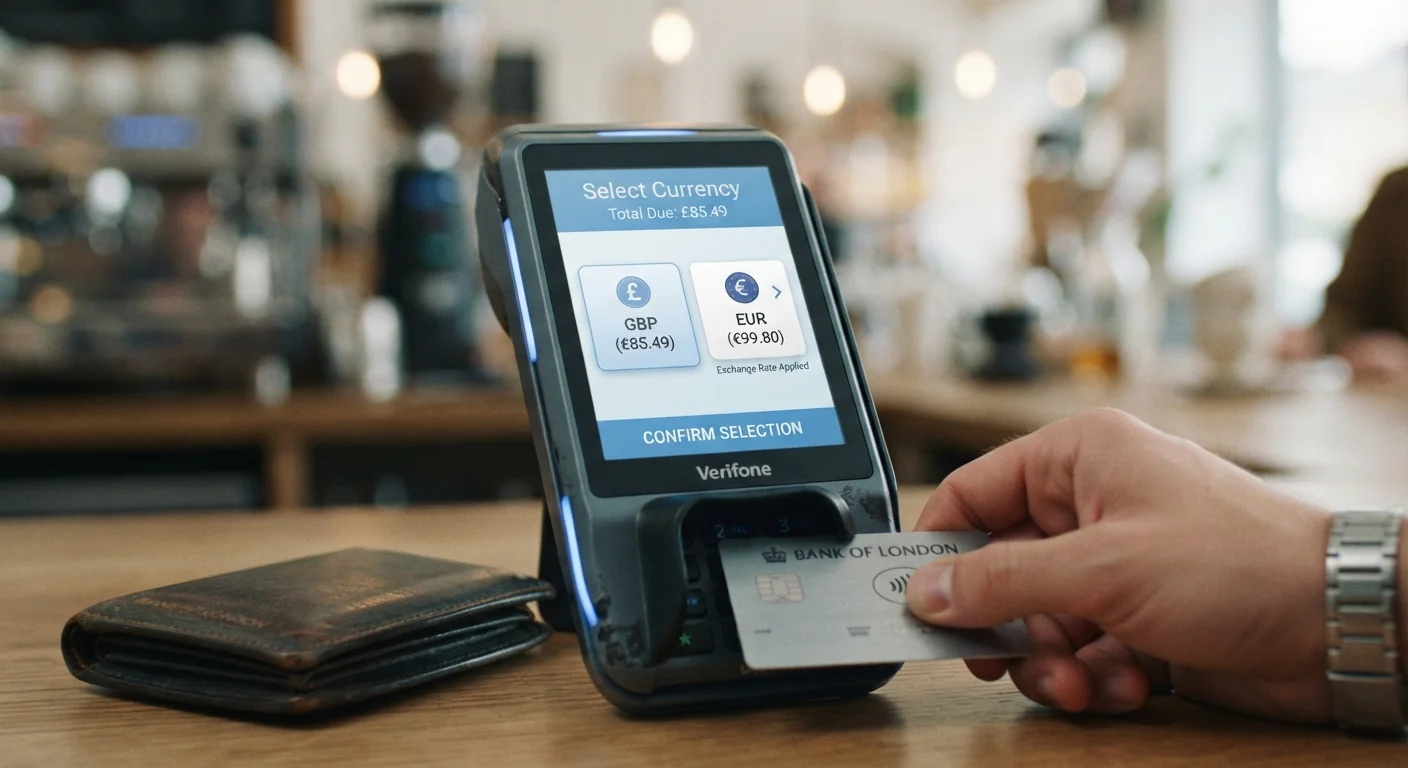
What Actually Happens When You Accept DCC
You're at a restaurant in Europe, tap your card, and the terminal asks: "Would you like to pay in USD?" It seems straightforward — of course you know what USD is. But what you're actually agreeing to is letting the merchant's payment processor handle the currency conversion instead of your bank.
Here's where the cost difference shows up. Your bank converts currency using rates close to the interbank rate — the wholesale rate banks use among themselves. The DCC provider uses a rate that includes their own markup, which functions as their fee for performing the conversion at the point of sale. That markup is typically built into the exchange rate itself, so it doesn't appear as a separate line item. You see a USD total, and the surcharge is invisible inside the rate.
Research and consumer finance regulators have consistently found that DCC exchange rates carry markups ranging from roughly 3% to over 7% above mid-market rates, though the exact figure varies by provider and transaction. On a $500 purchase, that's potentially $15–$35 in extra costs — not trivial on a student travel budget.
3%–7%+
Typical DCC markup above mid-market exchange rate
Consumer finance regulators and independent payment researchers have documented DCC markups in this range, though exact figures vary by provider.
~$15–$35
Potential extra cost on a $500 purchase via DCC
Calculated using a mid-range DCC markup estimate; actual amounts depend on the rate applied by the specific merchant or ATM operator.
Why the 'Convenience' Framing Matters
DCC is marketed around certainty: you know exactly what you'll be charged in your home currency before you confirm. For a first-time traveler unfamiliar with exchange rates, that framing feels reassuring. But the certainty comes at a cost you're not shown transparently.
There's also a subtle psychological mechanism at work. Seeing a familiar currency makes the purchase feel less abstract. Behavioral finance research has documented that people tend to spend more freely when prices are denominated in currencies they know well — sometimes called the 'foreign currency effect.' DCC effectively removes that psychological friction, which may lead to looser spending decisions overall.
It's worth understanding that the myths surrounding travel money often center on convenience framing. DCC fits that pattern neatly.
Default to Local Currency — Always
Make it a habit: whenever a foreign terminal or ATM asks which currency to use, choose the local one. You don't need to calculate rates on the spot — just decline the home currency option. Your bank's conversion rate, while not perfect, is consistently more favorable than the DCC rate applied at the point of sale.
How to Spot and Decline DCC Every Time
DCC prompts appear in several forms, and they're not always clearly labeled as a choice. Here's what to watch for:
- Terminal prompts: A screen asking whether you want to pay in your home currency or the local currency. Always select local currency.
- Pre-selected options: Some terminals default to your home currency automatically. Scroll through the screens before confirming and check which currency is selected.
- ATM conversion offers: Phrases like "accept guaranteed rate" or "be charged in " at international ATMs are DCC. Select local currency withdrawal instead. Our guide on ATM withdrawals abroad covers related fee layers in detail.
- Cashier-initiated DCC: Occasionally a cashier selects the currency on your behalf. You can ask them to cancel and retry in local currency — most payment systems allow this.
The principle is consistent: whenever you're given a choice of currency at a foreign terminal or ATM, choose the local currency. Let your card issuer handle the conversion. For a fuller picture of the costs that stack up when using cards overseas, the travel money fundamentals guide covers the complete landscape from scratch.
DCC in Context: One Fee Among Several
Avoiding DCC is one piece of the broader puzzle of minimizing overseas payment costs. It's worth keeping DCC separate from other charges you may encounter:
- Foreign transaction fees — charged by your card issuer, typically 1–3%, and apply regardless of DCC. See what foreign transaction fees are and when they apply.
- ATM operator fees — flat fees charged by the ATM network, separate from any DCC or card issuer charges.
- Card issuer currency conversion — the rate your bank applies when you pay in local currency, which is generally more favorable than DCC but still includes a small spread.
Understanding how these costs interact helps you make smarter decisions at each point of payment. Whether you're weighing card options or deciding between cash and card, the cash vs. card trade-offs article works through each scenario practically.
This article is for general informational purposes only and does not constitute financial or legal advice. Rates, fees, and policies vary by card issuer, payment processor, and country. Verify current terms with your card issuer before traveling.
Frequently Asked Questions
Rarely. DCC exchange rates consistently include a markup above standard interbank rates. In virtually all documented cases, paying in the local currency and letting your bank handle conversion produces a better rate. The main appeal is seeing a known currency amount upfront, but that predictability comes at a price.
When the terminal prompts you to choose a currency, select the local currency option. Phrasing varies — look for 'pay in [local currency]', 'decline conversion', or 'no thanks'. If the cashier has already selected DCC on your behalf, you can ask them to cancel the transaction and re-run it in local currency.
No. Foreign transaction fees are charged by your card issuer and apply whenever you use the card abroad, regardless of which currency you choose at checkout. DCC and foreign transaction fees are two separate costs. See our explainer on <a href="/travel-on-a-budget/travel-money-tips/what-is-a-foreign-transaction-fee-and-when-does-it-apply">foreign transaction fees</a> for more detail.
Yes. Many international ATMs prompt you to accept a 'guaranteed exchange rate' and be charged in your home currency. This is DCC applied at the ATM level. The same rule applies: choose to be charged in local currency and let your home bank convert it instead.
The merchant or ATM operator typically receives a share of the DCC margin, which is why staff sometimes default to it or present it as the easier option. The payment processor providing the DCC service takes another portion. Your bank receives nothing from this arrangement.
The content provided on our blog site traverses numerous categories, offering readers valuable and practical information. Readers can use the editorial team’s research and data to gain more insights into their topics of interest. However, they are requested not to treat the articles as conclusive. The website team cannot be held responsible for differences in data or inaccuracies found across other platforms. Please also note that the site might also miss out on various schemes and offers available that the readers may find more beneficial than the ones we cover.