

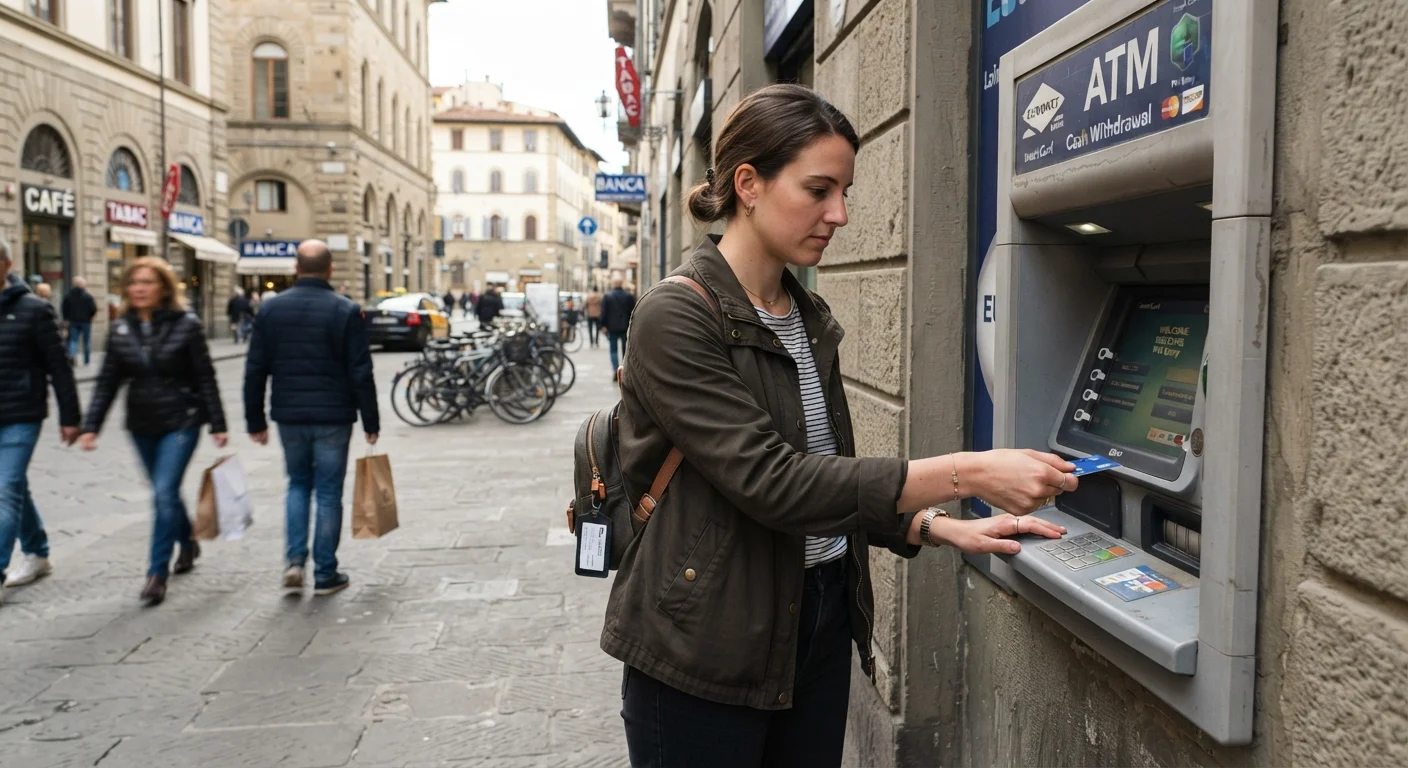
The Fee Stack: What You're Actually Paying
Using an ATM abroad typically triggers not one fee but a combination of up to four separate charges. Many students are surprised when their bank statement reflects a much higher cost than the machine displayed. Understanding each layer is the first step to managing them.
- Foreign transaction fee: Charged by your home bank or card issuer — commonly 1–3% of the withdrawal amount. Some accounts waive this entirely. See what a foreign transaction fee is and when it applies for a full breakdown.
- Out-of-network ATM fee: Your home bank may charge a flat fee (often $2–$5) for using any ATM outside its network, domestically or abroad.
- Operator/local ATM fee: The ATM's owner charges a separate fee, displayed on screen before you confirm. This is negotiable in the sense that you can cancel and find another machine.
- Exchange rate margin: Your bank converts the local currency at its own rate, which is typically less favorable than the mid-market rate. This isn't labeled as a fee but functions like one.
These charges are independent — a single withdrawal can include all four simultaneously. The only one you can see in real time is the operator fee, which is why the total cost often looks different on your statement than it did at the ATM screen.
Dynamic Currency Conversion: The On-Screen Trap
Some international ATMs will ask whether you want to be charged in your home currency (e.g., U.S. dollars) or the local currency. This is called dynamic currency conversion (DCC), and it almost always works against you.
When you accept DCC, the ATM operator applies their own exchange rate — typically far worse than your bank's rate — and locks in the conversion. Your bank then processes a transaction already in dollars, so it has nothing left to convert. The result: you absorb the ATM operator's margin on top of your regular fees.
Always choose to be charged in the local currency. Your bank's conversion, even with its own margin, is generally more favorable than a third-party DCC rate. Dynamic currency conversion is explained in detail here if you want to understand the mechanics more fully.
DCC Can Appear on ATMs and Card Terminals
Dynamic currency conversion isn't limited to ATMs — it also appears at hotel checkouts, restaurant card terminals, and retail point-of-sale machines. The same rule applies in every case: select the local currency. If a terminal has already processed a DCC charge without asking, you can request that the merchant void and re-run the transaction in local currency, though not all will comply.
Withdrawal Limits and How They Work Against You
ATM withdrawal limits exist at two levels: your home bank's daily limit and the local ATM's per-transaction limit. Both caps can affect your costs.
If the local ATM's limit is lower than your bank's, you may need multiple transactions to get the cash you need — and each transaction triggers a new round of flat fees. A $5 out-of-network fee on a $50 withdrawal is a 10% charge. That same $5 fee on a $200 withdrawal is only 2.5%.
Practical approach: Check your home bank's daily ATM limit before you travel. At your destination, try to withdraw larger amounts less frequently rather than small amounts often. This reduces the total number of flat fees you pay.
Be aware that some countries have low maximum per-transaction limits by default — this varies by country and ATM operator and is not always predictable. For a broader look at where ATMs fit among currency exchange options, see how ATMs compare to other currency exchange channels.
This article provides general financial information for educational purposes and is not personalized financial advice. Fee structures vary by bank, account type, and destination. Always verify current terms directly with your financial institution before traveling.
The content provided on our blog site traverses numerous categories, offering readers valuable and practical information. Readers can use the editorial team’s research and data to gain more insights into their topics of interest. However, they are requested not to treat the articles as conclusive. The website team cannot be held responsible for differences in data or inaccuracies found across other platforms. Please also note that the site might also miss out on various schemes and offers available that the readers may find more beneficial than the ones we cover.