

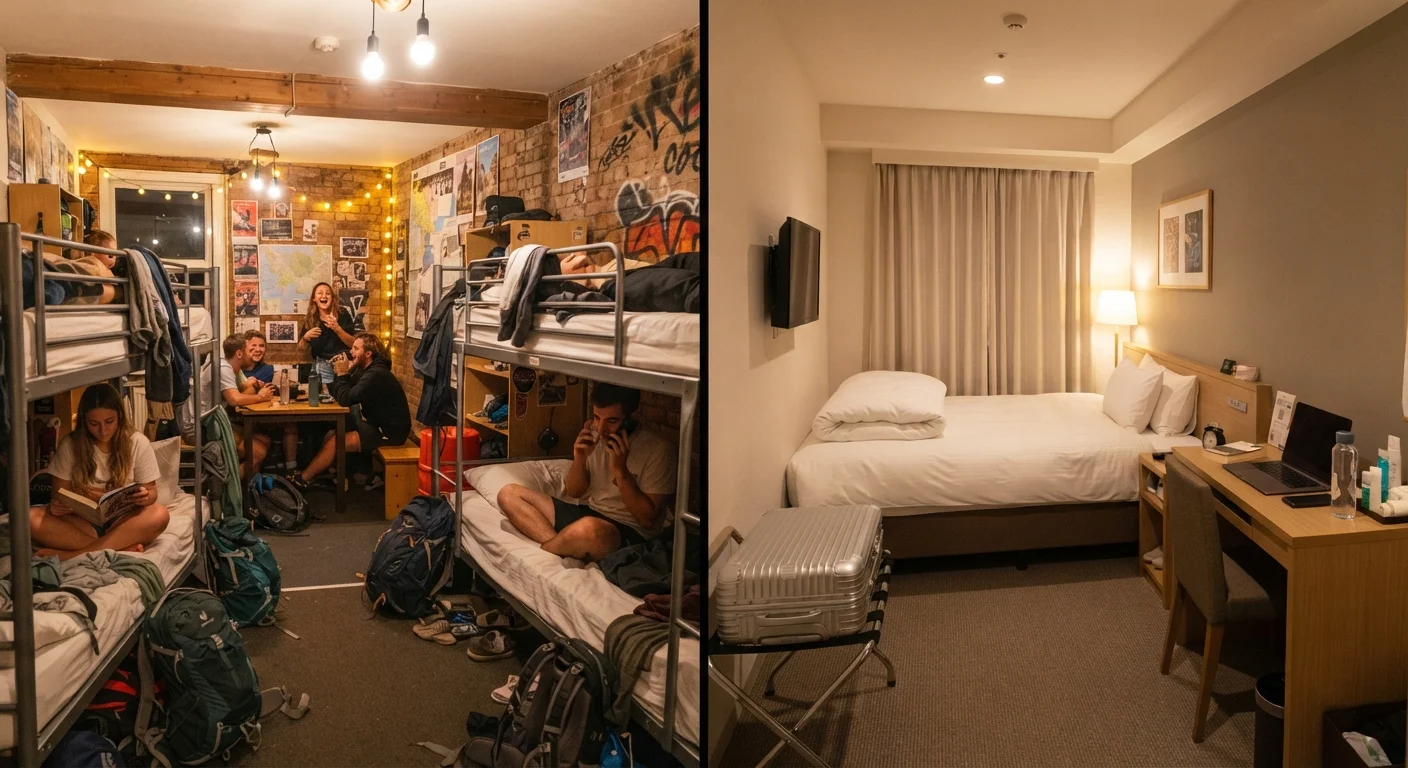
Option A
Hostels
The social, lower-cost option for flexible student travellers.
Best for: Students travelling solo or wanting to meet people, who can trade privacy for a lower nightly rate.
Option B
Budget Hotels
The predictable, private option for travellers who value personal space.
Best for: Students travelling in pairs or groups, or anyone who needs reliable sleep and a private room.
What You're Actually Paying For in Each Option
The price difference between a hostel dorm bed and the entry-level room at a budget hotel is real — but it reflects more than just square footage. Understanding what each rate actually covers helps you make a smarter choice before you book.
A hostel dorm bed typically includes a bunk bed in a shared room (often with 4–12 other guests), access to shared bathrooms, and usually a communal kitchen. Many hostels also include a locker for valuables, though some charge a small fee for padlocks. The social infrastructure — common rooms, organised pub crawls, notice boards — is part of the product, not a bonus.
A budget hotel room, even at the lower end, gives you a private room with a lockable door, your own bathroom in most cases, and a bed setup designed for uninterrupted sleep. You're paying for predictability: no strangers coming in at 2 a.m., no negotiating shower schedules, no communal noise.
| Criterion | Hostels | Budget Hotels |
|---|---|---|
| Room type | Shared dorm (private room optional) | Private room standard |
| Bathroom | Usually shared | Usually private (en suite) |
| Nightly cost (dorm vs. single room) | Generally lower per bed | Higher for solo travellers |
| Kitchen access | Communal kitchen typical | Rarely available |
| Social environment | Built-in; common areas, events | Minimal; individual stays |
| Sleep predictability | Variable (shared space noise) | High (private room) |
| Security | Lockers provided; shared access | Private lockable room |
| Hidden fees | Linen, lockers, city tax | Breakfast, parking, facility fees |
Neither option is objectively better — they solve different problems. The hostel model works when the experience of travelling matters as much as the destination. The budget hotel model works when the accommodation is a functional base, not part of the trip itself. For a deeper look at how this trade-off shows up in your living situation back home, the framework in this guide to choosing between apartment types translates directly.
The Real Costs Students Miss
Hostel listings often show a low headline price that doesn't survive contact with the booking process. City tourist taxes — common across Europe — are typically charged per person per night and added at checkout. Linen hire, locker deposits, and Wi-Fi fees (though increasingly rare) can add several dollars per night. In some cities, a hostel dorm bed with all extras included ends up within a few dollars of a budget hotel room when you're travelling with one other person.
Budget hotels carry their own hidden costs. Parking, breakfast (rarely included at the lowest price tier), and resort or facility fees — common in the US — can inflate the final bill. Some properties also charge for early check-in or late checkout.
~40%
Typical price gap: dorm bed vs. budget hotel
Industry booking data generally suggests hostel dorm beds run 30–50% below entry-level private hotel rooms in the same city, though this varies widely by destination.
60%+
Solo travellers who cite social experience as a hostel benefit
Hostel guest surveys consistently show meeting other travellers ranks among the top reasons solo travellers choose dorm accommodation over private options.
The practical move is to compare total cost, not headline nightly rate. Calculate what you'll spend across accommodation, meals (factoring in kitchen access), and any mandatory fees before assuming one option is clearly more affordable. These are the expenses most student travellers overlook — worth reading before you finalize any accommodation booking.
One often-missed saving in the hostel column: cooking your own meals in a shared kitchen for even two or three nights on a week-long trip can offset the difference in nightly rates. Budget hotels rarely offer this.
Security, Sleep Quality, and Practical Realities
Security concerns about hostels are legitimate but often overstated. Most established hostels use keycard or PIN entry for dorm rooms, provide lockable storage for bags and valuables, and have front-desk staff on rotation. That said, the risk of minor theft — a phone left on a bunk, an unlocked locker — is higher in a shared room than in a private one. Use the locker, keep valuables on your person, and the risk drops considerably.
Sleep quality is the more honest objection. A dorm of eight people from different time zones and travel schedules will not be as quiet as a private room. If you have an early flight, a full day of sightseeing, or simply need to recover from a long journey, a budget hotel room removes that variable entirely. This is particularly relevant if you're travelling to an unfamiliar city for the first time — fatigue compounds navigation anxiety.
For students who want a middle ground, many hostels now offer private rooms at rates that sit between dorm beds and budget hotels. These give you hostel perks (kitchen, common room, social scene) with private-room sleep. It's worth checking availability, especially for longer stays. You can explore how this accommodation spectrum plays out destination by destination in our comparison of city hostels and guesthouses.
If you're open to skipping a night's accommodation altogether, overnight trains and buses let you travel between cities while you sleep — a strategy worth considering on multi-stop itineraries regardless of which accommodation type you prefer.
Hostels Vary Significantly by Property
A highly-rated hostel in Lisbon and a poorly-reviewed one in a tourist hotspot can be completely different experiences even at the same price point. Read recent guest reviews specifically about noise levels, cleanliness, and security before booking — star ratings alone don't capture this. The same caution applies to budget hotels, where photos can misrepresent room size and condition.
The content provided on our blog site traverses numerous categories, offering readers valuable and practical information. Readers can use the editorial team’s research and data to gain more insights into their topics of interest. However, they are requested not to treat the articles as conclusive. The website team cannot be held responsible for differences in data or inaccuracies found across other platforms. Please also note that the site might also miss out on various schemes and offers available that the readers may find more beneficial than the ones we cover.