

Our Verdict
No single exchange method wins for every traveler or every trip. For most students, a combination of pre-trip bank exchange for immediate arrival cash, paired with ATM withdrawals for ongoing spending, tends to limit costs while keeping access to local currency flexible. Airport kiosks should generally be a last resort, used only when no other option is available.
| Best for | Recommended |
|---|---|
| Students who want reliable access to local cash on arrival | Home bank exchange before departure |
| Travelers making larger, infrequent cash withdrawals abroad | Local ATM (with a low-fee checking account) |
| Those caught without cash at the airport in an emergency | Airport kiosk (as a last resort only) |
Why the Exchange Method Matters More Than You Think
Currency exchange isn't just about swapping dollars for euros — every method involves two hidden costs: the exchange rate spread (the gap between the market rate and what you're offered) and any flat or percentage fees tacked on top. Together, these can make a significant dent in your travel budget before you've even left the terminal.
Most first-time student travelers assume all exchange options are roughly the same. They aren't. The difference between the worst and best available method on a $500 conversion can realistically exceed $30–$50, depending on the currency pair and provider. For a tight student budget, that's a couple of nights of hostel accommodation.
Understanding how each channel works — airport kiosks, ATMs, and bank exchanges — puts you in control rather than leaving it to chance. See our travel money tips hub for a broader look at managing spending abroad.
Airport Kiosks: Convenient, But at a Price
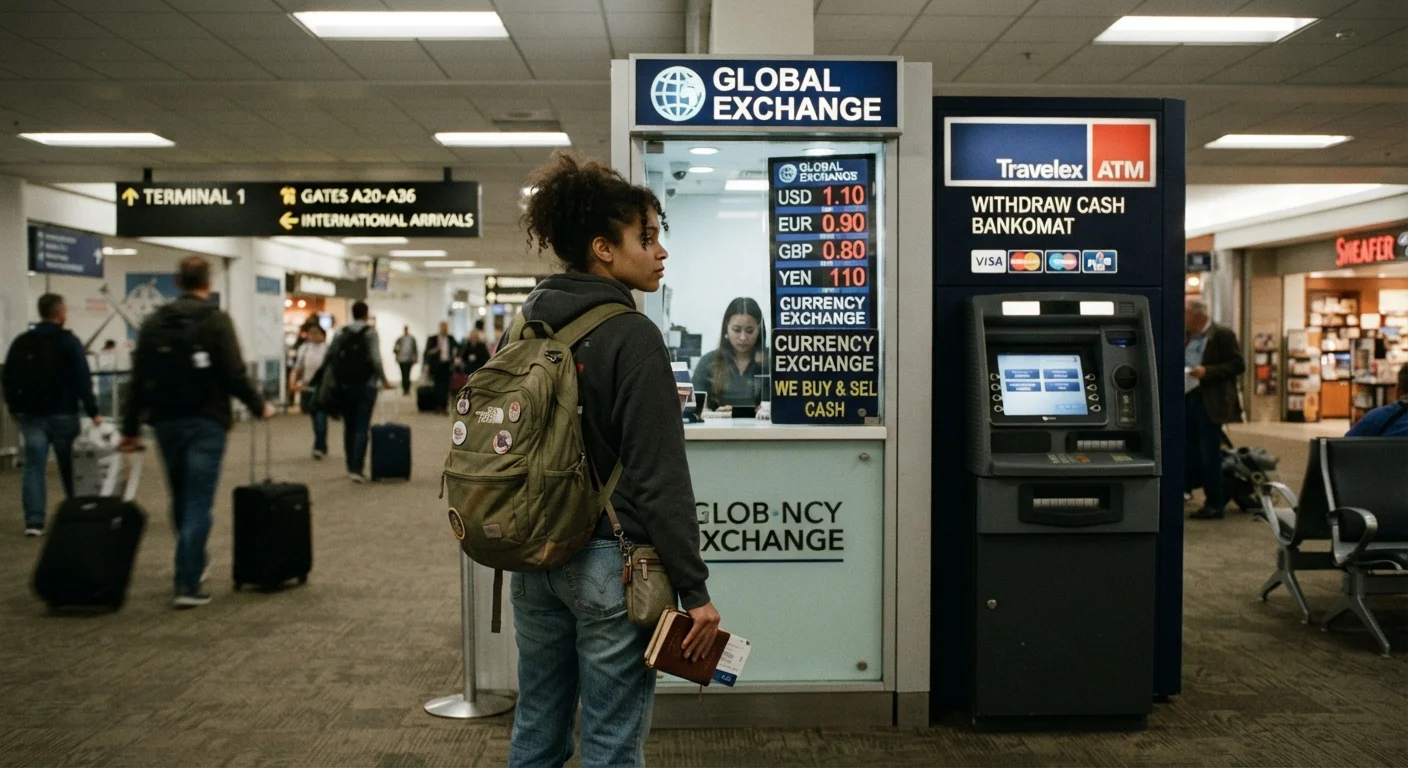
Currency exchange kiosks inside airports are hard to miss and open at almost any hour — which is exactly why travelers use them. But that convenience comes with a real cost. Airport kiosks consistently offer exchange rates that deviate further from the mid-market (interbank) rate than most other options, and many add a flat transaction fee on top.
It's worth noting that not all airport kiosks are equal — some located in city-side terminals or international arrival halls may offer marginally better rates than those inside secured departure areas. But as a general rule, you're paying a premium for location.
Never Convert to USD at a Foreign ATM or Kiosk
When an ATM or exchange kiosk offers to process your transaction in US dollars rather than local currency, it sounds helpful — but this is dynamic currency conversion, and the rate applied is almost always unfavorable. Always choose to be charged in the local currency and let your own bank handle the conversion. The savings can be meaningful even on a single transaction.
If you must use an airport kiosk, exchange only a small amount — enough to cover your transport and first meal. You can secure better rates once you're settled at your destination. Also, always decline any offer to lock in a rate in your home currency at the terminal; that's a practice called dynamic currency conversion, and it typically makes your exchange more expensive. Learn more in our article on dynamic currency conversion.
ATMs Abroad: Often Competitive, but Fee-Layered
Withdrawing local currency from an ATM at your destination is one of the most widely recommended approaches — and for good reason. The exchange rate applied is typically much closer to the mid-market rate than airport kiosks provide. However, the actual cost depends heavily on which fees stack up during the transaction.
A single international ATM withdrawal can trigger up to three separate charges: a foreign transaction fee from your home bank (often 1–3%), an ATM operator fee charged by the machine's owner, and potentially a currency conversion fee if you accept the ATM's offer to charge you in USD instead of local currency. That last one — dynamic currency conversion — should always be declined.
Students with accounts at banks or credit unions that reimburse international ATM fees, or that waive foreign transaction fees entirely, will get significantly more value from this method. For a full breakdown of how these fees layer, see our guide on ATM withdrawals abroad.
| Airport Kiosk | ATM Abroad | Home Bank Exchange | |
|---|---|---|---|
| Exchange rate quality | Furthest from mid-market | Close to mid-market | Moderate to good |
| Transaction fees | Flat fee + spread | Up to 3 layered fees | Often none for account holders |
| Convenience | Very high — available on arrival | High — widely available abroad | Requires advance planning |
| Planning required | None | Minimal | 1–3 business days ahead |
| Best use case | Emergency small amount only | Ongoing cash needs abroad | Pre-trip arrival cash |
| Risk of hidden costs | High | Medium (fee stacking) | Low |
Bank Exchange Before You Leave: The Underused Option
Exchanging currency at your home bank or credit union before your trip is a straightforward option many students overlook. Most major US banks will exchange common foreign currencies, often with no flat transaction fee for account holders. The exchange rate is generally better than airport kiosks, though it may not match the rate you'd get from an ATM at your destination.
The main drawback is lead time — some banks need a few business days to order less common currencies, and you'll need to plan ahead. For popular currencies like euros, British pounds, or Japanese yen, same-day or next-day availability is often possible.
This approach works particularly well as a supplement: exchange enough to cover your first day or two of expenses before departure, then rely on local ATMs for the rest. That way you're never scrambling for cash on arrival, and you're not over-converting at unfavorable rates. If you're hopping between multiple countries, our guide on managing money across multiple currencies covers how to plan ahead.
This article is for general informational purposes only. Exchange rates, fee structures, and bank policies vary and change over time. Always verify current terms with your bank or financial institution before traveling.
The content provided on our blog site traverses numerous categories, offering readers valuable and practical information. Readers can use the editorial team’s research and data to gain more insights into their topics of interest. However, they are requested not to treat the articles as conclusive. The website team cannot be held responsible for differences in data or inaccuracies found across other platforms. Please also note that the site might also miss out on various schemes and offers available that the readers may find more beneficial than the ones we cover.