

Our Verdict
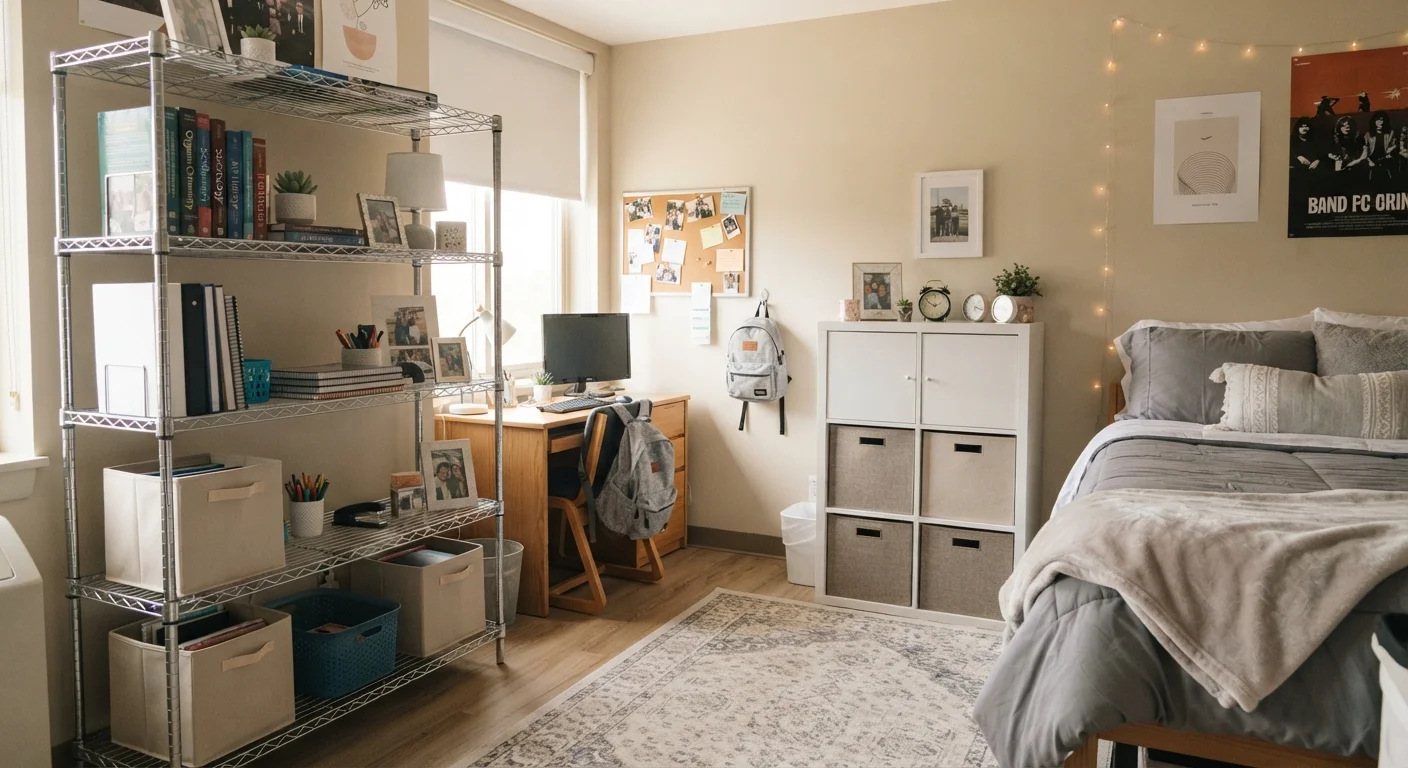
Neither open shelving nor closed storage is the universally better choice for a dorm room — each suits different habits and stuff. Open shelves work best when you're disciplined about tidying and need fast, visible access to frequently used items. Closed storage earns its keep when you have a mix of items you'd rather not put on display and when you share the room with someone who values a calm visual environment.
Students who want a practical, low-stress system will likely do best combining both: open shelves for textbooks and daily supplies, closed bins or drawers for clothing, toiletries, and anything that tends to accumulate.
Why Storage Choice Matters More in a Dorm Than Anywhere Else
A typical dorm room runs between 100 and 200 square feet — often shared with at least one other person. Every storage decision you make either adds usable space or steals it. More importantly, the wrong system can quietly raise stress levels: a cluttered visual field has been associated in environmental psychology research with increased feelings of overwhelm, which is the last thing you need during finals week.
Before choosing between open and closed storage, take stock of two things: what you actually own, and how you naturally behave. If your desk already has three half-finished projects on it, open shelving will amplify that tendency. If you tend to forget things unless you can see them, locking everything behind cabinet doors may cause you to miss items you need. See our space-planning guide for dorm rooms to measure and map what you're working with before committing to any system.
The Case for Open Shelving
Open shelves — wire cube units, floating ledges attached with adhesive strips, or freestanding bookcases — put your belongings in plain sight. That visibility is the core benefit.
Instant visibility speeds up your daily routine
When items are in plain view, you spend no time hunting for them. This matters most for frequently used supplies like notebooks, chargers, and reference books.
Easier to reconfigure as needs change
Open shelving units — especially modular wire or cube styles — can be rearranged or stacked differently without much effort, adapting to shifting semester demands.
Generally lighter and more portable
Freestanding open shelves are easier to move in and out of a dorm without risking damage deposits, and most require no tools or wall anchors.
Lower upfront cost for comparable capacity
Simple wire or plastic open shelving units tend to cost less than equivalently sized enclosed storage furniture, a real consideration on a student budget.
The practical upside shows up most clearly with textbooks, school supplies, and items you reach for multiple times a day. When everything is visible, you spend less time searching and more time working. Open shelving also tends to be lighter and easier to reconfigure as your needs shift across the semester. Many styles sit directly on the floor or desk surface, which keeps you within most dorms' no-drilling policies. Check out how to use vertical space effectively for approaches that maximize height without touching the walls.
The Case for Closed Storage
Closed storage — drawers, lidded bins, trunks, zipper cubes, or wardrobe units — conceals what's inside. That single quality drives most of its advantages.
Clutter is always on display
Any disorganization on an open shelf is immediately visible to you, your roommate, and anyone who visits — which can make a small room feel more chaotic than it is.
Items collect dust faster
Exposed surfaces accumulate dust more quickly than enclosed storage, meaning open shelves require more frequent wiping down to stay presentable.
Offers no visual privacy for personal items
Medications, personal documents, or items you'd simply prefer not to advertise are visible to anyone in the room, which can feel uncomfortable in a shared space.
Requires consistent tidying habits to look good
Open shelving only looks organized when you actively maintain it; a few busy weeks can leave it looking noticeably disheveled in a way that closed storage would hide.
If you share a room, closed storage can be a diplomatic tool as much as a practical one. A roommate who prefers a tidy visual environment will find it easier to live with bins and drawers than with a shelf displaying your snack collection and tangled charging cables. Closed storage also offers a layer of privacy for personal items like medication, financial documents, or anything you simply don't want visible to visitors. For no-drill solutions that still offer enclosed storage, dorm storage ideas that don't require a drill covers a range of renter-friendly options.
Check Your Dorm's Furniture Policy First
Many residence halls prohibit wall anchors, screws, or adhesive strips that leave residue — which rules out certain shelving installations. Some dorms also restrict freestanding furniture taller than a set height for fire safety reasons. Before purchasing any storage unit, review your housing agreement or contact your resident adviser to confirm what's permitted. Violating these rules can result in fines at move-out.
Making a Hybrid System Work
Most students end up with both types, intentionally or not. The goal is to make that mix deliberate rather than accidental.
A workable rule of thumb: items you use daily and that have a fixed, predictable spot (textbooks by subject, a water bottle, your laptop charger) belong on open shelves where you can grab them without thinking. Items that are irregular, personal, or visually messy (laundry, toiletries, off-season clothing, snacks) do better behind a door or inside a lidded bin.
~150 sq ft
Average US double dorm room size
The National Center for Education Statistics and campus housing surveys consistently place standard double occupancy dorm rooms in the 150–180 square foot range.
2-in-1
Storage types recommended by organizers
Professional organizers generally recommend combining open and closed storage in small spaces to balance accessibility with visual calm.
Coordinating with your roommate matters here too. A shared conversation at the start of the semester about visual preferences — not just storage preferences — can prevent friction later. Keeping a dorm room tidy when you share twelve feet of floor space offers practical frameworks for that kind of roommate coordination. If you're also weighing how your furniture layout affects storage decisions, lofting vs. bunking your bed is worth reading alongside this article.
The content provided on our blog site traverses numerous categories, offering readers valuable and practical information. Readers can use the editorial team’s research and data to gain more insights into their topics of interest. However, they are requested not to treat the articles as conclusive. The website team cannot be held responsible for differences in data or inaccuracies found across other platforms. Please also note that the site might also miss out on various schemes and offers available that the readers may find more beneficial than the ones we cover.