

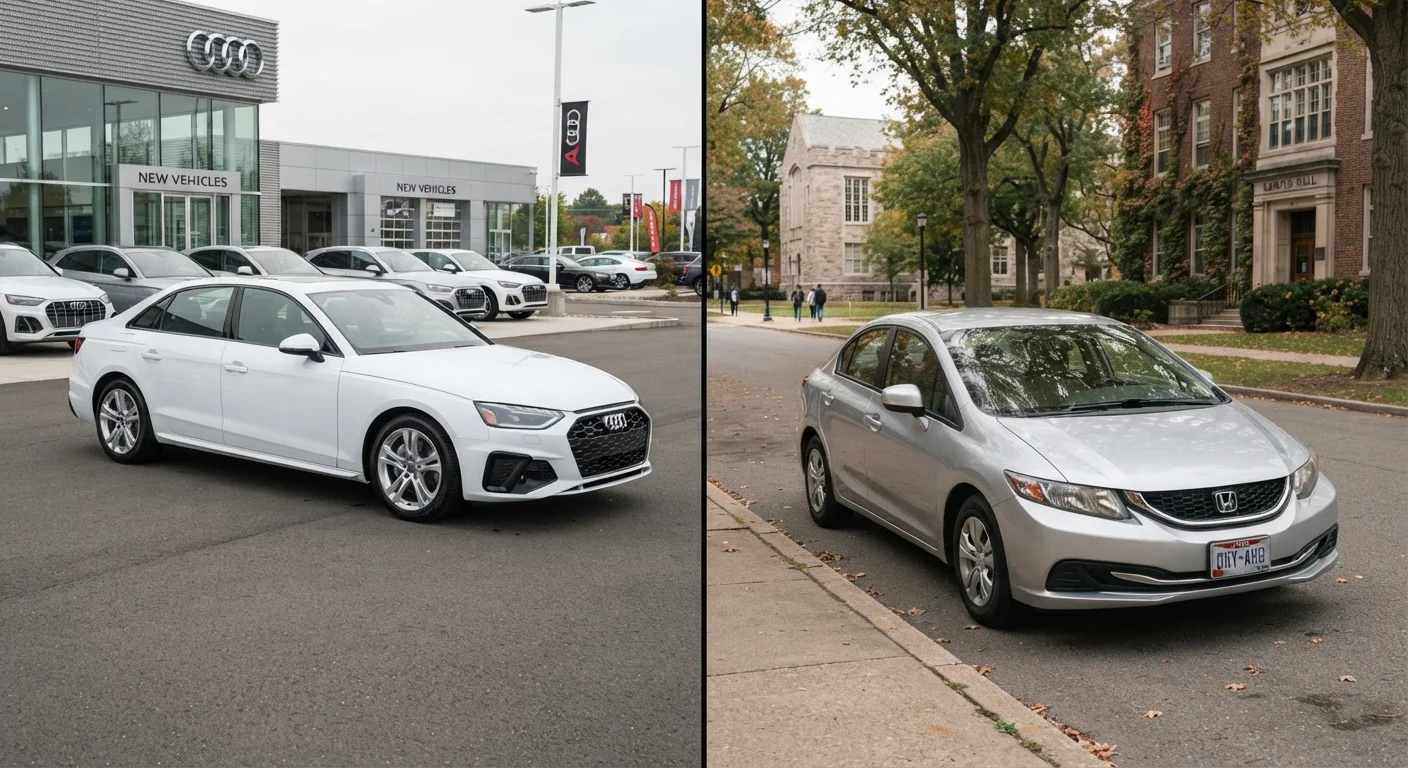
Our Verdict
For most students, a reliable used car in the two-to-five-year-old range offers the best balance of affordability and dependability - avoiding the steepest depreciation while still being recent enough to have modern safety features. A new car can make sense if you have strong financing terms, plan to keep it for many years, and want the peace of mind of a full warranty. Neither choice is universally superior; the right answer depends on your financial situation, commute needs, and risk tolerance.
Students on a tight monthly budget who need a dependable, low-cost-to-own vehicle will generally find the used market a better fit than buying new.
Why This Decision Matters More for Students
Choosing between a new and a used car is one of the first major financial decisions many college students make. Unlike most purchases, a car comes with a long tail of ongoing costs - insurance, fuel, maintenance, and loan payments - that can strain a student budget for years. Understanding the real trade-offs before you sign anything is essential.
For a full picture of what those ongoing costs look like, see our introduction to car ownership costs before going further. The new-vs.-used question feeds directly into almost every cost category covered there.
15-20%
New car value lost in year one
Industry estimates consistently show new vehicles lose a significant portion of their value within the first twelve months of ownership.
~$500+
Average monthly new-car payment (U.S.)
Experian's State of the Automotive Finance Market reports have tracked average new-car monthly payments rising steadily into the $500-$700+ range in recent years.
The Case for Buying New
New cars come with real advantages that are easy to underestimate when you're focused on the sticker price.
Full manufacturer warranty covers most early repairs
Most new cars include at least three years of bumper-to-bumper coverage, meaning mechanical failures in that window cost you nothing out of pocket.
Lower interest rates often available on new-car loans
Lenders and manufacturers sometimes offer promotional financing rates on new vehicles that aren't available for used cars, which can reduce total interest paid over the loan term.
Latest safety features included as standard
Automatic emergency braking, rearview cameras, and other driver-assistance technologies are now standard on most new models, offering meaningful safety benefits for newer drivers.
Predictable maintenance schedule in early years
Brand-new cars are unlikely to need significant repairs for the first several years, making it easier to budget monthly costs without surprises.
No unknown ownership history
You know exactly how the car has been driven, serviced, and treated - there's no risk of inheriting someone else's neglected maintenance.
Manufacturer warranties - typically three years bumper-to-bumper and five years on the powertrain - mean that most mechanical failures in the first few years are covered at no cost to you. That predictability has genuine value when you're living on a student income. Newer vehicles also tend to qualify for lower APR (interest rate) financing, sometimes as low as 0% through promotional offers from manufacturers, though those deals depend heavily on your credit history.
Modern safety technology - automatic emergency braking, lane-keep assist, and blind-spot monitoring - is now standard on many new models but absent or optional on cars made even five years ago. For a first-time driver, that added layer of protection matters.
The Case for Buying Used
For most students, the used market is where the practical math works out better.
Steep depreciation in the first year
New cars commonly lose 15-20% of their value within the first twelve months, meaning you absorb that loss immediately if you need to sell or trade in early.
Higher purchase price strains student budgets
The average new vehicle price in the U.S. has climbed significantly in recent years, making it difficult to keep monthly payments manageable on a part-time or entry-level income.
Higher insurance premiums due to greater replacement value
Comprehensive and collision coverage on a new car cost more because the insurer's potential payout is larger, adding to monthly expenses.
Older used cars may lack modern safety technology
Vehicles more than five years old often omit features like automatic emergency braking or lane-departure warnings that are now standard on new models.
Reliability risk increases with vehicle age
Wear and mechanical degradation accumulate over time; a used car is statistically more likely to need unplanned repairs, especially beyond 100,000 miles.
Higher loan interest rates on used vehicles
Lenders treat used-car loans as higher risk, which typically results in a higher APR than equivalent new-car financing - partially offsetting the lower purchase price.
The single biggest argument for used is depreciation. A new car can lose 15-20% of its value in the first year alone. When you buy a car that's two or three years old, the original owner has already absorbed that loss. You pay a lower price for a vehicle that still has most of its usable life ahead of it. For a plain-language explanation of how this works, our article on car depreciation breaks it down step by step.
Certified Pre-Owned: A Middle Ground
Many automakers offer Certified Pre-Owned (CPO) programs, which are used vehicles that have passed a manufacturer inspection and come with an extended limited warranty. CPO cars typically cost more than standard used cars but less than new ones, and they reduce some of the reliability uncertainty. If you're concerned about repair risk on an older used car but can't afford new, a CPO vehicle is worth investigating - just read the warranty terms carefully, as coverage varies by manufacturer and program.
Insurance premiums on used cars are generally lower because the vehicle's replacement value is lower. Comprehensive and collision coverage - the portions of your policy that pay to repair or replace your car - are priced partly based on what the car is worth. A three-year-old vehicle typically costs meaningfully less to insure than its brand-new equivalent.
Where the Numbers Actually Diverge
Monthly payment comparisons between new and used can be misleading. A lower purchase price on a used car doesn't automatically mean a lower total cost, because used-car loans often carry higher interest rates and shorter terms. Run the full loan calculation - principal, rate, and term - before comparing options.
Maintenance costs trend higher as cars age, and older used vehicles may not be covered by any remaining warranty. A single unexpected repair - a transmission issue, for example - can wipe out months of savings from a lower monthly payment. Budgeting a small repair fund each month is a sensible safeguard. For a broader view of the costs students commonly overlook, see our guide to car ownership costs that students often don't budget for.
The financial case for and against owning a car in college is worth reading alongside this comparison - it puts the new-vs.-used decision inside the bigger question of whether a car makes financial sense for your situation at all.
This article is for general informational and educational purposes only and does not constitute financial or purchasing advice. Financing terms, insurance rates, and vehicle values vary widely by individual circumstances. Consult a licensed financial professional before making significant financial decisions.
The content provided on our blog site traverses numerous categories, offering readers valuable and practical information. Readers can use the editorial team’s research and data to gain more insights into their topics of interest. However, they are requested not to treat the articles as conclusive. The website team cannot be held responsible for differences in data or inaccuracies found across other platforms. Please also note that the site might also miss out on various schemes and offers available that the readers may find more beneficial than the ones we cover.