

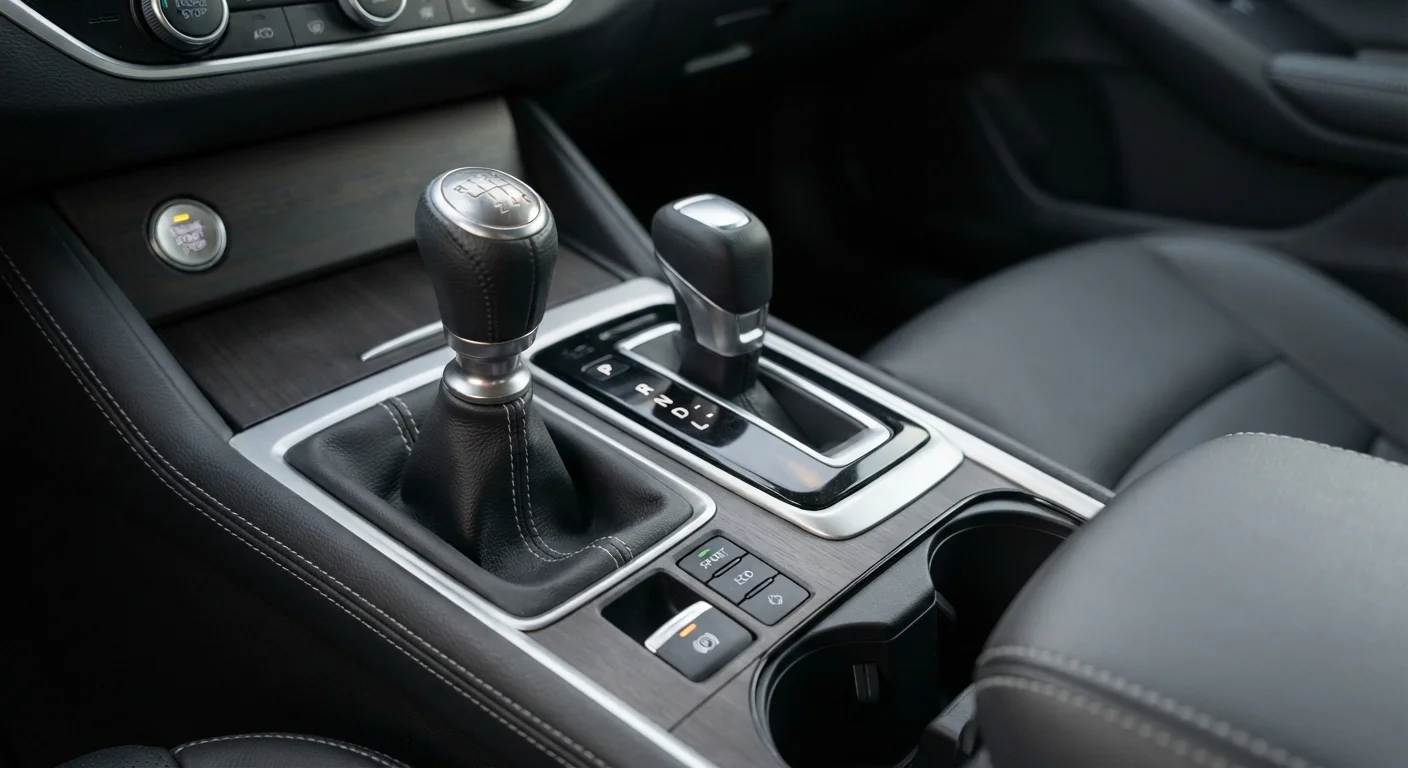
Option A
Manual Transmission
The hands-on, driver-controlled gearbox.
Best for: Drivers who want more control over the vehicle and are comfortable operating a clutch pedal.
Option B
Automatic Transmission
The self-shifting, convenience-focused system.
Best for: Drivers who prioritize ease of use, especially in heavy traffic or hilly urban environments.
What Actually Differs Between the Two
At its core, a transmission's job is to transfer power from the engine to the wheels at the right ratio for your speed. For a fuller picture of how the engine and drivetrain connect, see our plain-language guide to how cars actually work.
In a manual transmission, the driver presses a clutch pedal to temporarily disconnect the engine from the drivetrain, selects a gear with the gear lever, then releases the clutch to re-engage. This happens every time you accelerate, slow significantly, or stop. In a automatic transmission, a hydraulic system called a torque converter - along with onboard sensors - handles all of that automatically. You select Drive, and the car does the rest.
The mechanical difference is significant: manuals have a clutch disc that wears over time, while automatics rely on transmission fluid, a torque converter, and a more complex valve body to manage shifting.
| Criterion | Manual Transmission | Automatic Transmission |
|---|---|---|
| Driver input required | Clutch + gear selection every shift | Select Drive; car shifts itself |
| Learning curve | Steeper; stalling is common early on | Gentler; easier for beginners |
| City/stop-go traffic | More tiring; constant clutch use | Easier; no clutch management |
| Fuel economy (modern vehicles) | Comparable; advantage narrowed | Often equal or better with CVT/8-speed |
| Typical maintenance concern | Clutch disc wear and replacement | Transmission fluid changes |
| Upfront vehicle cost | Generally lower sticker price | Generally higher sticker price |
| Driving flexibility | Can drive both manual and automatic | Limited to automatic only |
Day-to-Day Driving Experience
The gap between the two transmission types is felt most on ordinary drives. In a manual, every red light, parking maneuver, and hill start requires active input. This can feel engaging on open roads but genuinely exhausting during a long campus commute with frequent stops. Stalling - where the engine cuts out if the clutch is released too quickly - is a real concern for new drivers.
Automatic vehicles remove that friction. You brake, stop, and go without managing a third pedal. For students juggling a coffee, a phone mount, and an unfamiliar parking structure, that simplicity has genuine value.
That said, many drivers report that manuals offer a greater sense of connection to the vehicle - you're choosing your gear, modulating engine braking, and actively participating in how the car behaves. Neither experience is objectively better; they suit different temperaments and commutes.
~96%
U.S. new car sales that are automatic
According to industry data, automatic transmissions now account for the vast majority of new passenger vehicles sold in the United States.
50k-100k miles
Typical clutch lifespan on a manual
Clutch longevity varies widely based on driving style, traffic conditions, and vehicle type - city driving tends to accelerate wear.
Fuel Economy and Running Costs
Historically, manuals had a clear fuel-efficiency advantage because drivers could optimize gear selection. Modern automatics - especially those with six or more gears and continuously variable transmissions (CVTs) - have largely closed that gap. In many newer vehicles, the automatic version actually matches or outperforms the manual on EPA fuel economy ratings.
Cost differences show up more clearly in maintenance. A clutch on a manual transmission typically needs replacement every 50,000-100,000 miles depending on driving style, and that repair can run several hundred dollars at a shop. Automatic transmissions generally require periodic fluid changes, which are less dramatic in cost but still essential - neglecting them can lead to expensive internal damage. For a broader look at what mechanics actually recommend on service intervals, see our maintenance myths vs. reality guide.
If you're weighing transmission type alongside broader ownership costs, fuel type is another major variable worth understanding - our gas vs. electric running cost comparison breaks that down clearly.
Which Transmission Makes Sense for a Student Driver?
There's no universally correct answer, but a few factors apply directly to the college context. If your campus is in a dense city with grid traffic, an automatic reduces daily fatigue. If you're buying an older used vehicle on a tight budget, manuals tend to be cheaper upfront and are common in the used market. If you're renting cars internationally or borrowing vehicles from family, manual skills expand your options considerably.
Consider where you'll actually drive most - parking decks, highway commutes, hilly neighborhoods - and be honest about your current skill level. Learning to drive a manual is absolutely achievable, but it requires dedicated practice time, ideally in a low-stakes environment like an empty lot.
For context on the mechanical components involved in either system, the anatomy of a car reference guide covers transmission-related parts in plain language. Whatever you choose, understanding how your vehicle works puts you in a stronger position as a first-time owner.
The content provided on our blog site traverses numerous categories, offering readers valuable and practical information. Readers can use the editorial team’s research and data to gain more insights into their topics of interest. However, they are requested not to treat the articles as conclusive. The website team cannot be held responsible for differences in data or inaccuracies found across other platforms. Please also note that the site might also miss out on various schemes and offers available that the readers may find more beneficial than the ones we cover.