

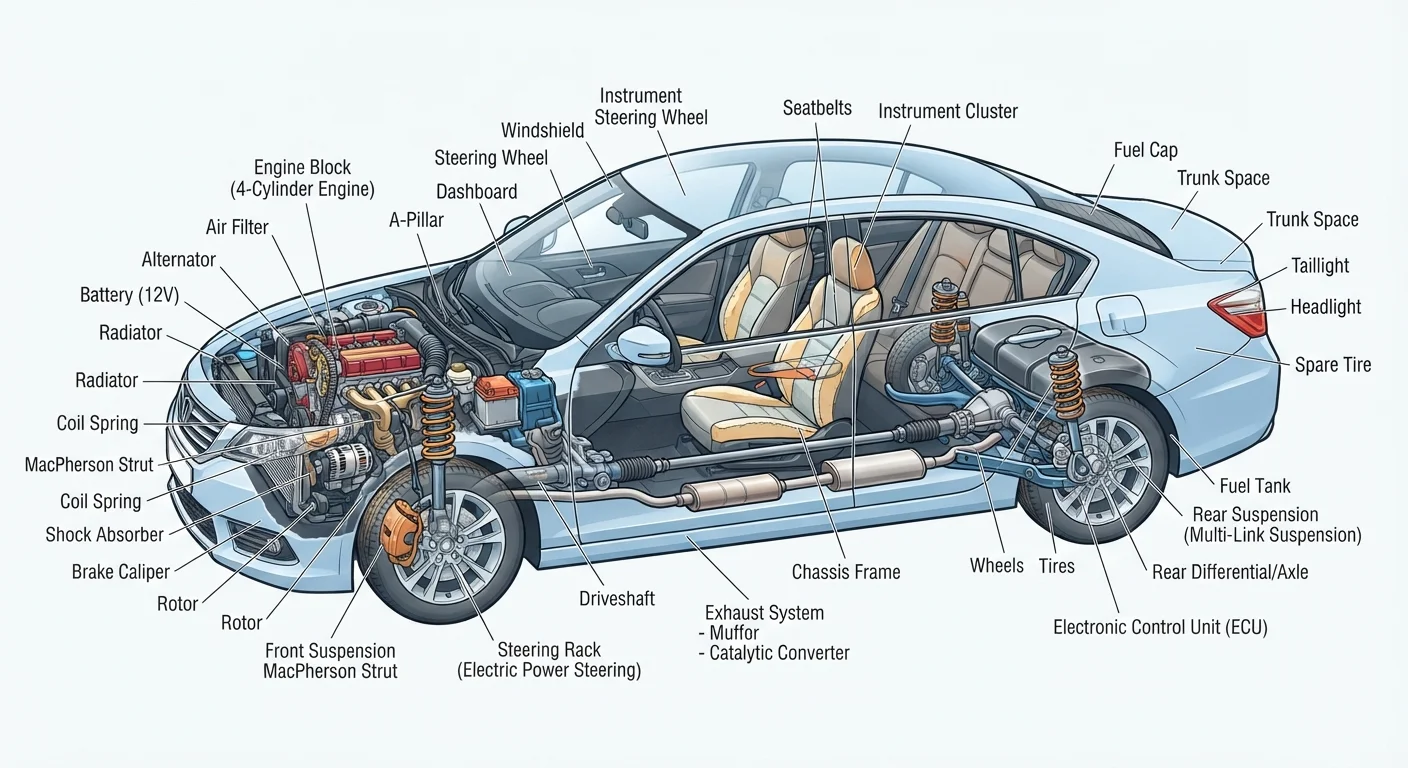
Why Knowing Your Car's Parts Matters
You don't need to be a mechanic to own a car - but knowing what each major component does gives you a real advantage. You'll recognize warning signs sooner, ask better questions at the shop, and avoid being caught off guard by repair bills. Think of this guide as your foundational reference: a plain-language map of the systems that keep a car moving safely.
For a deeper look at how these systems work together, see our plain-language guide to how cars actually work. And if you're still budgeting for ownership, a student's first look at car ownership costs explains what to plan for financially.
| Major system categories | Powertrain, Electrical, Fuel, Braking, Suspension, Cooling, Exhaust |
| Most common breakdown cause | Battery failure (AAA roadside assistance data) |
| Typical brake pad lifespan | 25,000-65,000 miles (varies by driving style) |
| Engine coolant flush interval | Every 30,000-50,000 miles (check owner's manual) |
| Tire tread minimum (U.S.) | 2/32 inch - replace at or before this depth (NHTSA guidelines) |
The Powertrain: Making the Car Move
The powertrain is the collection of components that generate and deliver power to the wheels. Its core elements include:
- Engine: Burns a mixture of fuel and air to produce mechanical energy. Most student cars use a four-cylinder gasoline engine. The engine's displacement (measured in liters) gives a rough sense of its power output.
- Transmission: Transfers power from the engine to the wheels and manages gear ratios so the engine operates efficiently at different speeds. Automatic transmissions handle gear changes on their own; manuals require the driver to shift using a clutch pedal.
- Drivetrain: The shafts, axles, and differentials that carry power from the transmission all the way to the wheels. Front-wheel drive (FWD) is common on smaller, fuel-efficient cars.
Powertrain
The group of components - engine, transmission, and drivetrain - that generate power and deliver it to the wheels.
Alternator
A generator driven by the engine that produces electricity to recharge the battery and power the car's electrical systems while the engine is running.
Suspension
The system of springs, shock absorbers, and linkages connecting the wheels to the vehicle frame, absorbing road impact and maintaining tire contact with the surface.
Catalytic Converter
An emissions control device in the exhaust system that converts harmful combustion gases (such as carbon monoxide and hydrocarbons) into less harmful substances before they exit the tailpipe.
Displacement
The total volume swept by all pistons inside an engine's cylinders, measured in liters or cubic centimeters. Larger displacement generally means more power but also higher fuel consumption.
Brake Fluid
A hydraulic fluid that transmits pressure from the brake pedal through the braking system to the brake pads or shoes, enabling the car to slow down.
Electrical and Fuel Systems
Modern cars rely on two interconnected systems to start and run consistently:
- Battery: Stores electrical energy and powers the starter motor that gets the engine running. A dead battery is one of the most common roadside issues students encounter.
- Alternator: Once the engine is running, the alternator generates electricity to recharge the battery and power onboard electronics. If the alternator fails, the battery drains quickly.
- Fuel system: Includes the fuel tank, fuel pump, and fuel injectors. The pump draws gasoline from the tank; injectors spray a precise mist of fuel into the engine's cylinders for combustion.
Check Engine Light: Don't Ignore It
The check engine light can signal anything from a loose gas cap to a failing catalytic converter or oxygen sensor. While it doesn't always mean immediate danger, leaving it unaddressed can turn a minor fix into a costly repair. If the light is flashing rather than steady, that typically indicates a more urgent issue - have the car inspected by a qualified mechanic promptly.
Safety and Control Systems
These components determine how well a car stops, steers, and handles unexpected road conditions:
- Brakes: Most cars use disc brakes on the front wheels and either disc or drum brakes on the rear. Pressing the brake pedal forces brake pads against a rotor, creating friction that slows the wheel. Brake fluid transmits the pressure hydraulically.
- Suspension: A network of springs, shock absorbers, and linkages that keeps the tires in contact with the road and absorbs bumps. Worn suspension makes rides rougher and reduces steering precision.
- Steering system: Translates movement of the steering wheel into directional changes at the front tires. Most modern cars use power-assisted steering, which reduces the effort required.
- Tires: The only part of the car touching the road. Proper inflation, adequate tread depth, and correct alignment all affect braking distance, fuel economy, and handling.
Understanding these systems also helps when shopping for car insurance, since coverage decisions often involve knowing what components may need repair after an incident.
44%
Of roadside breakdowns caused by tire issues or battery failure
According to AAA's annual roadside assistance report, these two categories consistently rank as the leading causes of calls for help.
30,000 mi
Typical interval for first major maintenance check
Many manufacturers recommend a comprehensive inspection around 30,000 miles, covering filters, fluids, and belts.
Cooling and Exhaust: Managing Heat and Emissions
Combustion generates enormous heat. Without proper management, an engine would destroy itself in minutes.
- Cooling system: Circulates coolant (a mix of water and antifreeze) through the engine block and into a radiator, where heat is transferred to the outside air. The thermostat regulates coolant flow to maintain optimal operating temperature.
- Exhaust system: Channels waste gases out of the engine, through the catalytic converter (which reduces harmful emissions), and out through the muffler and tailpipe. A failing catalytic converter often triggers a check-engine light and can affect emissions test results.
For a full breakdown of maintenance costs tied to these systems, see student car costs at a glance.
The content provided on our blog site traverses numerous categories, offering readers valuable and practical information. Readers can use the editorial team’s research and data to gain more insights into their topics of interest. However, they are requested not to treat the articles as conclusive. The website team cannot be held responsible for differences in data or inaccuracies found across other platforms. Please also note that the site might also miss out on various schemes and offers available that the readers may find more beneficial than the ones we cover.