

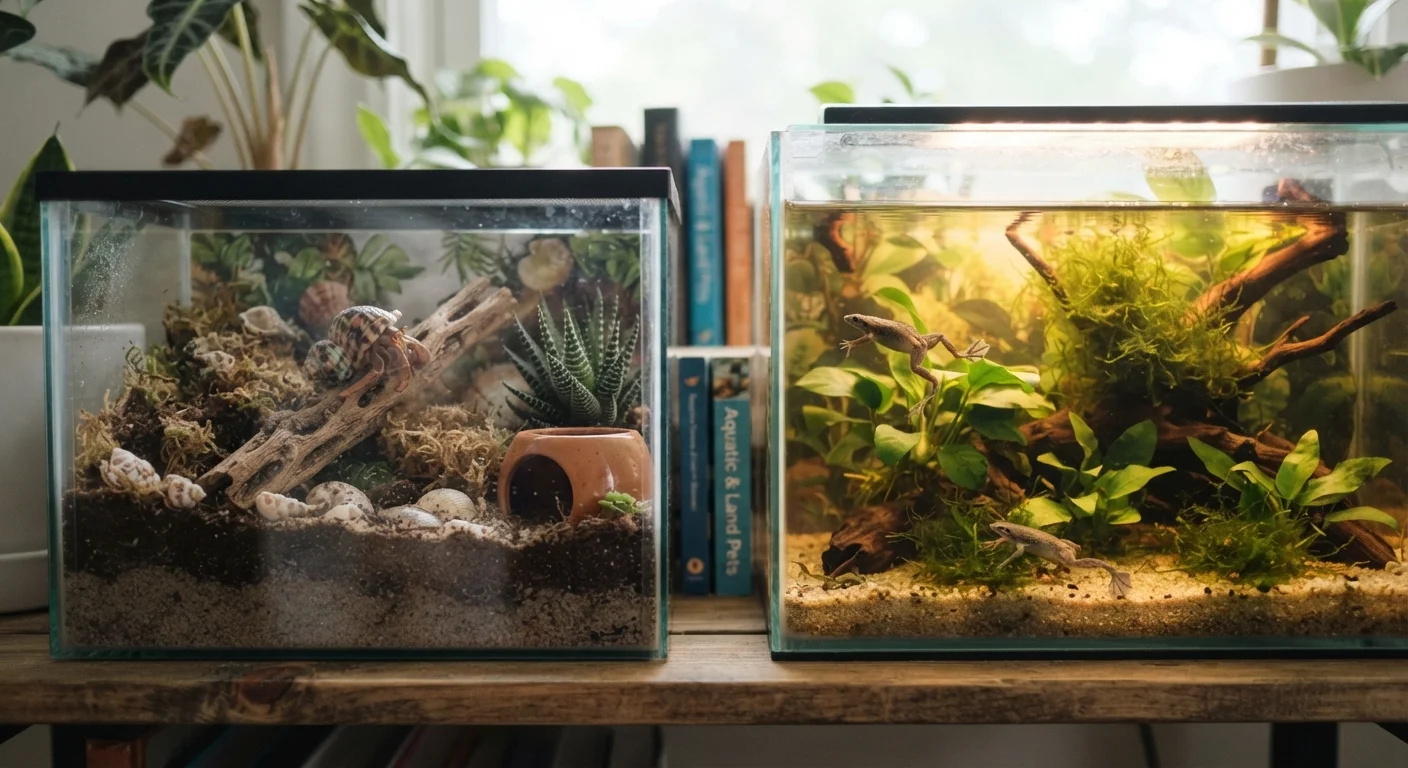
Option A
Hermit Crab
The hands-on, habitat-sensitive choice.
Best for: Students who enjoy setting up and maintaining a specialized environment and want occasional low-key interaction.
Option B
African Dwarf Frog
The quiet, fully aquatic, mostly observe-don't-touch option.
Best for: Students who want a living, moving pet they can watch without handling or complex terrarium management.
What You're Really Signing Up For
Both hermit crabs and African dwarf frogs are marketed as easy starter pets, and both appear regularly on dorm-permitted animal lists. But the reality of caring for each is more nuanced than the pet store display suggests. Understanding what each animal genuinely needs - before you bring one home - is the most important step you can take.
For a broader look at how small pets stack up across time, cost, and daily effort, see our comparison of small pet care demands.
| Criterion | Hermit Crab | African Dwarf Frog |
|---|---|---|
| Environment type | Humid terrestrial enclosure | Cycled freshwater aquarium |
| Minimum setup complexity | Moderate-high (humidity, substrate, shells) | Moderate (nitrogen cycle, heater, filter) |
| Typical lifespan | 10+ years with proper care | 5-10 years |
| Handling | Possible, but limited | Not recommended |
| Noise level | Low (nighttime scratching) | Very low (male humming possible) |
| Social needs | Better kept in pairs or groups | Can be kept in small groups |
| Diet | Omnivore; benefits from variety | Carnivore; frozen/sinking foods |
| Primary maintenance task | Humidity and temperature monitoring | Weekly partial water changes |
Habitat Requirements: More Complex Than the Packaging Suggests
Hermit crabs are land animals that require a carefully managed terrestrial enclosure. They need a substrate deep enough to allow full burial during molting - generally at least six inches of a sand-and-coconut fiber mix. Humidity must be kept between roughly 70-80%, and temperature should stay around 72-80°F. Failing to meet these conditions, particularly during molting, can be fatal. You'll also need to provide multiple spare shells in varying sizes, since hermit crabs change shells as they grow.
African dwarf frogs, by contrast, are fully aquatic - they cannot survive on land. They need a cycled freshwater aquarium (a process that establishes beneficial bacteria and typically takes two to four weeks before the animal is introduced), a gentle filter, a heater to maintain water around 72-78°F, and a secure lid, since they are escape artists. A small aquarium of five gallons is generally considered a workable minimum for one or two frogs.
70-80%
Humidity range hermit crabs require
Consistent humidity within this range is considered essential for hermit crab health, particularly during the molting process.
5 gallons
Minimum aquarium size for African dwarf frogs
Many frog care resources recommend at least five gallons to maintain stable water parameters for one to two frogs.
2-4 weeks
Time to cycle a new aquarium
The nitrogen cycle - establishing beneficial bacteria before adding animals - typically takes two to four weeks and should not be skipped.
Neither animal tolerates neglect of its environment. The key difference is the type of monitoring required: hermit crabs demand attention to air conditions, while African dwarf frogs demand attention to water quality.
Feeding, Lifespan, and Day-to-Day Commitment
Hermit crabs are omnivores and benefit from dietary variety - commercial pellets supplemented with fresh or dried fruits, vegetables, and protein sources. Fresh, dechlorinated water must always be available in both a freshwater dish and a saltwater dish (mixed with marine-grade salt, not table salt). Spot-cleaning the enclosure regularly and doing deeper cleans periodically keeps odors manageable.
African dwarf frogs are carnivores and typically accept frozen bloodworms, brine shrimp, or specially formulated sinking pellets. They are fed every one to two days. Partial water changes - usually around 25% weekly - help maintain water quality alongside the filter. They are sensitive to chlorine and copper, so tap water must be treated before use.
On lifespan: hermit crabs in proper captive conditions can live well over a decade - some reported cases exceed 20 years, though this is exceptional. African dwarf frogs typically live five to ten years. Both represent a commitment that may outlast your college years, which is worth considering seriously. Our article on the true cost of common dorm-friendly pets covers ongoing expense planning in more detail.
Interaction, Noise, and Roommate Considerations
Hermit crabs are most active at night and can produce audible scratching or shell-clinking sounds. They can be gently handled, though they may pinch if they feel insecure, and frequent handling is stressful for them. They are social animals and generally do better in pairs or small groups - a factor that affects both enclosure size and cost.
African dwarf frogs are quiet, though males do produce a soft humming or buzzing sound, particularly at night, as a mating call. They should not be handled - their skin is sensitive, and human hands introduce oils and bacteria that can harm them. They are enjoyable to watch, however, and their periodic dashes to the surface for air make them surprisingly engaging as display animals.
Always Confirm Your Dorm's Pet Policy First
Even animals that are widely considered "dorm-friendly" may be prohibited in specific residence halls or at particular universities. Policies differ not just by school but sometimes by building. Before purchasing any animal or equipment, get written confirmation from your housing office about which pets - and enclosure types - are permitted. Some schools restrict aquarium size, for example, which directly affects which setup is feasible for you.
If you're weighing other pet options for off-campus or dorm-adjacent living, the cats vs. dogs for dorm-adjacent living guide offers a useful contrast with higher-maintenance companions. For more compact-space options, small pets that fit real dorm life is a good next read.
The content provided on our blog site traverses numerous categories, offering readers valuable and practical information. Readers can use the editorial team’s research and data to gain more insights into their topics of interest. However, they are requested not to treat the articles as conclusive. The website team cannot be held responsible for differences in data or inaccuracies found across other platforms. Please also note that the site might also miss out on various schemes and offers available that the readers may find more beneficial than the ones we cover.