

Start here
Why Dorm Pet Ownership Is Different
Next
Understanding Campus Pet Policies
Then
Which Pets Actually Work in a Dorm
Plan your budget
Budgeting for Your First Dorm Pet
Know the routine
Daily Care Realities for Student Owners
Take action
Before You Commit: Next Steps
Why Dorm Pet Ownership Is Different
Owning a pet in a dorm room is genuinely different from pet ownership in any other living situation. You are working within a shared, managed space with rules you did not write, a schedule that shifts constantly, and a physical environment often smaller than 200 square feet. Understanding these constraints upfront is the most important thing a first-time student owner can do.
Pet ownership in college carries demands most students underestimate - time, money, and the emotional weight of being responsible for a living creature during one of the most demanding periods of your life. This guide helps you figure out whether a dorm pet is genuinely right for you, and if so, which kind makes sense.
Bioload
The amount of waste an animal produces in its environment. Higher bioload means more frequent tank or enclosure cleaning to keep water or air quality safe for the animal.
Emotional Support Animal (ESA)
An animal that provides emotional comfort to a person with a documented mental health condition. ESAs have specific legal recognition in housing contexts but are not the same as service animals or ordinary pets.
Housing contract
The formal agreement between a student and their university's housing office. It specifies the rules for what is and is not allowed in residence halls, including pet policies.
Exotic animal vet
A veterinarian with specialized training in treating animals other than cats and dogs - such as reptiles, birds, and small mammals. Their services often cost more than a standard vet visit.
Temperature gradient
A range of temperatures within a reptile's enclosure that allows the animal to move between warmer and cooler zones to regulate its own body temperature naturally.
Understanding Campus Pet Policies
Before you research a single species, you need to read your housing contract. Campus pet policies vary dramatically - some schools allow only fish under a certain tank size, others permit small caged mammals in select residence halls, and many ban all animals except service animals recognized under the Americans with Disabilities Act (ADA).
Emotional support animals (ESAs) are a separate category from pets. They may be permitted in campus housing through an accommodations process, but they are not automatically allowed, and approval is never guaranteed. Attempting to register a pet as an ESA without a legitimate need is both dishonest and increasingly scrutinized by institutions.
Campus pet policies have fine print that catches many students off guard - know what yours says before you commit to an animal. Contact your housing office directly and get any permissions in writing.
Never assume verbal permission is enough
A resident advisor saying "fish are probably fine" is not the same as written permission in your housing agreement. If your animal is found in violation of policy, you - not your RA - are responsible for the consequences. Always get confirmation of what is permitted from your official housing office before acquiring any pet.
Which Pets Actually Work in a Dorm
Given typical dorm constraints, the most realistic options tend to fall into a few categories:
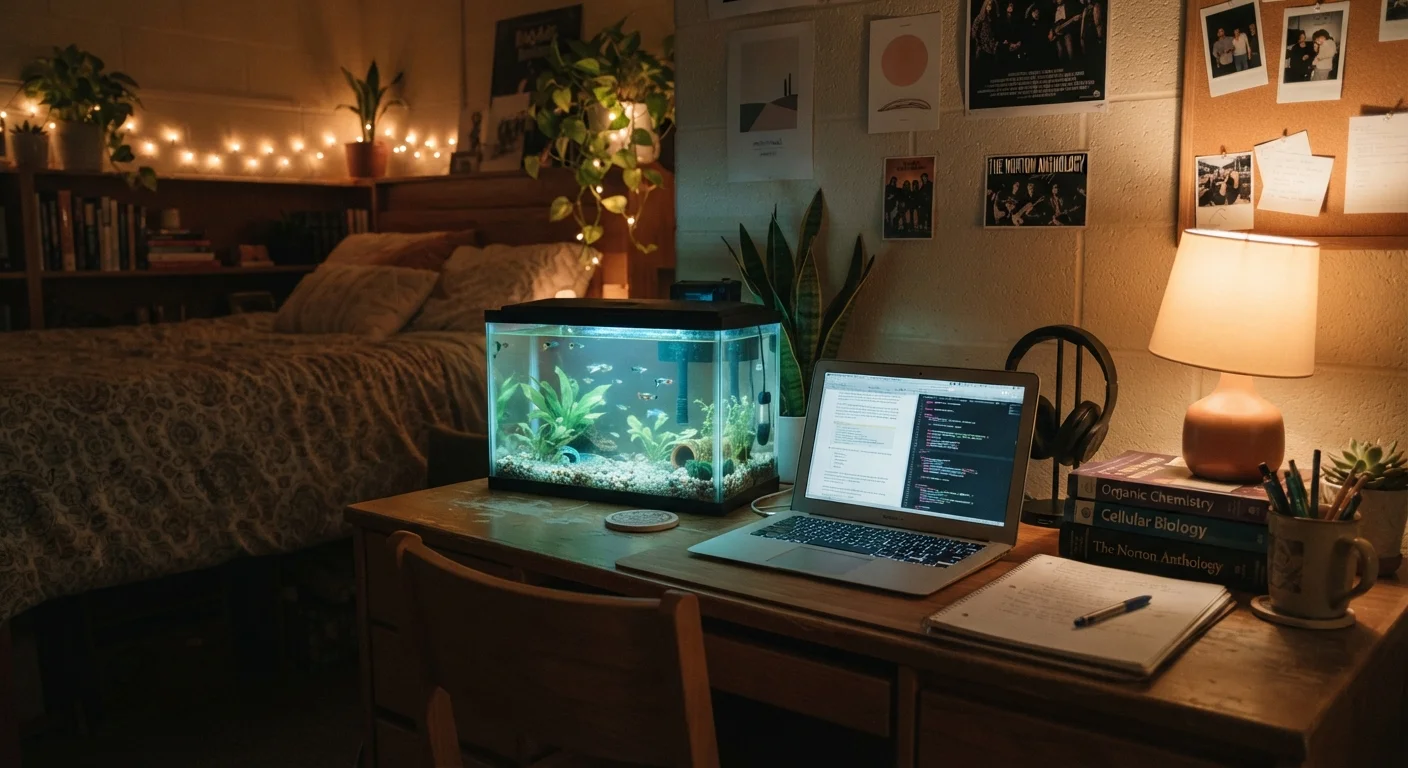
- Betta fish: Hardy, visually engaging, and manageable in a 5-gallon tank. Bettas are solitary and do not require companions, making them well-suited to small spaces. They still need a heater, a filter, and regular water changes.
- Freshwater snails or shrimp: Often permitted alongside fish, and useful for keeping a tank clean. Minimal handling required, low bioload.
- Small reptiles (where permitted): Leopard geckos and crested geckos can thrive in a 20-gallon enclosure, are quiet, and tolerate a student's irregular schedule better than mammals. Verify your school allows reptiles - many do not.
- Small caged mammals (where permitted): Hamsters and gerbils are popular, but they are nocturnal and can be disruptive to sleep. Guinea pigs are social and require more space and daily attention than most students expect.
Dogs and cats are not realistic for most standard dorm rooms, regardless of what individual students manage to arrange. For a deeper look at those options for off-campus students, see our comparison of cats and dogs for college living.
Match the pet to your actual schedule
Write down a realistic version of your weekly routine - including late nights, early classes, and frequent overnights. Then check that routine against the care requirements of any pet you are considering. A pet that fits your life as it actually is will be far easier to care for responsibly than one chosen for how you hope your life will look.
Budgeting for Your First Dorm Pet
Every pet involves both upfront setup costs and ongoing monthly expenses. Many first-time owners underestimate the startup investment for even a simple aquarium. A reasonable estimate for a betta fish setup runs $60-$150 depending on equipment quality. Reptile enclosures with proper lighting and temperature control can cost $150-$300 or more to set up correctly.
Monthly costs are typically lower but add up: food, water conditioner, replacement filter media, and occasional veterinary expenses. Reptiles may require live or frozen feeder insects, which need their own sourcing plan.
Vet care is the cost most students forget entirely. Even small animals can require veterinary attention, and exotic animal vets - those who treat reptiles, birds, or small mammals - often charge more per visit than dog-and-cat clinics. Factor this into your decision honestly before acquiring any animal.
This article provides general financial information for planning purposes only. Actual costs depend on your specific situation, location, and the needs of the individual animal.
Daily Care Realities for Student Owners
The most sustainable dorm pet is one whose care requirements genuinely fit your schedule - not the schedule you wish you had. Ask yourself honestly: How many nights per week are you out late or sleeping elsewhere? When are your exam blocks? What happens during winter break or spring break?
Fish require water changes typically once per week and feeding once or twice daily. Reptiles need temperature gradients maintained consistently, even when you are not home. Mammals need daily feeding, fresh water, and regular cage cleaning that cannot be skipped.
Break periods are one of the most overlooked challenges. You need a concrete care plan for every animal before you acquire it - not a vague intention to figure it out later. A readiness checklist can help you confirm you have covered every essential before your pet arrives.
Your roommate's comfort also matters. Discuss any plans with them early - noise, allergies, and shared space expectations are real issues that can affect both your friendship and your housing situation.
Roommate consent matters
Even if your school permits a specific type of pet, your roommate may have allergies, fears, or strong preferences that make cohabiting with an animal genuinely difficult for them. Having an open conversation before you bring any animal into a shared space is both respectful and practical - it protects the animal, your roommate, and your living situation.
Before You Commit: Next Steps
If you have worked through this guide and still feel confident, here is a simple order of operations: confirm your housing policy in writing, discuss with your roommate, set a realistic budget, research the specific species care requirements in depth, and then acquire your pet from a reputable source.
Avoid impulse decisions - especially around the start of the semester when excitement is high and the reality of coursework has not yet set in. Common first-timer mistakes are predictable and avoidable if you take the time to prepare.
For more guidance on the full scope of what student pet ownership involves, our basic pet care hub is a good ongoing resource. And if you are still figuring out your dorm room setup more broadly, understanding what your dorm room will actually look like is a useful place to start.
AVMA Pet Ownership Resources
The American Veterinary Medical Association publishes general guides on responsible pet ownership, including care basics for a wide range of species. A good reference for first-time owners researching any animal.
Your University Housing Office
The single most important resource for confirming what is actually permitted in your specific residence hall. Contact them directly - not through secondhand student accounts - before acquiring any animal.
Frequently Asked Questions
Most residence halls permit only fish in small tanks (commonly 10-20 gallons or under). Some schools also allow small caged animals like hamsters or guinea pigs in specific buildings. Always verify with your housing office in writing - policies vary widely by institution.
Emotional support animals (ESAs) may be permitted in housing under certain accommodations processes, but they are not automatically allowed and are not the same as pets. Students typically need to go through their school's disability or accommodations office and provide relevant documentation. Requirements differ by institution.
A basic betta fish setup - tank, filter, heater, light, and substrate - typically costs $50-$120 upfront. Monthly costs for food, water conditioner, and occasional supplies are generally under $10. Unexpected illness or equipment failure can add to this.
Consequences vary by school but commonly include fines, required removal of the animal, and a formal housing violation on your record. Repeat violations can affect your housing eligibility. It is not worth the risk to the animal or to your academic standing.
This is one of the most overlooked challenges. You need a confirmed plan before you acquire any pet - whether that means a trusted friend, a family member, or a professional pet sitter. Many animals cannot safely be left alone for days or weeks without care.
Both require more daily interaction and maintenance than a fish - including regular cage cleaning, fresh food, and social time. Guinea pigs in particular are social animals that often do better in pairs. They may also be louder at night, which can affect both you and your roommate.
The content provided on our blog site traverses numerous categories, offering readers valuable and practical information. Readers can use the editorial team’s research and data to gain more insights into their topics of interest. However, they are requested not to treat the articles as conclusive. The website team cannot be held responsible for differences in data or inaccuracies found across other platforms. Please also note that the site might also miss out on various schemes and offers available that the readers may find more beneficial than the ones we cover.