

Our Verdict
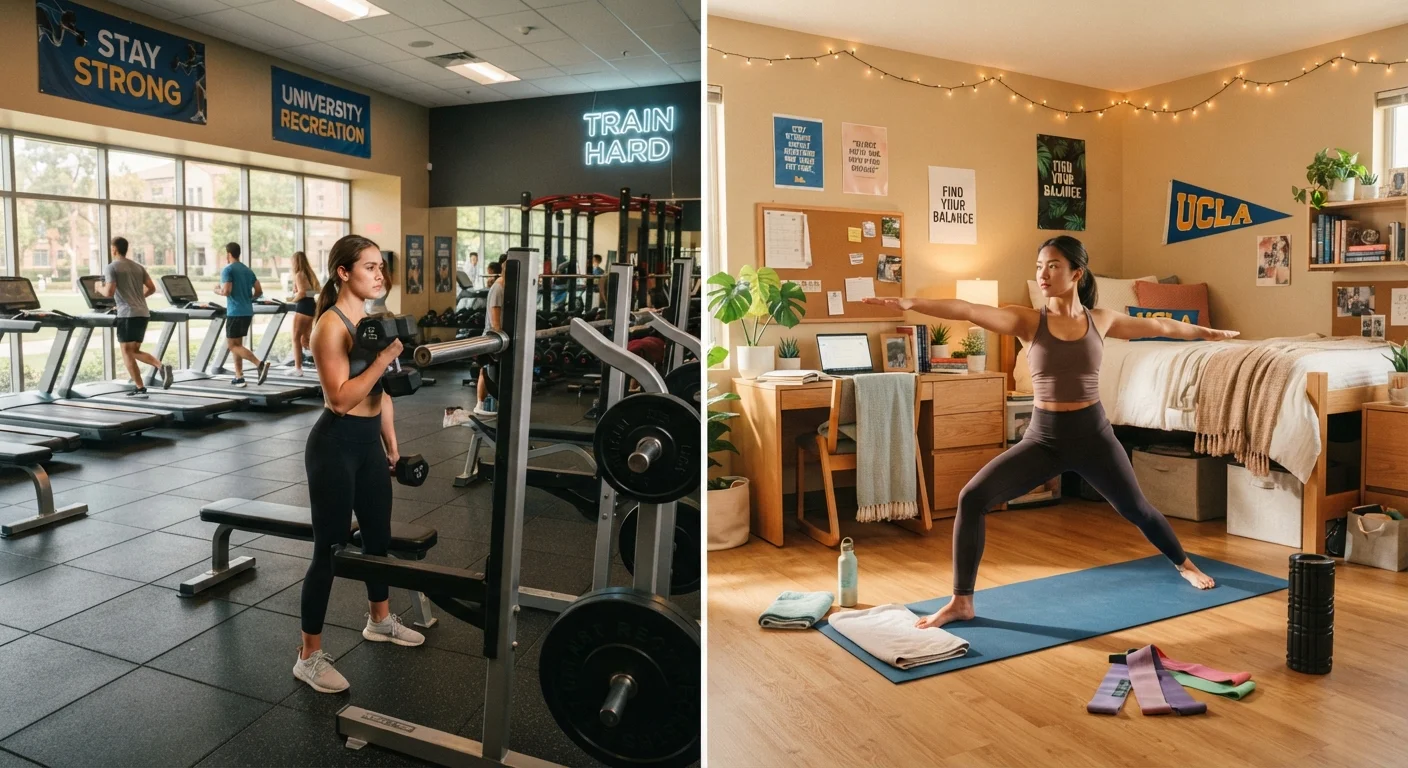
Neither the campus gym nor a dorm-room setup is universally better - each fits a different kind of student. The gym wins on equipment and social energy; home wins on convenience and zero commute. For most students, using both strategically produces the most sustainable routine.
| Best for | Recommended |
|---|---|
| Students who thrive on structure and social motivation | Campus Gym |
| Students with packed schedules or early morning or late-night windows | Dorm-Room Workouts |
| Students focused on building strength or specific fitness goals | Campus Gym |
| Students who want a low-barrier daily movement habit | Dorm-Room Workouts |
The Real Friction Points of College Fitness
Getting to the gym sounds simple - until a 9 a.m. class runs long, the rec center closes at 10 p.m., and your roommate is already asleep. College fitness doesn't fail because students stop caring; it usually fails because the logistics quietly pile up. Understanding where each option actually breaks down is the first step to building something that sticks.
Before assuming one approach beats the other, it helps to check common assumptions about what exercise has to look like. Our piece on fitness myths that circulate every college campus is a good reality check - many students over-complicate things based on ideas that don't hold up to evidence.
Campus Gym: The Case For and Against
Most schools include rec center access in student fees, so the financial barrier is lower than many students realize. The real currency you spend is time and energy - getting there, waiting for equipment, and getting back can add 30-45 minutes to any workout.
On the upside, a campus gym typically offers:
- Free weights, machines, and cardio equipment you simply can't replicate in a dorm room
- Group fitness classes, which research consistently links to higher exercise adherence
- A social environment that some students find motivating
- Dedicated space that mentally separates "workout mode" from study or sleep space
The downsides are just as real. Peak hours - typically late afternoon and early evening - can mean crowded equipment and wait times. If the gym is across campus and your only available window is between two classes, that window may not be long enough. Hours can also be limited around holidays and finals.
| Campus Gym | Dorm-Room Workout | |
|---|---|---|
| Equipment variety | High - weights, machines, cardio | Low - bodyweight and bands only |
| Commute required | Yes - 5-20 min each way | None |
| Cost | Usually covered by student fees | Low - minimal gear needed |
| Flexibility of hours | Limited by operating hours | Anytime, schedule permitting |
| Social / motivational energy | High - peers and classes | Low - self-directed only |
| Space required | No dorm space used | Small floor area needed |
| Noise/neighbor impact | None in your room | Potential concern for jumping moves |
Dorm-Room Workouts: What's Actually Possible in a Small Space
A standard dorm room offers roughly 150-200 square feet total - and you're sharing much of it. That said, effective bodyweight training requires surprisingly little floor space: a yoga mat's worth is often enough for push-ups, squats, lunges, planks, and core circuits. Resistance bands add meaningful variety without taking up drawer space.
Cardio vs. strength training for students who only have 30 minutes explores how to structure short sessions wisely - a useful framework for dorm workouts where you may have an even tighter window.
The biggest advantages of working out in your room:
- Zero commute - you can exercise in the time you'd spend walking to the gym
- No wait times or crowding
- Flexibility to work out at 6 a.m. or midnight if your roommate situation allows
The honest limitations: noise and floor impact can be a genuine concern for downstairs neighbors, weights aren't an option, and motivating yourself without external structure is harder than most people expect. If you share a room, coordination matters - see working out with a roommate: the upsides, the friction, and the reality for a candid look at how that dynamic plays out.
Maximize Your Dorm Workout Space
Before clearing furniture, check what you're actually working with. Measure the open floor between your bed and desk - even a 6×4 ft strip is enough for most bodyweight exercises. Resistance bands hung on a door anchor add pulling movements that pure floor work misses. Low-impact alternatives like yoga flows, Pilates, and slow tempo strength moves also reduce noise significantly for neighbors below.
Building a Hybrid Routine That Actually Holds
The most sustainable approach for most students isn't either/or - it's intentional mixing. Reserve gym sessions for days when you have a longer gap in your schedule and want to focus on strength or use cardio machines. Use dorm workouts on days when time or energy is tight; a 15-minute bodyweight circuit is infinitely better than nothing.
A few practical anchors help hybrid routines survive the semester:
- Schedule gym days on your calendar like a class - treating them as optional makes them easy to skip.
- Keep a minimal dorm kit ready - a mat and a set of resistance bands take up almost no room. Check out our space-planning basics for dorm rooms for ideas on carving out a small workout footprint.
- Define a minimum effective dose - on the hardest days, even 10 minutes of movement counts toward habit maintenance.
The American College Health Association notes that regular physical activity is associated with improved academic performance and lower stress levels - not because any particular workout format is magic, but because consistency compounds. Both environments can get you there; the key is removing as many friction points as possible for your specific schedule.
This article is for general informational and educational purposes only and is not a substitute for professional medical or fitness advice. Consult a qualified healthcare or fitness professional before starting a new exercise program, especially if you have any health conditions or injuries.
The content provided on our blog site traverses numerous categories, offering readers valuable and practical information. Readers can use the editorial team’s research and data to gain more insights into their topics of interest. However, they are requested not to treat the articles as conclusive. The website team cannot be held responsible for differences in data or inaccuracies found across other platforms. Please also note that the site might also miss out on various schemes and offers available that the readers may find more beneficial than the ones we cover.