

Why a Basic Toolkit Belongs in Every Student Rental
Moving into your first rental — whether it's an off-campus apartment or a shared house — means you're now responsible for the small stuff. Loose hinges, a shelf that won't sit straight, a showerhead that drips: none of these are emergencies, but without the right tools, each one becomes a call to your landlord or a task that festers for months.
Having a compact set of basic tools doesn't mean becoming a handyperson. It means handling the dozens of minor, completely manageable situations that come up in any rental without waiting on anyone else. It also helps protect your security deposit — the money you paid upfront that your landlord can deduct from if you leave the place in poor condition. Many deposit deductions come from damage that was easily preventable or repairable with simple equipment.
If you're still searching for your place, our guide to apartment hunting on a student budget covers what to look for before you sign. Once you're settled, this toolkit list is your next step. These are the seven tools worth owning from day one.
Check Your Lease Before Any DIY Work
Many rental agreements specify what tenants are and aren't permitted to alter, from painting walls to drilling holes. Before using any tool to make a modification — even a minor one — review your lease terms and, when in doubt, ask your landlord in writing. This protects you from deposit deductions or tenancy disputes. For guidance on what maintenance vocabulary actually means, see our plain-English maintenance terms guide.
The Seven Tools Worth Having From Day One
Hammer
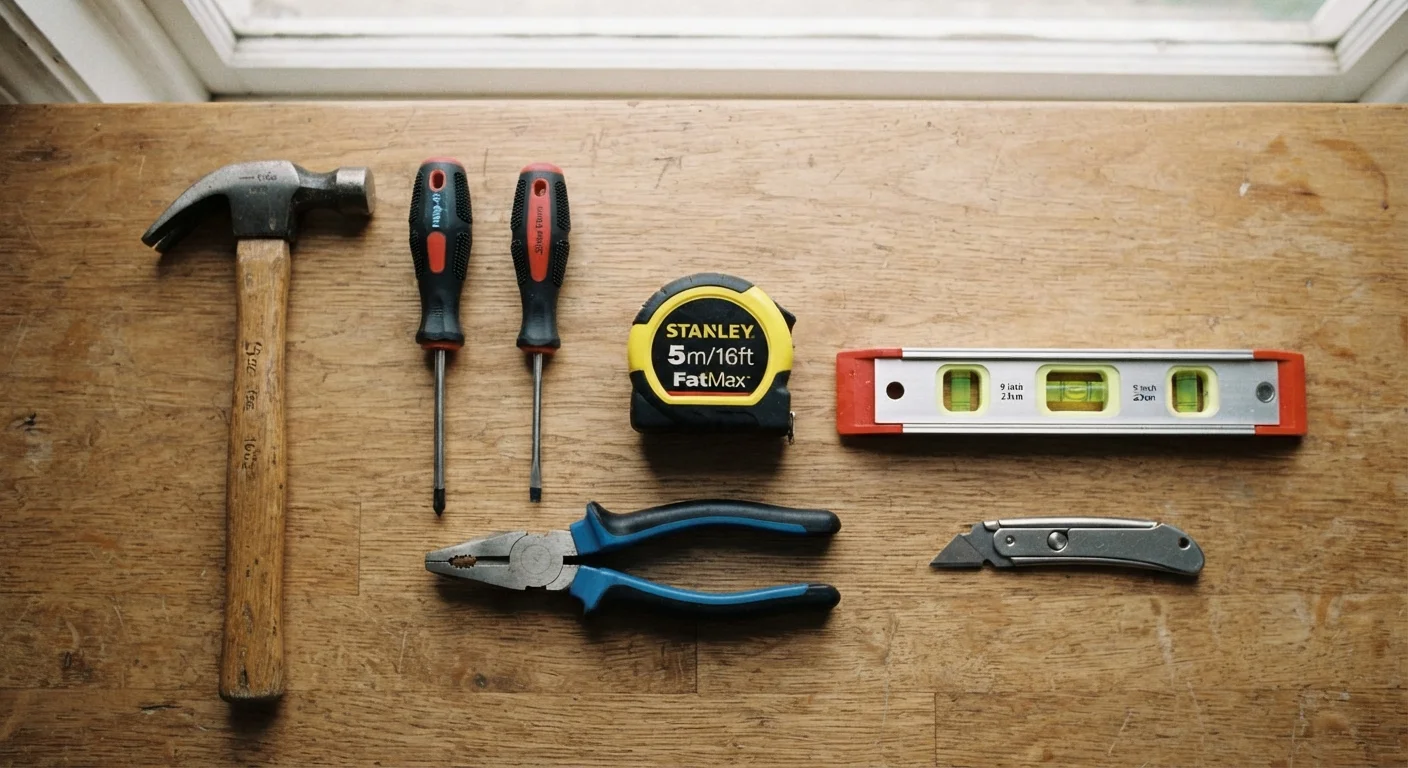
A standard claw hammer covers two of the most common rental tasks: driving nails into walls to hang pictures or shelving brackets, and pulling them back out cleanly when you move. The claw end is designed for prying nails free without gouging the wall surface unnecessarily. Look for one with a comfortable grip and a head weight around 16 oz — heavy enough to work efficiently, light enough to control. Always check your lease before putting anything into walls; some landlords require you to fill nail holes before leaving, which is easily done with a small tube of spackling compound.
The claw end removes nails cleanly, which matters enormously when your deposit is on the line.
Screwdriver set (flathead and Phillips)
Screws come in two dominant head types — flathead (a single slot) and Phillips (a cross-shaped recess) — and you'll encounter both constantly. Tightening a loose cabinet hinge, assembling flat-pack furniture, swapping a light switch cover plate, and opening battery compartments all require a screwdriver. A basic set with two or three sizes of each type covers most situations you'll face. Sets with interchangeable bits offer versatility in a compact format. Keep them somewhere accessible; this is the tool you'll reach for more than any other.
Screwdrivers are the single most frequently used tool in any rental — keep them within easy reach.
Measuring tape
Before you buy a rug, sofa, desk, or set of shelves, you need to know whether it will actually fit. A retractable measuring tape — at least 12 feet long — lets you measure room dimensions, doorway widths, and furniture footprints before committing. It also helps when centring items on a wall or checking that a bed frame clears a radiator. This is one of those tools that seems unnecessary until you've already ordered a bookcase that won't go through the door. A lock mechanism on the blade keeps it extended while you work alone.
Measure before you buy anything large — returns are far more difficult than a quick double-check.
Spirit level
A spirit level — sometimes called a bubble level — tells you whether a surface or object is truly horizontal or vertical. Hanging a shelf that looks straight but isn't will irritate you every time you look at it, and items may slide or fall. A compact magnetic level (around 9 inches) is inexpensive, easy to store, and works for shelves, frames, and towel rails. Place it on the object you're mounting, and adjust until the bubble sits between the two lines. Simple, fast, and the difference between a polished result and a crooked one.
A level turns a frustrating guessing game into a five-second check every time you hang something.
Adjustable wrench and slip-joint pliers
Pliers grip, twist, and hold things your fingers can't manage — whether that's tightening a loose showerhead, removing a stuck bolt from flat-pack furniture, or bending a wire hook. Slip-joint pliers have jaws that adjust to different sizes. An adjustable wrench (also called a crescent wrench) is essential for any nut-and-bolt work: tightening a loose towel rail bracket, reconnecting a flexible supply line beneath a sink, or dealing with compression fittings. For anything beyond routine tightening — especially work touching gas lines or electrical panels — always contact a qualified professional. These tools handle the ordinary; the dangerous requires a trained tradesperson.
Pliers and a wrench handle the everyday gripping and tightening tasks no other tool can replace.
Utility knife
A utility knife (also called a box cutter) has more uses in a rental than most people expect. Opening moving boxes without tearing the contents, trimming shelf liner paper, cutting rope, scoring drywall for small patch repairs, and stripping packaging tape are all cleaner and safer with a sharp blade than with scissors. Retractable blades reduce injury risk when the knife isn't in use. Replace the blade when it dulls rather than pressing harder — a sharp knife requires less force and is consistently safer. Store it in a drawer rather than loose in a bag.
A sharp utility knife handles cutting tasks cleanly and safely that scissors simply cannot manage.
Flashlight or headlamp
When a circuit breaker trips or a fuse blows, the area you most need to see is often the darkest one — a utility closet, the space under a sink, or a breaker panel in a hallway cupboard. A reliable flashlight (or a hands-free headlamp) is essential for these moments. It's also useful when changing a bulb in an awkward fitting, investigating a plumbing noise behind a cabinet, or navigating a power outage. Keep fresh batteries in it and store it somewhere you'll remember even in the dark. Your phone's flashlight function is a backup, not a substitute — battery life matters in an outage.
A flashlight is the one tool you'll desperately need precisely when conditions make it hardest to find.
Build Your Kit Gradually
You don't need to buy everything at once. Start with a screwdriver set and measuring tape — the two tools you'll use before you even unpack. Add a hammer and level once you're ready to hang things. Pliers, a wrench, a utility knife, and a flashlight can follow. Spreading out the cost makes the toolkit manageable on a student budget without cutting corners on quality.
Putting Your Toolkit to Work
Owning these tools is only useful if you know when to reach for them — and when not to. For everyday tasks like hanging frames, assembling furniture, tightening fixtures, and measuring before you buy, this kit has you covered. For anything involving your electrical panel, gas supply, structural elements, or serious plumbing, the right move is always to contact your landlord or a licensed professional. That boundary matters both for safety and for your lease.
To get more out of your rental from a maintenance standpoint, check out our article on habits that prevent the most common rental maintenance problems. Small, consistent actions — like checking seals, keeping drains clear, and catching issues early — do more to protect your deposit than any reactive fix. And if you're dealing with a slow drain right now, our step-by-step guide to unclogging a drain without calling anyone walks you through safe, tool-light methods that work.
A little preparation goes a long way. Seven tools, stored in a small bag or box, and you're equipped for the majority of what student renting will throw at you.
The content provided on our blog site traverses numerous categories, offering readers valuable and practical information. Readers can use the editorial team’s research and data to gain more insights into their topics of interest. However, they are requested not to treat the articles as conclusive. The website team cannot be held responsible for differences in data or inaccuracies found across other platforms. Please also note that the site might also miss out on various schemes and offers available that the readers may find more beneficial than the ones we cover.