

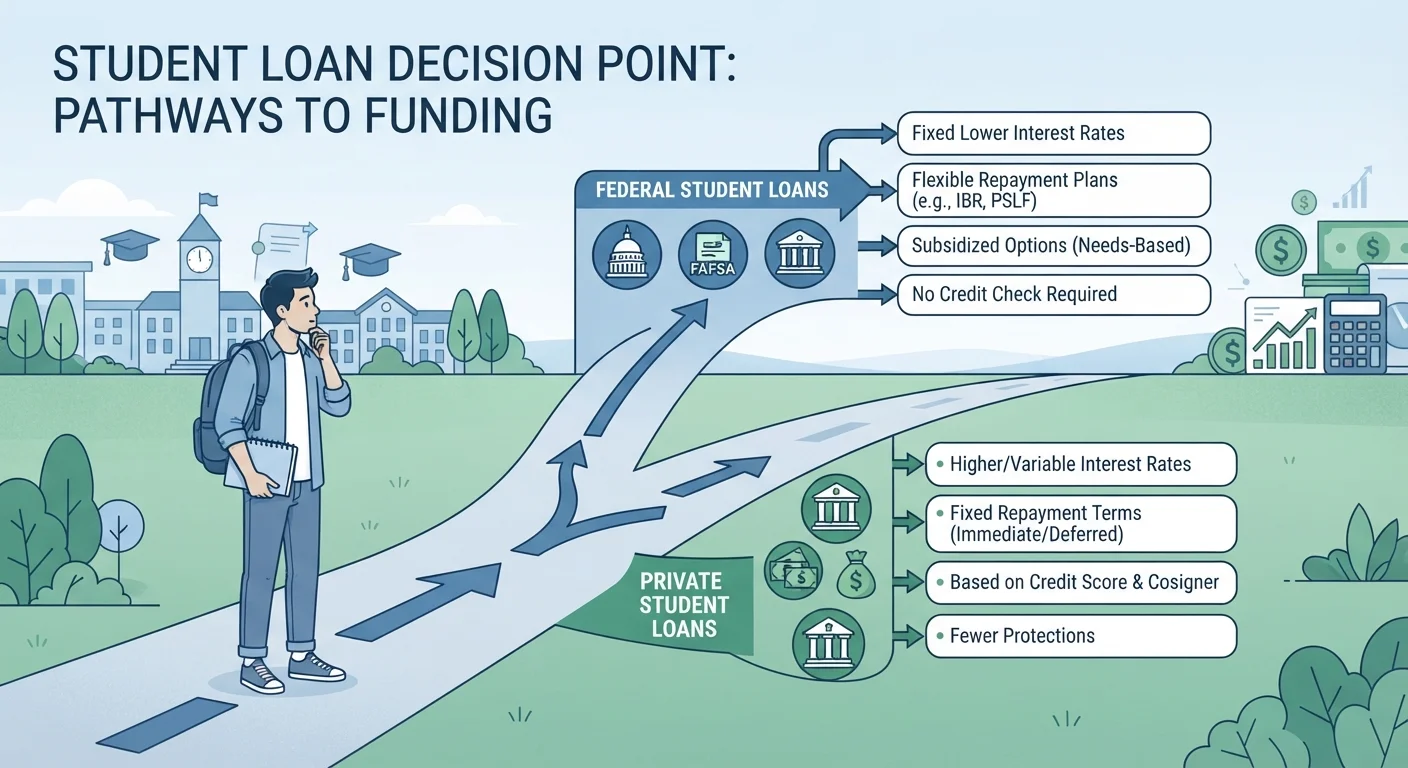
Option A
Federal Student Loans
The government-backed, borrower-protective option.
Best for: Students who want flexible repayment, income-driven protections, and access to forgiveness programs.
Option B
Private Student Loans
The credit-based, lender-determined alternative.
Best for: Students who have exhausted federal aid and need additional funding to cover remaining costs.
Who Issues the Loan — and Why That Changes Everything
Federal student loans are funded by the U.S. Department of Education. Private student loans are issued by banks, credit unions, and other financial institutions. That distinction isn't just administrative — it determines every rule that governs your loan, from how interest accrues to what happens if you lose your job.
Before comparing specifics, it helps to understand how you even end up with federal loans. When you complete the FAFSA, your school uses that information to assemble a financial aid package. Federal loans are typically included in that package up to annual and lifetime limits set by law. Private loans, by contrast, require a separate application directly with a lender, and approval depends on your creditworthiness — or that of a cosigner. For a deeper foundation on how borrowing works from the start, see our plain-language breakdown of student loans.
| Criterion | Federal Student Loans | Private Student Loans |
|---|---|---|
| Lender | U.S. Department of Education | Banks, credit unions, private lenders |
| Credit check required | No (most loan types) | Yes — or cosigner needed |
| Interest rate type | Fixed, set by Congress | Fixed or variable, set by lender |
| Income-driven repayment | Available | Rarely available |
| Loan forgiveness eligibility | Yes (qualifying programs) | No |
| Deferment / forbearance | Standardized federal options | Lender-defined, not guaranteed |
| Grace period after graduation | 6 months (standard) | Varies by lender |
| Annual borrowing limits | Set by law (loan type/year) | Up to cost of attendance |
Interest Rates, Fees, and How Costs Accumulate
Federal student loan interest rates are set annually by Congress and are the same for all borrowers in a given loan category — your credit score has no effect. For example, all undergraduate Direct Subsidized and Unsubsidized Loan borrowers in a given academic year pay the same rate. Federal loans also carry a small origination fee deducted from each disbursement.
Private loan rates, on the other hand, can be fixed or variable and are determined by the lender based on your credit profile. A borrower with strong credit (or a creditworthy cosigner) may secure a competitive rate; a borrower with little or no credit history may face a substantially higher rate — or be denied entirely. Variable rates introduce additional uncertainty, since your payment can change over time. For unfamiliar terms like origination fee or variable rate, the Student Loan Glossary defines 30 key terms new borrowers encounter.
92%
Share of student debt that is federal
According to Federal Reserve data, federal loans account for approximately 92% of all outstanding student loan debt in the United States.
~8M
Borrowers enrolled in income-driven repayment
The U.S. Department of Education has reported that millions of federal loan borrowers use income-driven repayment plans to manage their monthly obligations.
It's also worth noting that within federal loans, there's an important distinction between subsidized and unsubsidized types that affects how interest accrues while you're still in school. How interest accrual differs between the two can meaningfully change what you owe at graduation.
Repayment Flexibility and Borrower Protections
This is where the gap between federal and private loans is widest. Federal borrowers can choose from multiple repayment plans, including income-driven options that cap monthly payments relative to income and extend the repayment period. Federal loans also offer deferment and forbearance — formal pauses in payment — during hardship, military service, or graduate school enrollment. Certain careers in public service or nonprofit work can qualify borrowers for loan forgiveness after a defined period of payments.
Private lenders are not required to offer any of these protections. Some do provide hardship forbearance or interest-rate discounts for autopay, but these are at the lender's discretion and are not standardized. If you default on a federal loan, the government has specific procedures and rehabilitation options; private loan defaults move faster toward collections and legal action. To explore the full range of federal repayment structures, compare federal repayment plans side by side.
One often-overlooked consideration: private student loans can affect the credit history you're building as a student. Missing payments has real consequences for your score. For context on how borrowing fits into your broader credit picture, visit the Building Credit hub.
This article is for general informational and educational purposes only and does not constitute personalized financial or legal advice. Loan terms, rates, and program eligibility change over time — consult your school's financial aid office or a qualified financial professional for guidance specific to your situation.
The content provided on our blog site traverses numerous categories, offering readers valuable and practical information. Readers can use the editorial team’s research and data to gain more insights into their topics of interest. However, they are requested not to treat the articles as conclusive. The website team cannot be held responsible for differences in data or inaccuracies found across other platforms. Please also note that the site might also miss out on various schemes and offers available that the readers may find more beneficial than the ones we cover.