

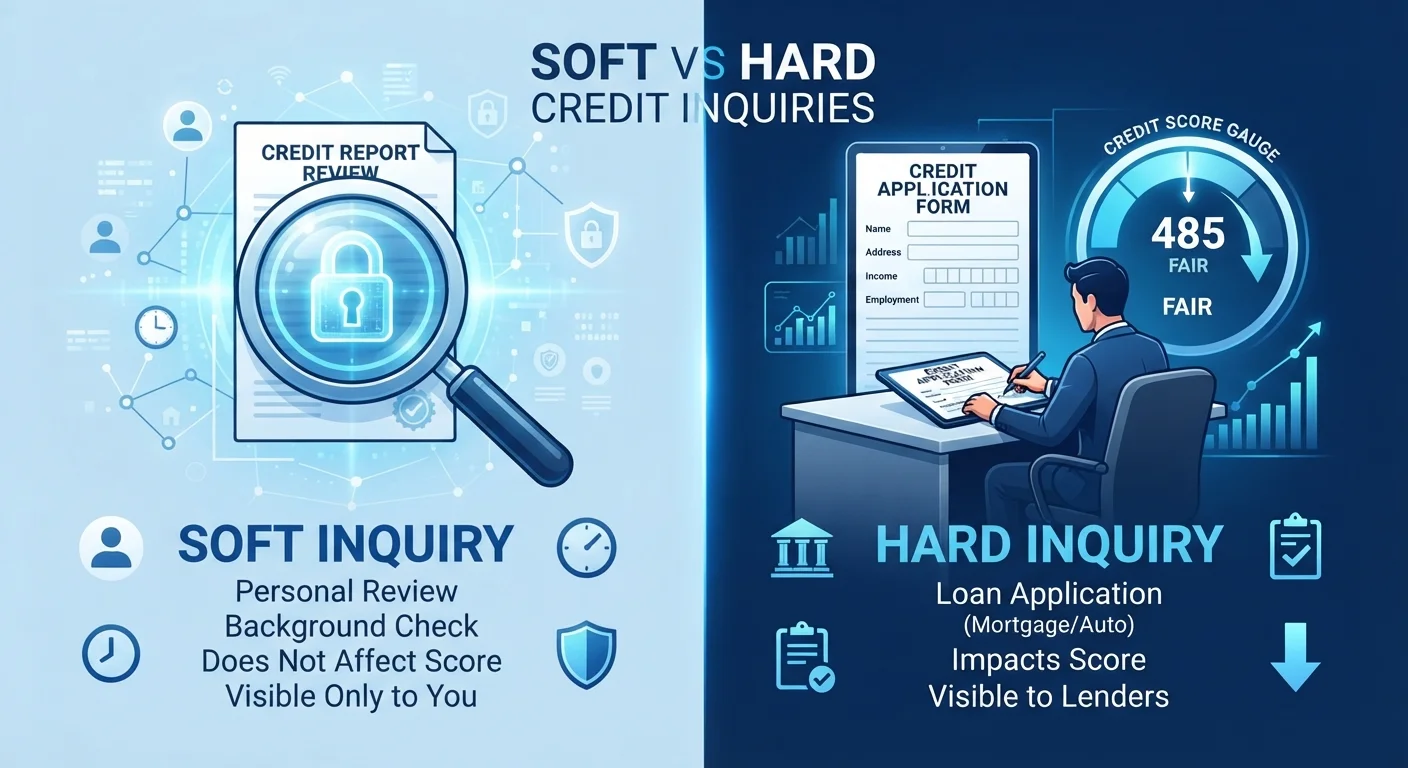
Option A
Hard Inquiry
The visible check that can temporarily affect your score.
Best for: Understanding when applying for new credit will show up on your report and why timing matters.
Option B
Soft Inquiry
The invisible check that leaves your score untouched.
Best for: Monitoring your own credit, getting pre-qualified, or being reviewed by an employer — without any scoring impact.
What Makes an Inquiry 'Hard' or 'Soft'?
When someone accesses your credit report, the event is recorded as an inquiry. But not all inquiries are created equal. The difference between a hard and soft inquiry comes down to one key factor: whether you are actively applying for new credit.
A hard inquiry (also called a hard pull) happens when a lender reviews your credit report to make a lending decision — for example, when you apply for a credit card, a private student loan, or an auto loan. Because you've initiated the application, the lender has your permission to conduct a full credit review, and the event is visible to other lenders on your report.
A soft inquiry (or soft pull) occurs when a credit check is performed without a formal application for credit. Common examples include checking your own score through a credit monitoring service, a lender pre-approving you for an offer, or a landlord or employer reviewing your background. Soft inquiries do not appear to lenders when they review your report, and they have no effect on your credit score. Understanding how your credit score is calculated is helpful context for why this distinction matters.
How Hard Inquiries Affect Your Credit Score
Hard inquiries are factored into your credit score under the "new credit" category, which accounts for roughly 10% of a FICO score. Each hard inquiry can reduce your score by a small number of points — typically fewer than five — and the effect generally fades within a year. Hard inquiries remain listed on your credit report for two years, but most scoring models stop counting them against you after 12 months.
| Criterion | Hard Inquiry | Soft Inquiry |
|---|---|---|
| Triggered by | Applying for new credit | Checking own credit, pre-qualification, background checks |
| Affects credit score | Yes — typically a few points | No impact |
| Visible to other lenders | Yes — appears on report | No — not visible to lenders |
| Stays on credit report | Up to 2 years | May appear in your own view only |
| Scoring model counts it after | Approximately 12 months | Never counted |
| Requires your authorization | Yes — via credit application | Varies; some require consent |
The impact of a single hard inquiry is modest for most people. However, if your credit history is short — as is common for students just starting out — each inquiry carries slightly more weight because there is less positive history to offset it. That's one reason it pays to apply for credit only when you genuinely need it.
One important exception: rate shopping. When you apply to multiple mortgage lenders, auto lenders, or student loan servicers within a concentrated time window (typically 14 to 45 days, depending on the scoring model), most models bundle those inquiries into a single event. This encourages consumers to compare offers without being penalized. The same bundling does not apply to credit card applications — each one counts separately.
You can read more about the factors quietly shaping your credit in our guide to credit utilization and your score.
Soft Inquiries: What They Are and Why They Don't Count
Soft inquiries cover a wide range of common credit-related activities. Here are the most frequent ones students encounter:
- Checking your own credit — via AnnualCreditReport.com or a free monitoring service
- Pre-qualification checks — when a lender checks whether you might qualify before you formally apply
- Employer background checks — with your written consent, some employers review credit as part of hiring
- Landlord screenings — apartment applications often include a credit check
- Existing creditor reviews — your current card issuer may periodically review your account
None of these affect your score. In fact, checking your own credit report regularly is considered a best practice — it helps you catch errors and identity theft early. Federal law under the Fair Credit Reporting Act (FCRA) entitles every consumer to at least one free report annually from each of the three major bureaus through AnnualCreditReport.com. For a full walkthrough of what you'll find when you pull that report, see our guide to reading your first credit report.
~5 pts
Typical score drop from one hard inquiry
According to FICO, a single hard inquiry generally lowers a score by fewer than five points for most consumers.
10%
Weight of 'new credit' in FICO scoring
FICO's publicly disclosed score breakdown attributes approximately 10% of your score to new credit activity, including hard inquiries.
3
Free credit reports available annually
Under the Fair Credit Reporting Act, consumers are entitled to one free report per year from each of the three major credit bureaus via AnnualCreditReport.com.
This article is for general educational purposes only and does not constitute personalized financial or credit advice. Consult a qualified financial professional for guidance specific to your situation.
The content provided on our blog site traverses numerous categories, offering readers valuable and practical information. Readers can use the editorial team’s research and data to gain more insights into their topics of interest. However, they are requested not to treat the articles as conclusive. The website team cannot be held responsible for differences in data or inaccuracies found across other platforms. Please also note that the site might also miss out on various schemes and offers available that the readers may find more beneficial than the ones we cover.