

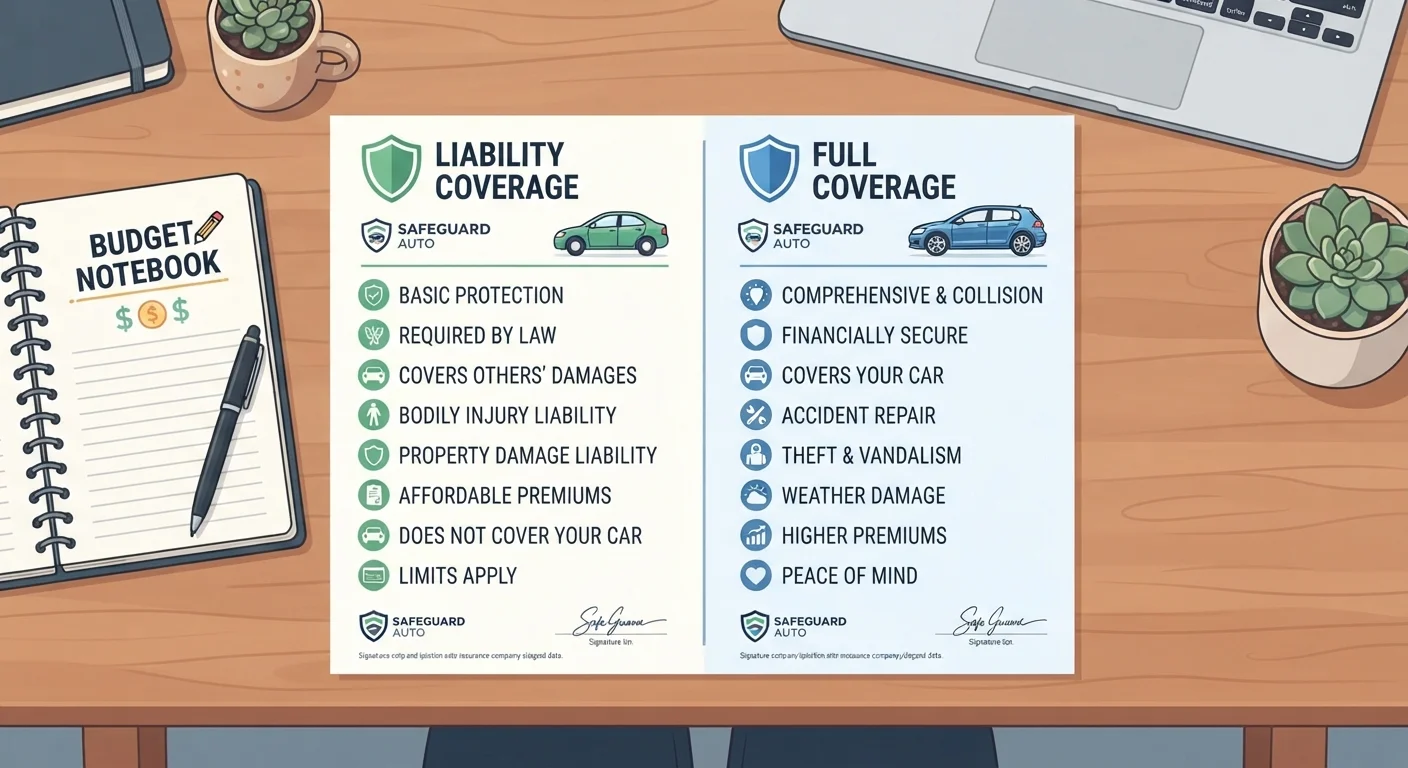
Option A
Liability-Only Coverage
The legally required minimum — covers others, not your own car.
Best for: Students driving older, lower-value vehicles where the cost of full coverage exceeds the car's worth.
Option B
Full Coverage
Broader protection that covers your own vehicle in addition to others.
Best for: Students with newer or financed vehicles who need protection against theft, collisions, and non-collision damage.
What Liability-Only Coverage Actually Includes
Liability coverage is the legal baseline in nearly every U.S. state. It pays for injuries and property damage you cause to other people in an accident where you are at fault. It does not pay to repair or replace your own vehicle under any circumstances.
A standard liability policy has two components:
- Bodily injury liability — covers medical expenses, lost wages, and legal costs for people you injure.
- Property damage liability — covers repair or replacement costs for another driver's car or property you damage.
Policies are typically expressed as split limits (for example, 25/50/25), representing thousands of dollars per person injured, total per accident, and property damage respectively. Each state sets its own minimum, but those minimums are often considered insufficient for serious accidents.
For a deeper look at core insurance terminology before shopping for a policy, see our car insurance basics guide.
State Minimums Are a Floor, Not a Recommendation
Every state requires at least some liability coverage, but minimum limits are often set well below what a serious accident can cost. If your liability limits are exhausted by a claim, you may be personally responsible for the remainder. Many financial advisors suggest carrying limits above the state minimum when your budget allows.
What Full Coverage Adds to the Picture
"Full coverage" is an informal term — no single policy is truly all-inclusive — but it generally means your policy includes liability plus two additional components:
- Collision coverage — pays to repair or replace your vehicle after an accident with another car or object, regardless of fault.
- Comprehensive coverage — covers non-collision events such as theft, vandalism, hail, flooding, fire, or hitting an animal.
Both collision and comprehensive come with a deductible — the amount you pay out of pocket before insurance contributes. Choosing a higher deductible lowers your monthly premium but increases what you owe after a claim.
Full coverage does not automatically include medical payments, uninsured motorist protection, roadside assistance, or rental reimbursement. Those typically require separate add-ons. Understanding how these optional coverages fit into your overall budget is part of the same planning process covered in our guide to fixed vs. variable expenses.
| Criterion | Liability-Only | Full Coverage |
|---|---|---|
| Covers damage you cause others | Yes | Yes |
| Covers your own vehicle in a crash | No | Yes (collision) |
| Covers theft or weather damage | No | Yes (comprehensive) |
| Required by lenders | No | Yes, typically |
| Typical monthly cost (general range) | Lower | Higher |
| Deductible applies | No | Yes |
| Suitable for low-value vehicles | Often yes | Rarely cost-effective |
How to Decide Which Level Makes Sense for You
The most practical test is comparing your car's actual cash value (ACV) — what your vehicle is currently worth on the market — against the annual cost of adding collision and comprehensive coverage.
A common rule of thumb: if your annual full coverage premium plus your deductible exceeds 10% of your car's ACV, the math may favor dropping to liability-only. This is a general guideline, not a guarantee of the right outcome for every situation.
Other factors worth weighing:
- Loan or lease obligation — if you owe money on the car, the lender decides, and they almost always require full coverage.
- Parking environment — campus lots, urban streets, and areas with high weather risk increase the likelihood you'll need comprehensive coverage.
- Your savings cushion — if you couldn't absorb a $3,000–$5,000 repair or replacement out of pocket, liability-only carries real financial risk.
- Driving frequency — the more you drive, the greater your statistical exposure to at-fault accidents.
~$631
Average annual liability-only premium (U.S.)
According to Bankrate's analysis of national rate data, liability-only policies average significantly less than full coverage annually, though figures vary widely by state and driver profile.
~$2,014
Average annual full coverage premium (U.S.)
Bankrate's 2024 rate analysis places the national average for full coverage near this figure, with younger and less-experienced drivers typically paying considerably more.
6 in 10
U.S. drivers who carry full coverage
The Insurance Research Council has found that a majority of insured U.S. drivers maintain full coverage, though that proportion drops among drivers of older, paid-off vehicles.
This article provides general educational information about auto insurance. It is not personalized financial or insurance advice. Coverage options, costs, and requirements vary significantly by state and insurer. Consult a licensed insurance agent to evaluate what is appropriate for your specific situation.
The content provided on our blog site traverses numerous categories, offering readers valuable and practical information. Readers can use the editorial team’s research and data to gain more insights into their topics of interest. However, they are requested not to treat the articles as conclusive. The website team cannot be held responsible for differences in data or inaccuracies found across other platforms. Please also note that the site might also miss out on various schemes and offers available that the readers may find more beneficial than the ones we cover.