

Why Departure Timing Is More Complex Than It Looks
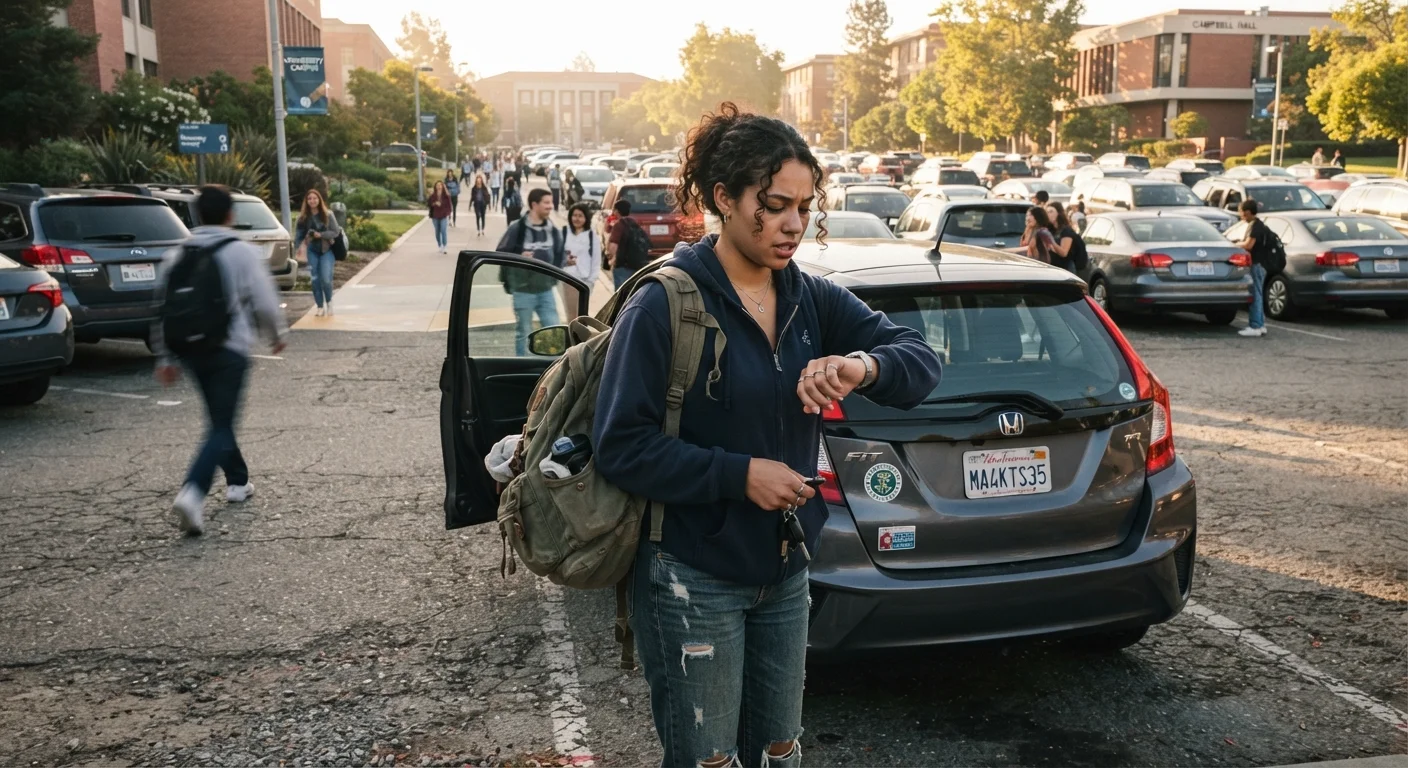
Most students think about commute time in terms of miles and traffic - how long the drive takes. What they underestimate is parking search time: the minutes spent circling a lot, waiting for someone to pull out, or walking from an overflow structure. On a busy campus morning, parking search can add anywhere from 5 to 25 minutes on top of the drive, and it varies far more day to day than the drive itself does.
The result is that two students leaving at the same time from the same neighborhood can arrive at their desks 20 minutes apart, simply because one found a spot immediately and one circled three times. Understanding this variability is the foundation of good departure planning. For a wider look at what the daily commute actually involves - costs, stress, and trade-offs - see driving to campus every day: the full picture.
What you will need
The Case Against Leaving "As Early as Possible"
Leaving extremely early feels like the safe move, but it carries real costs: less sleep, longer mornings, and time sitting idle in a parking lot or an empty classroom. If your optimal departure is 7:45 a.m. but you leave at 7:00 a.m. out of anxiety, you are trading 45 minutes of morning every single commuting day without meaningful benefit.
The goal is not to leave as early as possible - it is to leave early enough, with a modest buffer for bad days. The steps below give you a data-driven method for finding that specific window rather than guessing.
Don't Rely Solely on Navigation App Estimates
Navigation apps predict drive time based on historical traffic patterns, but campus parking search time - often the most variable part of your commute - is rarely captured in those estimates. A navigation app may show a 12-minute drive while your actual door-to-desk time is 35 minutes once parking is factored in. Always use your own logged data alongside any app estimate.
What You'll Need Before You Start
Gather the following before working through the steps. Having these in place will make your two-week observation log much easier to maintain consistently.
Notes app or commute journal
Record daily departure times, arrival times, and parking search durations over a two-week test period.
Campus parking map
Identify which lots or structures correspond to your permit type and their distance from your first class.
Navigation app with live traffic
Monitor drive-time variance across different departure windows before you commit to a routine.
Calendar or scheduling tool
Block your ideal departure time as a repeating event so it becomes a built-in habit.
If you are newer to structuring your time as a student, the time management overview for students provides useful grounding before you add commute planning to your schedule.
Step-by-Step: Finding Your Optimal Departure Time
Follow these steps in order at the start of a new semester. The process takes about two weeks of active data collection and roughly 15-20 minutes of review time afterward.
Map every class start time and its parking zone
Pull up your class schedule and write down each course's start time alongside the building it meets in. Cross-reference these with your campus parking map to identify which lots or structures are within comfortable walking distance. The lot closest to your 8 a.m. lecture may be a different permit zone than the one near your afternoon lab - and that affects which crunch window actually matters to you.
Identify your campus's peak parking window
Most campuses experience their highest lot demand between 9 a.m. and 11 a.m., when the largest number of classes begin simultaneously. Lots can reach capacity 20-40 minutes before that window closes. Your campus may differ - check whether your institution's parking or transportation office publishes occupancy data or historical demand patterns, as many do. If that data isn't available publicly, ask at the parking office directly.
Run a two-week observation log
For the first two weeks of semester, record four data points each commuting day: the time you left home, the time you arrived at the lot entrance, the time you found and parked in a spot, and how far you walked to class. Keep this simple - a voice memo or a quick note in your phone works fine. After 10 commuting days you will have enough real data to calculate your personal averages and spot your worst-case outliers.
Calculate your true door-to-desk time
Add together your average drive time, your average parking search time, and your walking time from the spot to your classroom door. This total - not just drive time - is what you need to back-calculate from your class start time. If drive time averages 18 minutes, parking search averages 9 minutes, and walking averages 5 minutes, your minimum door-to-desk time is 32 minutes. Build in a 5-8 minute buffer for outlier days, giving you a target departure roughly 37-40 minutes before class.
Test a slightly earlier and a slightly later window
Once you have your baseline figure, spend one week leaving 10 minutes earlier than that number and one week leaving 5 minutes later. Compare the parking search times from each trial against your baseline log. You may find that 10 extra minutes buys you a dramatically easier park - or that it produces almost no benefit. That comparison tells you whether your campus has a steep or gradual demand curve around your arrival time, which sharpens your decision considerably.
Decide what to do with surplus arrival time
If your optimal departure leaves you arriving 15 or more minutes before class, treat that time as protected study or review time rather than wasted waiting. Find a consistent spot - a campus café, a quiet hallway near your classroom, or the library - where you can do something useful. Leaving earlier is only worth the cost to your morning if you can recoup that time productively on the other end. If you genuinely cannot, consider whether a slightly later departure with a known overflow lot as backup is a better trade-off.
Revisit your schedule and class selection if timing stays painful
If you consistently cannot find a workable departure window - because your commute distance is long and peak hours are unavoidable - the most effective lever may not be departure time at all. When choosing classes each semester, filtering for sections that start at 7 a.m., 1 p.m., or later in the afternoon can shift you entirely outside the peak demand window. This is worth considering before next registration. For a broader view of whether daily driving to campus is the right fit for your situation, see the full picture of commuting to campus every day.
Use Your Commute Data Next Registration Period
Your two-week observation log is worth keeping beyond this semester. When you register for classes next term, use it to compare how different start times affected your parking difficulty. Choosing sections that avoid your campus's peak window is one of the highest-impact scheduling decisions a commuter student can make. A well-organized semester schedule is just as important as departure timing - see the semester-start checklist for getting your time under control for help structuring your term from day one.
When the Numbers Still Don't Add Up
Some commuters complete this process and find that no departure time feels workable - the drive is too long, the lots fill too fast, or class times are immovable. In that case, it is worth honestly evaluating whether daily driving is the right commuting mode for every day of the week, or whether a hybrid approach (driving two or three days, using transit or carpooling on others) reduces the problem more effectively than timing adjustments alone.
Timing optimization works best when the underlying commute is structurally viable. If it is not, no amount of departure adjustment will make it consistently stress-free. Good time management strategies across your whole student life - not just your commute - will ultimately matter more than any single scheduling fix.
Safety Over Speed - Always
Rushing to beat the clock is one of the most common contributors to minor collisions in campus parking lots. If you are running late, accept it and drive calmly. Arriving a few minutes late to class is far less consequential than a collision. Build your buffer so that a typical bad parking day does not put you in a position where speed feels necessary.
The content provided on our blog site traverses numerous categories, offering readers valuable and practical information. Readers can use the editorial team’s research and data to gain more insights into their topics of interest. However, they are requested not to treat the articles as conclusive. The website team cannot be held responsible for differences in data or inaccuracies found across other platforms. Please also note that the site might also miss out on various schemes and offers available that the readers may find more beneficial than the ones we cover.