

Why Your Brain Forgets - and When It Forgets
Memory doesn't work like a hard drive. You can't simply upload information and expect it to stay there. Without reinforcement, the brain treats unused information as low priority and gradually discards it - a process Hermann Ebbinghaus mapped in the 1880s with what he called the forgetting curve.
His research showed that people forget roughly half of newly learned material within a day if they don't review it, and even more within a week. The good news: each time you successfully retrieve a memory before it fades, the forgetting curve resets - and the next decline happens more slowly. That's the entire logic behind spaced repetition.
Understanding this process helps explain why cramming the night before an exam rarely serves you beyond test day. The material is never given the chance to move from short-term to long-term memory.
Spaced Repetition Is About Timing, Not Total Hours
A common misconception is that studying more hours always means remembering more. Spaced repetition research suggests it's when you study, not just how long, that determines long-term retention. Two 20-minute sessions separated by a day typically outperform one uninterrupted 40-minute session covering the same material.
How Spaced Repetition Actually Works
The method is straightforward: after learning something new, you schedule a review. If you recall it successfully, you wait a longer interval before reviewing again. If you struggle, you shorten the interval and practice it sooner. Over multiple cycles, difficult material gets more attention while well-learned material is reviewed less frequently.
A basic spacing schedule might look like this:
- Session 1: Learn the material
- Review 1: 1 day later
- Review 2: 3 days after that
- Review 3: 1 week later
- Review 4: 2-3 weeks later
Each successful review strengthens the memory trace in your brain. Cognitive scientists refer to this as the spacing effect - one of the most replicated findings in memory research.
Spaced repetition works especially well alongside active recall techniques, such as closing your notes and testing yourself, rather than passively re-reading.
Start Your First Review Within 24 Hours
The first review is the most critical. Don't wait until the weekend to look at material from Monday's lecture. A quick 10-minute self-test the following day resets the forgetting curve before significant decay sets in. Combine this with active study techniques for the strongest results.
Practical Ways to Apply It Without Special Software
You don't need an app to use spaced repetition. Here are three methods that work with everyday materials:
The Leitner Flashcard System
Divide a box into sections labeled 1 through 5. Start all cards in section 1. If you answer correctly, move the card to the next section (reviewed less often). If you answer incorrectly, return it to section 1. This creates a self-regulating system where weak material gets more practice.
A Weekly Review Calendar
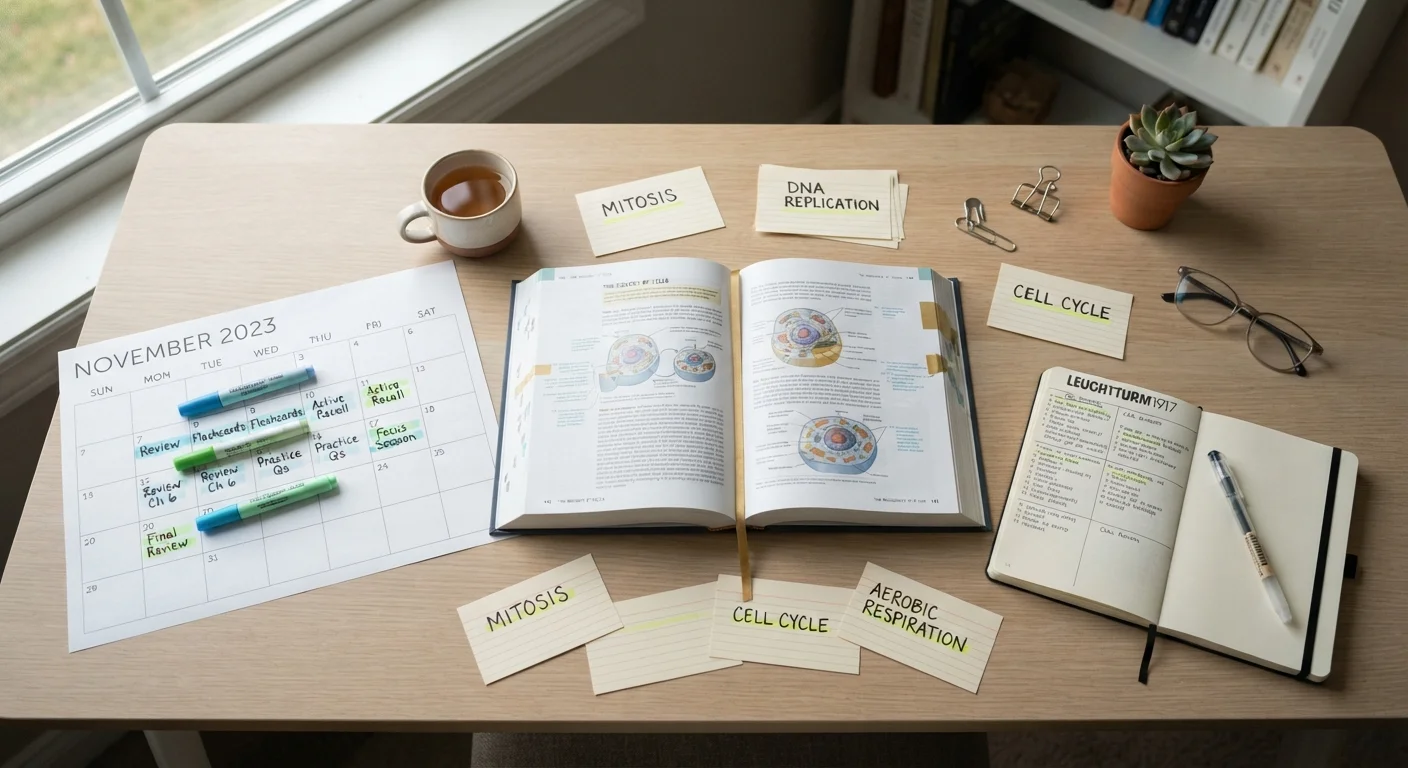
After each class or study session, note the date and schedule two or three future review slots - the next day, then three days later, then a week out. A simple paper planner or calendar app works fine. Our study schedule guide shows how to build these review blocks into a realistic weekly routine.
Color-Coded Notes
Mark concepts by confidence level: red for material you don't know, yellow for shaky knowledge, green for solid recall. Prioritize red and yellow items in your next session. Revisit greens only occasionally to confirm retention.
For a broader look at memory-strengthening strategies that complement spaced repetition, see memory techniques used by students and scholars.
Spaced Repetition and Sleep: A Critical Pairing
One factor that amplifies the benefits of spaced repetition is sleep. During sleep - particularly during deep non-REM and REM stages - the brain consolidates memories formed during the day, transferring them into longer-term storage. Reviewing material before sleep and then allowing a full night's rest can meaningfully strengthen retention compared to late-night cramming that cuts sleep short.
This is one reason a consistent sleep schedule supports academic performance. If you want to understand the mechanics behind this, how sleep cycles work is worth reading alongside your study planning.
~50%
Information forgotten within 24 hours without review
Based on Ebbinghaus's forgetting curve research, which has been replicated and extended by modern memory researchers.
10-30%
Typical long-term retention after a single study session
Memory research consistently shows that massed, single-session study produces far lower long-term retention than spaced practice over multiple sessions.
200%+
Improvement in recall with spaced vs. massed practice
A range of cognitive science studies have found spaced practice can double or more than double long-term retention compared to equivalent time spent in a single session.
Frequently Asked Questions
Regular studying often means reviewing everything in one sitting - sometimes the night before a test. Spaced repetition spreads those reviews across multiple days or weeks, timed so that you revisit material just before you'd forget it. This makes each session more effective and the memory far more durable.
No. While apps like Anki use algorithms to schedule reviews automatically, you can apply the principle manually using paper flashcards, a notebook, and a simple calendar. The key is the timing of reviews, not the tool you use.
Research generally supports reviewing new material within 24 hours of first learning it. After that, you extend the gap with each successful review - for example, 1 day, then 3 days, then 7 days, and so on.
Yes. While it's especially powerful for vocabulary, formulas, and facts, the underlying principle - spaced practice over time - also improves comprehension of complex concepts. Problem-solving practice spread across multiple sessions tends to outperform massed practice in subjects like math and science.
Cramming produces a temporary spike in recall because the material is fresh in short-term memory. That feeling of confidence is often misleading - most of what you crammed fades within 24 to 48 hours because it was never consolidated into long-term memory.
The key is building short review blocks - even 10 to 20 minutes - into your weekly plan rather than relying on a few long sessions. See our <a href="/academic-success/study-skills/building-a-study-schedule-that-youll-actually-stick-to">guide to building a study schedule</a> for practical ways to structure your week around spaced review.
The content provided on our blog site traverses numerous categories, offering readers valuable and practical information. Readers can use the editorial team’s research and data to gain more insights into their topics of interest. However, they are requested not to treat the articles as conclusive. The website team cannot be held responsible for differences in data or inaccuracies found across other platforms. Please also note that the site might also miss out on various schemes and offers available that the readers may find more beneficial than the ones we cover.