

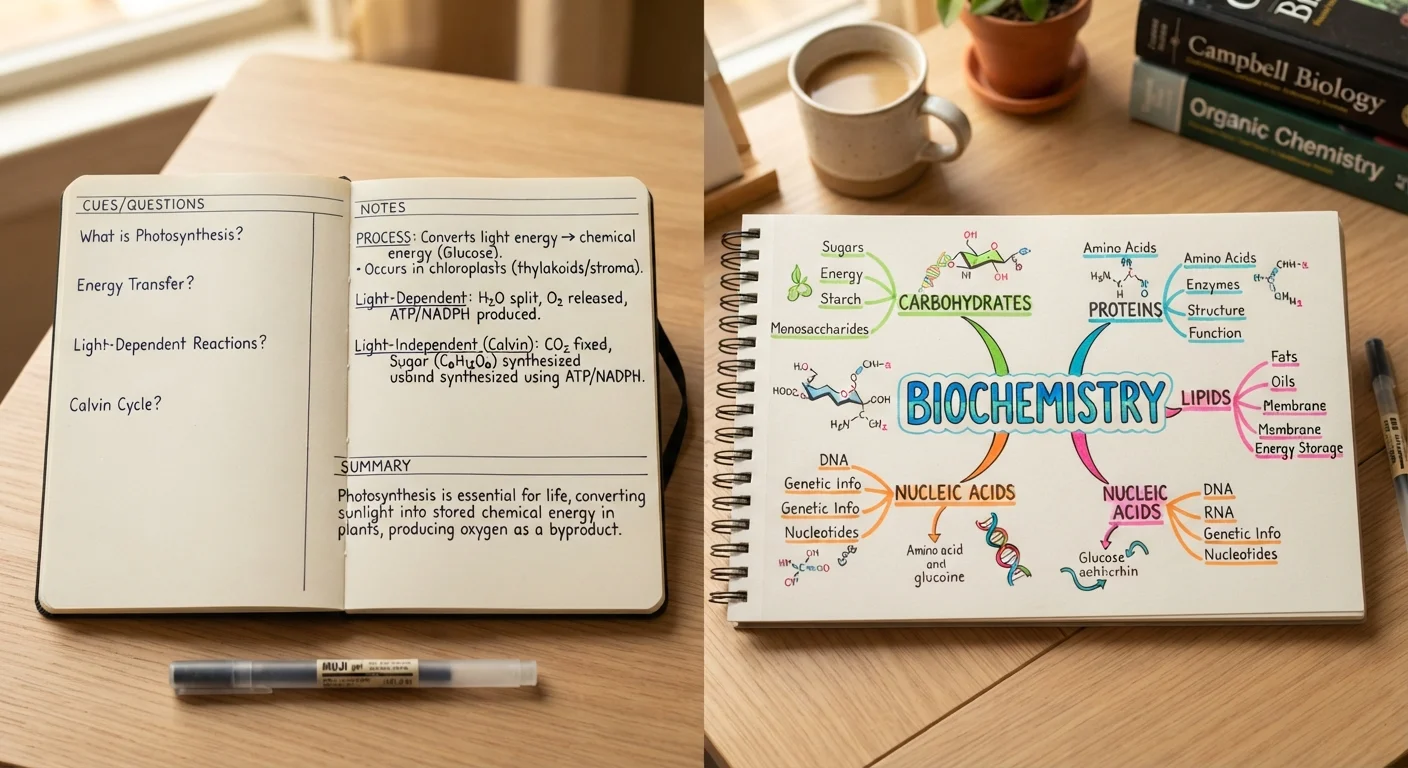
Option A
Cornell Notes
The structured, linear approach to organized learning.
Best for: Students who need a clear, sequential system that works well for lecture-heavy courses and exam review.
Option B
Mind Mapping
The visual, free-form method for connecting ideas.
Best for: Students who think in associations and benefit from seeing how concepts relate to one another across a topic.
How Each Method Works
Understanding the mechanics of each system makes it easier to judge which will fit your actual study routine.
Cornell Notes
Developed at Cornell University in the 1950s by Walter Pauk, the Cornell method divides a page into three sections: a narrow cue column on the left, a wide notes column on the right, and a summary box at the bottom. During a lecture or reading session, you record main ideas in the notes column. Afterward, you write questions or keywords in the cue column that correspond to those notes - essentially creating your own quiz prompts. The summary box at the bottom forces you to distill the page's content into two or three sentences in your own words.
Mind Mapping
Mind mapping starts with a single central idea written in the middle of a blank page. From there, you draw branches outward for major subtopics, and then smaller branches for supporting details. The result is a visual web that mirrors how associative memory actually works. There's no fixed format - you can use color, symbols, or images to distinguish ideas. Mind mapping is less prescriptive, which gives you creative freedom but requires more self-direction to stay focused.
For a broader look at how memory systems support both methods, see memory techniques used by students across disciplines.
Head-to-Head Comparison
The two methods differ across several dimensions that matter for day-to-day student life.
| Criterion | Cornell Notes | Mind Mapping |
|---|---|---|
| Page structure | Fixed three-section layout | Free-form, radial branching |
| Best content type | Sequential, factual material | Conceptual, interconnected ideas |
| Speed during lectures | Fast - format reduces decisions | Variable - requires more judgment |
| Built-in review mechanism | Yes - cue column and summary | Not inherent; must be added |
| Visual orientation | Low - primarily text-based | High - spatial and graphic |
| Learning curve | Low - clear template to follow | Moderate - requires practice to stay focused |
| Useful for essay planning | Limited | Strong |
These differences aren't just stylistic - they reflect different theories of how we process and retain information. Cornell Notes align with elaborative interrogation (asking yourself questions about content), while mind mapping draws on relational encoding (understanding how ideas connect). Both are supported by educational research as effective strategies when used consistently.
Matching the Method to Your Course and Wiring
No single note-taking system works equally well across every subject or every student. Context matters.
When Cornell Notes shine
- Sequential content: Courses like biology, economics, or U.S. history present information in a logical order that maps well onto a linear page layout.
- Exam-driven review: The built-in cue column functions like a set of flashcards you create in real time, supporting active recall practice - one of the most research-backed study strategies available.
- Fast lectures: The defined format means you spend less cognitive effort deciding where to put information, freeing attention for listening.
When mind mapping works better
- Conceptual or thematic subjects: Courses like sociology, literary analysis, or ethics involve ideas that interconnect rather than stack - a web captures that better than a list.
- Pre-writing and planning: Mapping out an essay argument or research topic before drafting can clarify your thinking and reveal gaps.
- Visual learners: If you naturally remember where on a page something was written, you may retain spatial diagrams more reliably than text columns.
~65%
Students who identify as visual learners
Research consistently finds that a majority of students report a preference for visual information, though learning-style theory itself remains debated among cognitive scientists.
24 hrs
Window for effective note consolidation
Educational research suggests that reviewing and elaborating on notes within 24 hours of a lecture significantly strengthens long-term memory formation.
After class, whichever format you used, writing a post-lecture summary within the hour significantly improves long-term retention.
Practical Tips for Getting Started
Trying a new note-taking system mid-semester can feel disruptive. Here's how to ease into either method without derailing your current workflow.
Starting with Cornell Notes
- Draw the Cornell template before class - or download a pre-formatted sheet and print several copies.
- Write only in the notes column during the lecture. Resist filling the cue column until the session ends.
- Within 24 hours, add cue questions and write your summary. This step is where most of the learning happens.
Starting with mind mapping
- Begin with paper and pen - digital tools can come later once the habit is established.
- Choose one chapter or lecture topic and write it in the center of a blank page.
- Set a timer for 10 minutes and branch out freely. Don't edit during the map; refine afterward.
You might also find it useful to consider whether you prefer analogue or digital tools as you build your system - analogue vs. digital planning trade-offs is worth a read if you're weighing that choice. Similarly, your preference for structure versus flexibility in note-taking often mirrors how you approach scheduling, so time blocking vs. task lists may offer complementary insight.
You Don't Have to Pick Just One
Many successful students use Cornell Notes in lecture-heavy courses and mind maps in discussion-based or seminar courses. Treating these as complementary tools rather than competing systems gives you more flexibility across a varied course load. Experimenting during a lower-stakes week - before midterms or finals pressure sets in - gives you time to find what actually sticks.
The content provided on our blog site traverses numerous categories, offering readers valuable and practical information. Readers can use the editorial team’s research and data to gain more insights into their topics of interest. However, they are requested not to treat the articles as conclusive. The website team cannot be held responsible for differences in data or inaccuracies found across other platforms. Please also note that the site might also miss out on various schemes and offers available that the readers may find more beneficial than the ones we cover.