

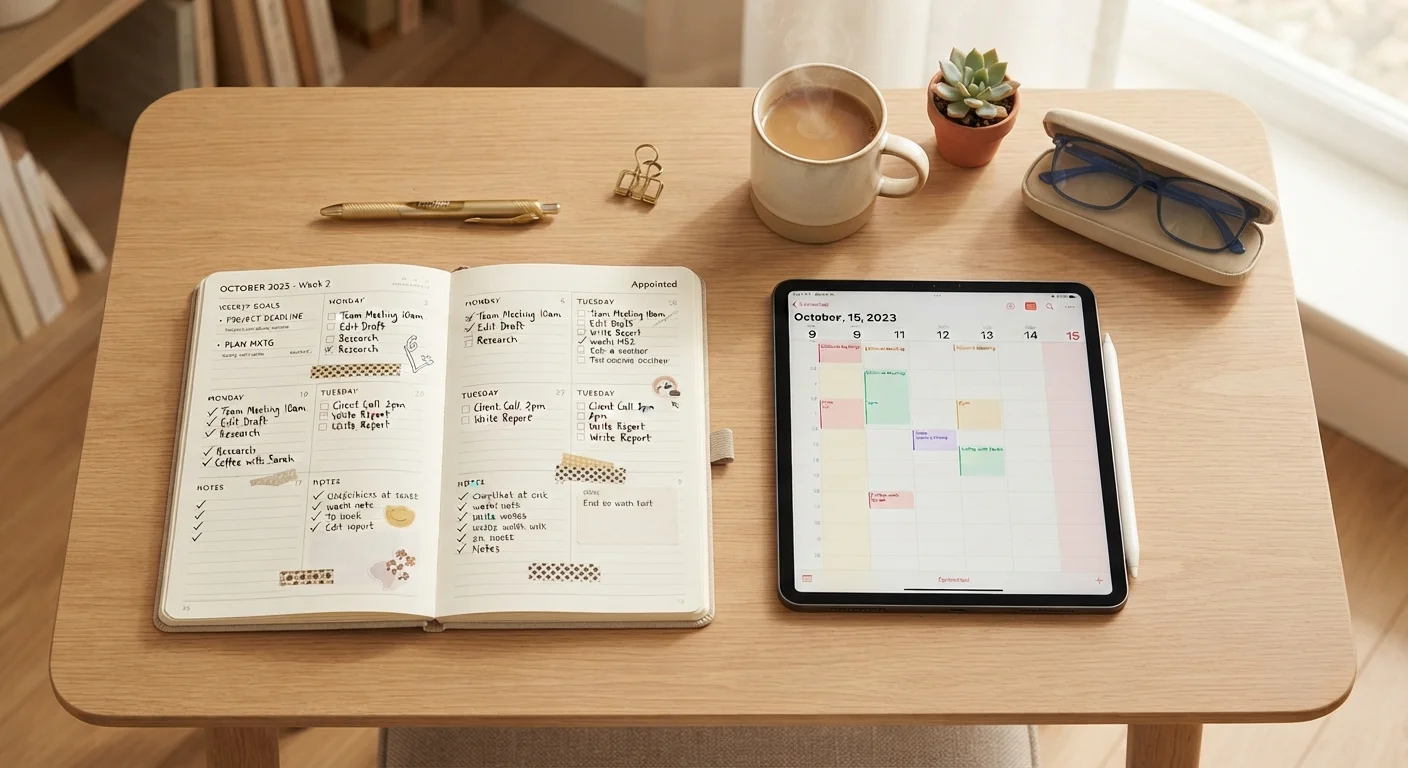
Option A
Analogue Planning (Notebooks & Paper Planners)
The tactile, distraction-free classic.
Best for: Students who think better with pen and paper, want zero screen distractions while planning, and benefit from the physical act of writing to remember commitments.
Option B
Digital Planning (Apps & Online Calendars)
The flexible, always-synced modern approach.
Best for: Students managing complex, shifting schedules who need reminders, cross-device access, and the ability to rapidly reorganize tasks without rewriting everything.
What Each System Actually Does Well
Before comparing the two, it helps to understand what each approach is genuinely good at - not just in theory, but in the day-to-day reality of student life.
Paper planners and notebooks excel at low-friction, intentional planning. There are no loading screens, no app updates, and no notifications pulling your attention sideways. Research in cognitive science has consistently suggested that handwriting activates deeper processing than typing, which may help you actually remember what you've scheduled. The physical act of crossing something off a list also provides a small but real sense of closure that many students find motivating.
Digital tools - calendar apps, task managers, reminder systems - shine when complexity increases. They can send you an alert 30 minutes before a deadline, sync across your phone, laptop, and tablet, and let you reorganize a week's worth of plans in seconds. For students managing overlapping course deadlines, part-time work, and extracurricular commitments, that flexibility has practical value that paper can't replicate.
If you're still exploring how to structure your week in either format, the step-by-step weekly planning guide is a useful starting point regardless of which tool you choose.
| Criterion | Analogue Planning | Digital Planning |
|---|---|---|
| Setup effort | None - open and write | Low to moderate - app choice, configuration |
| Distraction risk | Very low | Moderate to high |
| Reminders & alerts | None - manual review needed | Automated, customizable |
| Flexibility when plans change | Low - requires rewriting | High - drag, edit, reschedule |
| Memory retention of plans | Stronger (handwriting effect) | Weaker by default |
| Access across devices | Single physical object | Syncs everywhere |
| Risk of loss | High - one physical copy | Low - cloud-backed |
| Cost | Low (notebook + pen) | Free to moderate (most apps) |
The Real Trade-Offs You Should Know About
Both systems come with genuine limitations that are worth naming honestly.
Paper planners can feel limiting once your schedule gets complicated. Running out of space, forgetting a notebook at home, or losing a planner with a semester's worth of notes are real risks. There's also no search function - finding something you wrote three weeks ago means flipping through pages. And if you miss a deadline you wrote down but didn't see, there's no system to catch you.
Digital tools have their own pitfalls. The biggest is the setup trap: students sometimes spend more time customizing apps than actually planning. Notification overload is another issue - when everything beeps at you, nothing feels urgent. There's also a meaningful risk that a digital calendar becomes a passive record rather than an active guide, sitting in the background while life happens around it.
~78%
Students reporting digital distraction during planning
A survey by the American Psychological Association found that a large majority of college students identify smartphone notifications as a significant interruption to focused academic work.
29%
Better recall with handwritten over typed notes
Research published in Psychological Science (Mueller & Oppenheimer, 2014) found participants who took notes by hand outperformed typists on conceptual questions, suggesting deeper processing when writing.
One underrated factor is switching costs. Changing planning systems mid-semester - especially under stress - can reset your habits and cause things to fall through the cracks. Whichever system you start with, give it at least four to six weeks before deciding it isn't working. For more on building a consistent planning habit, see time management strategies worth knowing about.
How to Decide - and When a Hybrid Makes Sense
The most useful question isn't "which system is better?" - it's "which system will I actually use?" Consistency matters far more than optimization.
Start by asking yourself two things. First, do you tend to check your phone constantly, or does it stay in your bag during study sessions? If screens are a distraction, paper may help you plan more intentionally. Second, does your schedule change week to week, or is it mostly stable? A relatively fixed routine suits paper well; a shifting, complex schedule benefits more from digital flexibility.
Many students land on a hybrid approach: a paper notebook for daily to-do lists and priority-setting, paired with a digital calendar for deadlines, recurring events, and reminders. This separates the reflective work of deciding what matters today (pen and paper) from the logistical work of not missing things (digital alerts). It's worth noting that this approach requires discipline to keep both systems updated - if they diverge, you lose the benefit of either.
If you're still working out your broader planning style - not just the tool but the method - time blocking vs. task lists explores how different structural approaches suit different ways of thinking.
The Same Logic Applies to Budget Tracking
If you're weighing analogue vs. digital approaches for your finances too, the same trade-offs apply. Paper offers intentionality; apps offer automation and alerts. The hand vs. app budgeting comparison walks through both methods in a money context, which may help reinforce whichever planning style you're considering overall.
The content provided on our blog site traverses numerous categories, offering readers valuable and practical information. Readers can use the editorial team’s research and data to gain more insights into their topics of interest. However, they are requested not to treat the articles as conclusive. The website team cannot be held responsible for differences in data or inaccuracies found across other platforms. Please also note that the site might also miss out on various schemes and offers available that the readers may find more beneficial than the ones we cover.