

Our Verdict
Zero-based budgeting tends to suit students who prefer a structured, big-picture plan and are comfortable revisiting it each month. The envelope method works well for students who struggle with overspending in specific categories and benefit from a hard stop. Neither is objectively superior — the method you will actually stick with is the one that fits your life.
| Best for | Recommended |
|---|---|
| Students with variable income from part-time work or freelancing | Zero-based budgeting |
| Students who consistently overspend on food, entertainment, or shopping | Envelope method |
| Students who prefer digital tools and planning over physical cash | Zero-based budgeting |
| Students who want a simple, tangible spending limit with minimal math | Envelope method |
How Zero-Based Budgeting Works
Zero-based budgeting (ZBB) is a method where you allocate every dollar of your expected income to a specific category — housing, groceries, transportation, savings, and so on — until the total reaches zero. The goal isn't to spend everything; it means every dollar has a purpose, whether that's paying rent, building an emergency fund, or covering textbooks.
At the start of each budget period (usually a month), you total your anticipated income and then distribute it across all spending and saving categories until nothing is unassigned. If you earn $1,200 that month, every one of those 1,200 dollars gets a label.
For students, this approach is especially useful when income varies month to month. You build a fresh plan based on what you actually expect to receive — not a static template. If your hours at work drop, you adjust categories before the month begins rather than discovering a shortfall at the end.
If you've never built a budget at all, the complete starting guide for student budgeters covers the foundational steps to take before choosing any specific method.
Start With Your Real Income, Not an Estimate
When building a zero-based budget, use the income you can confirm — not what you hope to earn. If your part-time hours vary, use your lowest recent paycheck as the baseline and treat any extra as a bonus to assign later. This keeps your plan grounded and prevents overspending based on income that may not arrive.
How the Envelope Method Works
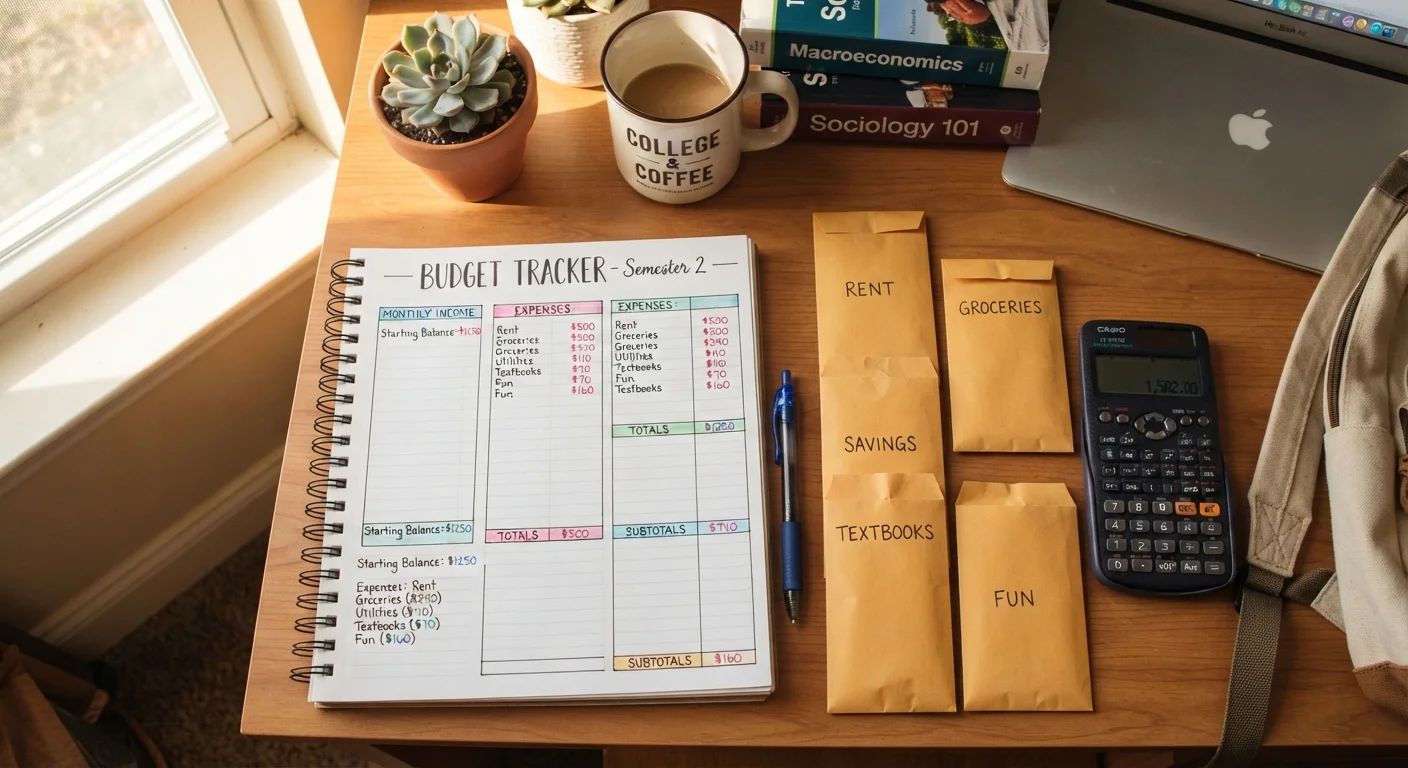
The envelope method divides your money into discrete spending categories, each represented by a physical envelope (or a digital equivalent). You place a set amount of cash — or track a set limit — in each envelope at the start of the period. When the envelope is empty, spending in that category stops until the next cycle.
Traditional envelopes use literal cash, which makes overspending physically impossible: you can see and feel the limit. Digital versions use apps or separate accounts that simulate the same boundary. Common envelopes include groceries, eating out, entertainment, transportation, and personal care.
The method's strength is its immediacy. There's no math required mid-month — you simply check whether an envelope still has money in it. This makes it appealing for students who find abstract budget categories easy to ignore but respond well to a concrete, visible limit.
One honest limitation: the envelope method works less naturally for expenses paid by card or bank transfer, like rent or utility bills. Many students use envelopes only for discretionary (optional, day-to-day) spending while handling fixed bills separately.
Cash-Only Envelopes Have a Real Risk
Carrying significant amounts of cash for envelope-based spending means losing an envelope could mean losing that money permanently — unlike a bank card that can be cancelled. If you use physical cash envelopes, store them somewhere secure and consider keeping emergency cash separate. Many students find digital envelope simulations (tracked in a spreadsheet or app) offer the same discipline with less risk.
Side-by-Side: Key Differences
Both methods share a core principle — intentional spending — but they differ significantly in structure, effort, and flexibility. The comparison below highlights the most relevant dimensions for a student context.
| Zero-Based Budgeting | Envelope Method | |
|---|---|---|
| Core concept | Every dollar assigned a purpose | Spending capped per category envelope |
| Setup effort | Moderate — monthly planning session required | Low — divide money into categories once |
| Best for irregular income | Yes — rebuilt fresh each month | Partially — requires estimating category amounts |
| Handles digital payments | Yes — works entirely digitally | Requires adaptation for card spending |
| Overspending prevention | Relies on reviewing plan mid-month | Hard stop when envelope is empty |
| Learning curve | Steeper — more categories to track | Gentler — intuitive and visual |
| Flexibility mid-month | High — can reallocate between categories | Lower — moving money feels deliberate |
For a broader look at how these and other frameworks fit different student situations, see approaches to budgeting that work for different student lifestyles. If you're weighing a simpler percentage-based alternative, the 50/30/20 rule explained for students offers a useful contrast.
Making Your Choice — and Sticking With It
The most effective budgeting method is the one you'll actually use consistently. A few questions can help you decide:
- How do you receive income? If you get a lump sum at the start of the semester (loans, grants, stipends), zero-based budgeting's monthly planning model helps stretch that amount deliberately. If you receive weekly or biweekly paychecks, either method can work.
- Where do you typically overspend? If eating out or impulse purchases are the problem, the envelope method's hard stop addresses that directly. If the bigger issue is not planning ahead at all, zero-based budgeting's upfront allocation builds that habit.
- How much time will you invest? Zero-based budgeting typically requires a 20–30 minute planning session at the start of each month. The envelope method requires less initial planning but more real-time awareness of each category's balance.
Whichever method you choose, pair it with a regular check-in — even a five-minute weekly review of where things stand. The habits that keep a student budget on track over time are what separate a one-time attempt from a lasting system. And if you're building a financial cushion alongside your budget, emergency funds on a student budget explains why even a small buffer matters.
This article is for general informational and educational purposes only and does not constitute personalized financial advice. Consider consulting a qualified financial professional for guidance tailored to your individual circumstances.
The content provided on our blog site traverses numerous categories, offering readers valuable and practical information. Readers can use the editorial team’s research and data to gain more insights into their topics of interest. However, they are requested not to treat the articles as conclusive. The website team cannot be held responsible for differences in data or inaccuracies found across other platforms. Please also note that the site might also miss out on various schemes and offers available that the readers may find more beneficial than the ones we cover.