

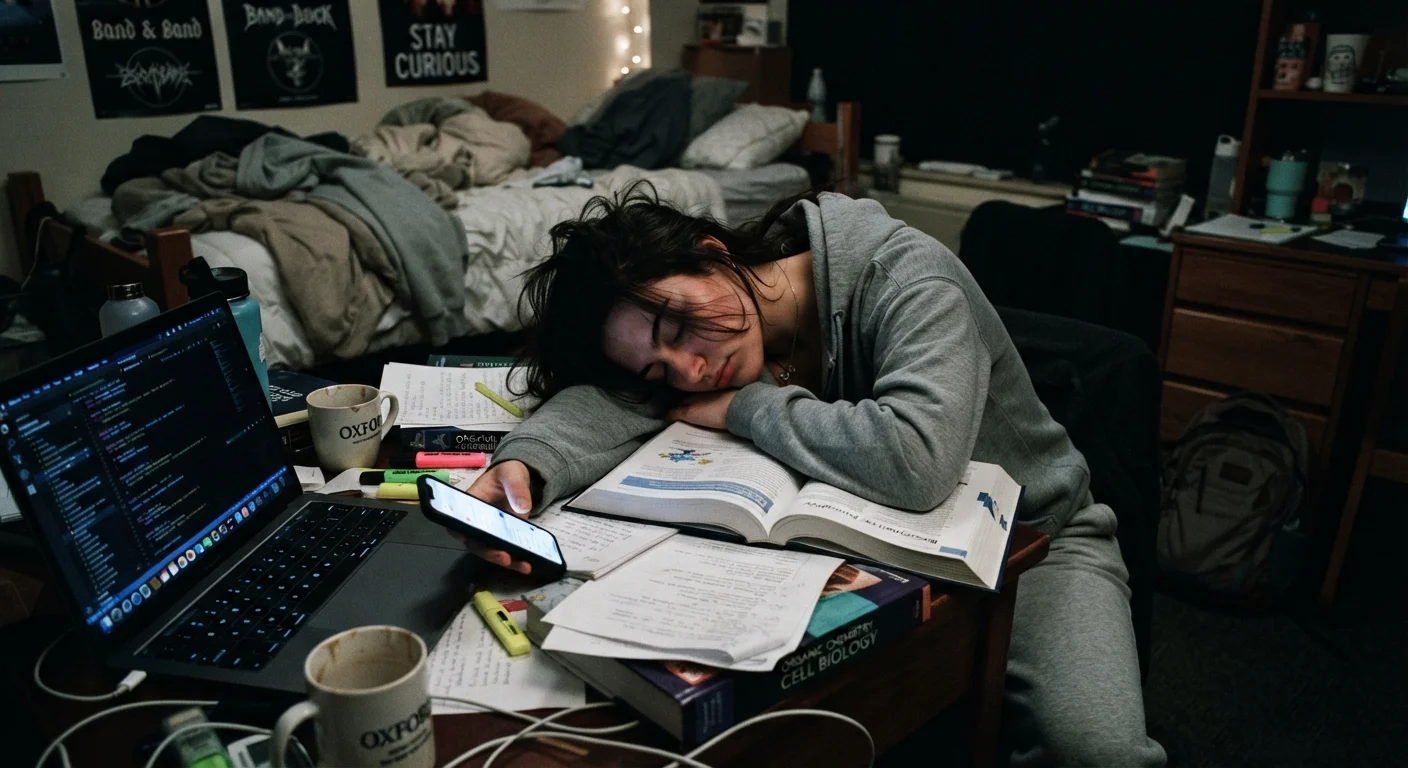
Why College Specifically Destroys Sleep Rhythms
Most students arrive at college already running a mild sleep deficit. Then everything that normally structures sleep - fixed family mealtimes, a consistent commute, parental reminders - disappears overnight. What replaces it is a calendar that changes every semester, social events that peak after midnight, and coursework that expands to fill every quiet hour.
Your body's internal clock, called the circadian rhythm, is surprisingly fragile. It depends on consistent light exposure, regular mealtimes, and - most critically - a predictable wake time. College dismantles all three simultaneously. Understanding why this happens is the first step toward pushing back against it. The mistakes below are the most common culprits, and each one is more fixable than it might feel at 2 a.m.
If you're also trying to get your broader schedule under control, the semester-start checklist is a practical place to begin before the pressure builds.
Sleeping in dramatically on weekends to "catch up" on lost weekday sleep.
Why it happens: It feels logical - you're tired, you have no early class, so you sleep until noon. But the American Academy of Sleep Medicine notes that social jetlag (shifting your sleep window by two or more hours) resets your clock backward, making Monday even harder.
Using caffeine as a substitute for sleep rather than a complement to it.
Why it happens: Coffee and energy drinks are cheap, socially normal, and feel effective - so students reach for them later and later in the day to push through evening study sessions.
Treating the hour before bed as extra study or screen time rather than a wind-down buffer.
Why it happens: Deadlines feel urgent, and the quiet of late night can feel like prime focus time. Students default to "just one more hour" without realising the blue light and cognitive stimulation delay melatonin release.
Scheduling 8 a.m. classes when you're a genuine evening-type sleeper.
Why it happens: Registration pressure, required courses, or the mistaken belief that early classes will "force" a better sleep schedule lead students to commit to wake times their biology strongly resists.
Letting the dorm room environment actively work against sleep.
Why it happens: Dorm rooms are simultaneously bedrooms, study spaces, and social hubs - roles that compete with each other. Bright overhead lights, a roommate's different schedule, and ambient noise make genuine sleep preparation difficult.
How to Build Back a Stable Sleep Routine
Fixing your sleep doesn't require going to bed at 10 p.m. or giving up your social life. Research consistently shows that anchor times - particularly a consistent wake time, even on weekends - are the most powerful lever for resetting your circadian rhythm. Start there before adjusting anything else.
60%
College students reporting poor sleep quality
The American College Health Association's National College Health Assessment consistently finds that a majority of students rate their sleep as poor or fair in quality.
~7-9 hrs
Recommended nightly sleep for adults 18-25
The National Sleep Foundation recommends seven to nine hours of sleep per night for young adults, a target most college students fall short of during the academic week.
Treat your sleep window the same way you'd treat a class block. When you're building your week, consider pairing sleep scheduling with the broader habit work described in building a sustainable daily routine - especially when your class times shift each term.
If disrupted sleep is affecting your mood, focus, or motivation beyond what feels manageable, that's worth a conversation with your campus health or counseling center. Sleep problems and mental health are closely linked, and support is available - asking for it is the practical move, not a last resort.
This article is for general informational and educational purposes only and is not a substitute for professional medical advice. If you have ongoing sleep difficulties or health concerns, please speak with a qualified healthcare provider.
The content provided on our blog site traverses numerous categories, offering readers valuable and practical information. Readers can use the editorial team’s research and data to gain more insights into their topics of interest. However, they are requested not to treat the articles as conclusive. The website team cannot be held responsible for differences in data or inaccuracies found across other platforms. Please also note that the site might also miss out on various schemes and offers available that the readers may find more beneficial than the ones we cover.