

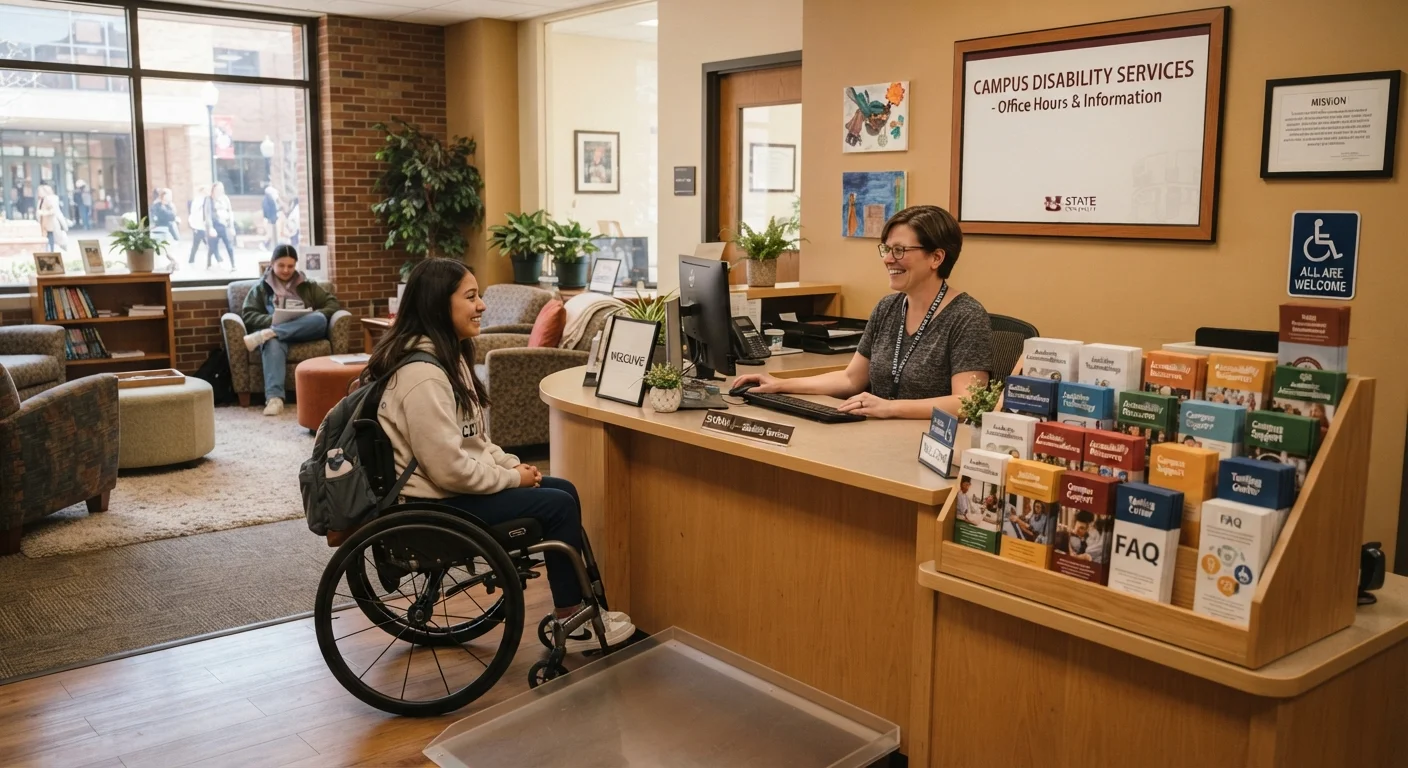
Who Disability Services Is Actually For
One of the most common misconceptions incoming students carry is that disability services is only for people who use wheelchairs or have severe physical impairments. In reality, the range of qualifying conditions is far broader and includes many conditions that aren't immediately visible.
Under the ADA, a disability is defined as any physical or mental impairment that substantially limits one or more major life activities - things like reading, concentrating, sleeping, or walking. Common qualifying conditions include:
- Learning disabilities - such as dyslexia, dyscalculia, or auditory processing disorder
- ADHD (Attention-Deficit/Hyperactivity Disorder)
- Mental health conditions - including anxiety disorders, depression, PTSD, and bipolar disorder
- Chronic health conditions - such as Crohn's disease, diabetes, or epilepsy
- Sensory impairments - vision or hearing loss
- Temporary disabilities - a broken arm, post-surgical recovery, or a concussion
- Autism spectrum disorder
If you're unsure whether your condition qualifies, the best first step is to contact your campus disability services office directly and ask. They can walk you through the eligibility criteria without requiring you to commit to anything.
High School Plans Don't Automatically Transfer
If you had an IEP or 504 plan in high school, it does not carry over to college automatically. College disability services operates under a different legal framework (the ADA rather than IDEA), and you'll need to register and provide current documentation through your institution's process. Bring copies of your previous evaluations - they can sometimes support your new application.
How the Registration Process Works
Unlike accommodations in K-12 education, college disability services require students to self-identify and register. Your high school IEP (Individualized Education Program) or 504 plan does not automatically transfer to college. You'll need to initiate the process yourself.
Here's what the typical process looks like:
- Gather documentation. Contact the office early to find out exactly what documentation they require. This usually means a letter or report from a licensed professional - a physician, psychologist, or psychiatrist - describing your diagnosis, functional limitations, and recommended accommodations.
- Submit an application. Most offices have an online intake form or application. You'll submit your documentation at this stage.
- Meet with a disability services coordinator. An advisor will review your documentation, discuss your needs, and determine which accommodations are reasonable and appropriate for your situation.
- Receive your accommodation letter. Once approved, you'll receive a formal letter listing your accommodations. You share this letter with each of your instructors - the disability office typically handles this automatically at many schools.
- Renew each semester if required. Many offices require you to request your accommodation letter each semester, even if your disability hasn't changed.
Register Before You Need It
The approval process can take days to weeks depending on your institution and the complexity of your documentation. Don't wait until midterms are approaching - register at the start of the semester, or even before classes begin if your school allows it. Early registration ensures accommodations are in place when you need them most.
What Accommodations Typically Look Like
Accommodations are tailored to the individual - what's approved for one student won't necessarily apply to another, even with the same diagnosis. That said, some of the most commonly approved accommodations include:
- Extended time on exams (commonly 1.5x or 2x the standard time)
- A reduced-distraction testing environment
- Note-taking assistance or access to recorded lectures
- Priority registration so you can build a schedule that works for you
- Flexibility around attendance policies for documented medical needs
- Captioning or sign language interpretation for deaf and hard-of-hearing students
- Accessible housing assignments
- Screen readers or assistive technology
If your needs involve emotional support animals in campus housing, that process involves a separate but related request. See our guide to requesting an ESA accommodation for a step-by-step breakdown.
It's also worth knowing that disability services often works alongside campus mental health resources. For a broader overview of how those services connect, see Campus Mental Health Services: A Plain-Language Overview.
21%
College students reporting a disability
According to the National Center for Education Statistics, roughly 1 in 5 college students reports having a disability - far more than typically use formal services.
~17%
Students who actually use disability services
Research consistently suggests a significant gap between students who qualify and those who register, often because students don't know they're eligible.
Your Rights and Confidentiality
Students registered with disability services have clear legal protections. Under the ADA and Section 504, institutions cannot discriminate against you because of your disability, and they are required to provide reasonable accommodations - accommodations that don't fundamentally alter the nature of a course or create undue burden on the institution.
Confidentiality is a cornerstone of this process. Your specific diagnosis is not shared with your professors, advisors, or other students. Instructors receive an accommodation letter that lists what adjustments to make, not medical details about why.
If you feel your accommodations aren't being honored, start by speaking with your disability services coordinator. Unresolved issues can be escalated through your institution's ADA/504 coordinator (a separate, campus-wide role) or reported to the U.S. Department of Education's Office for Civil Rights.
For students managing health conditions that overlap with mental health, campus health centers often house mental health services alongside primary care - which can make coordinating documentation more straightforward.
This article is for general informational purposes only and does not constitute legal or medical advice. Students with specific concerns about eligibility or rights should contact their institution's disability services office or a qualified professional.
Frequently Asked Questions
No. When accommodations are approved, the disability services office typically sends a formal letter to your instructors listing your accommodations - without disclosing your specific diagnosis. Professors are told what adjustments to make, not why.
Qualifying conditions include physical disabilities, chronic health conditions, mental health diagnoses, learning disabilities like dyslexia or ADHD, sensory impairments, and temporary disabilities from injuries or surgery. The key is that the condition must substantially limit one or more major life activities.
Most offices require documentation from a licensed healthcare or mental health professional - such as a psychoeducational evaluation, physician's letter, or diagnostic records. Requirements vary by institution and condition, so contact your specific office for guidance.
Yes, but accommodations are not applied retroactively. Any approved accommodations take effect after registration is complete, so registering early in the semester gives you the most benefit.
No. Accommodations are designed to provide equal access - not an academic edge. They level the playing field so students with disabilities can demonstrate their knowledge under conditions that work for them.
You can appeal the decision through your institution's formal grievance process. The ADA and Section 504 also give you the right to file a complaint with the U.S. Department of Education's Office for Civil Rights if you believe your rights were violated.
The content provided on our blog site traverses numerous categories, offering readers valuable and practical information. Readers can use the editorial team’s research and data to gain more insights into their topics of interest. However, they are requested not to treat the articles as conclusive. The website team cannot be held responsible for differences in data or inaccuracies found across other platforms. Please also note that the site might also miss out on various schemes and offers available that the readers may find more beneficial than the ones we cover.