

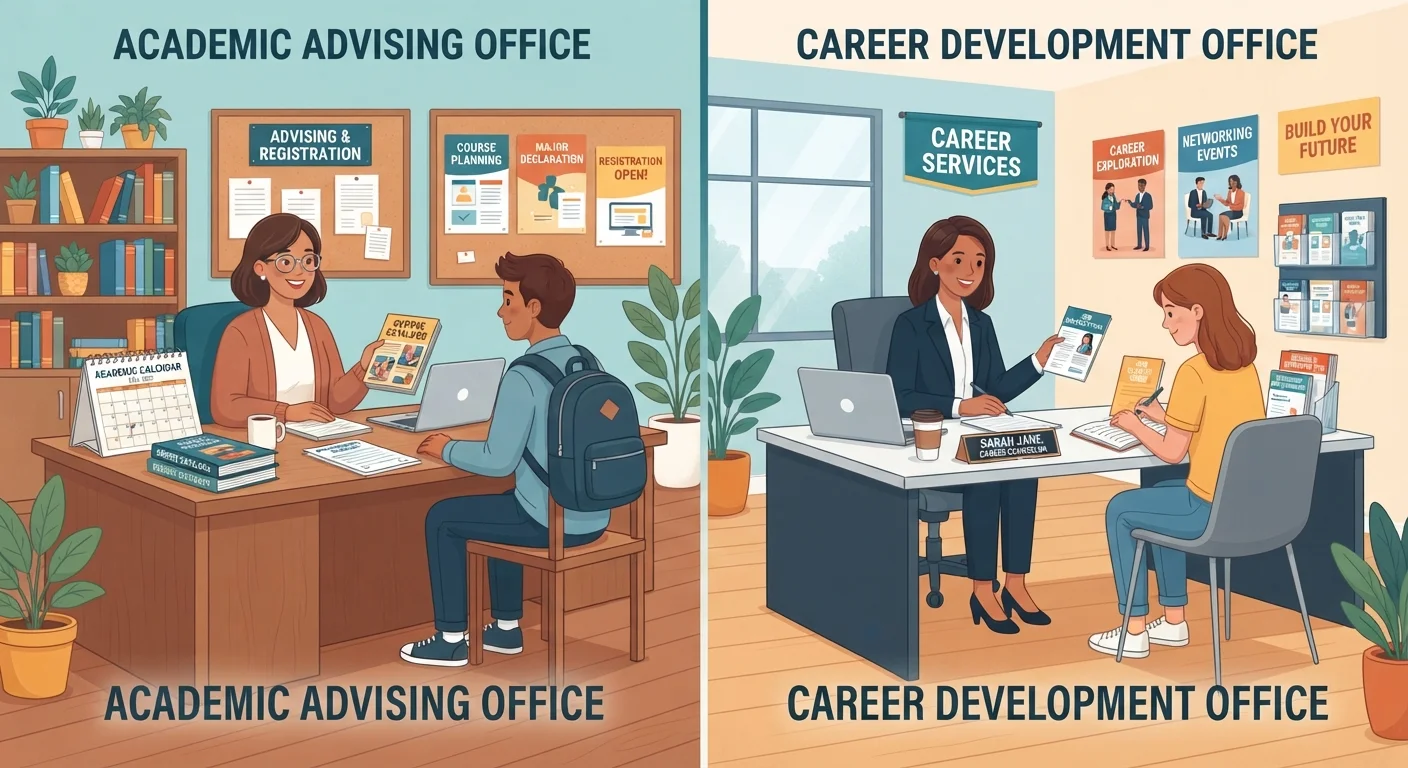
Option A
Academic Advising
Your guide to navigating degree requirements and course planning.
Best for: Students who need help choosing classes, understanding graduation requirements, or managing academic standing.
Option B
Career Counselling
Your partner for translating your education into professional opportunities.
Best for: Students who want to explore career paths, build job-search skills, or connect with internships and employers.
Why Students Confuse These Two Offices
When you arrive on campus, the sheer number of offices, centers, and departments can feel overwhelming. Academic advising and career counselling share a surface-level similarity - both involve one-on-one meetings and long-term planning conversations - but they operate from entirely different starting points and answer very different questions.
Mixing them up is a common mistake, especially in the first semester. A student worried about failing a class who books a career counselling appointment will walk away without the academic help they actually needed. Understanding what each office does - and doesn't do - is one of the most practical things you can do early in college. If you want a broader map of campus offices, see our guide to key campus offices for a quick reference. Similarly, knowing the difference between offices that handle money on campus can save real headaches - the same logic applies to financial aid, bursar, and scholarships offices.
What Academic Advising Actually Does
Academic advisors are the people who help you stay on track toward your degree. Their expertise is your institution's academic structure: degree requirements, course sequencing, registration holds, credit transfers, and academic policies like probation or withdrawal deadlines.
In a typical advising appointment, you might review which general education requirements you've completed, figure out which electives count toward your major, or discuss whether taking 18 credits in one semester is realistic given your situation. Advisors can also flag warning signs - for example, if you're enrolled in a prerequisite course too late to take a required upper-division class on schedule.
What advisors generally do not do is help you figure out what job to pursue after graduation or review your resume. Their lens is academic, not professional.
| Criterion | Academic Advising | Career Counselling |
|---|---|---|
| Primary focus | Degree completion and course planning | Career exploration and job readiness |
| Typical meeting topics | Course selection, major requirements, registration | Resume review, interview prep, internship search |
| Who staffs the office | Academic advisors, faculty advisors | Career counselors, employer relations staff |
| Best time to visit | Before registration; when facing academic issues | Sophomore year onward; before applying to jobs |
| Key tools used | Degree audit systems, academic policy documents | Career assessments, job boards, employer networks |
| Handles academic probation? | Yes | No |
| Helps with graduate school planning? | Partially (prerequisite planning) | Yes (career path framing, applications) |
What Career Counselling Actually Does
Career counselors (sometimes called career coaches or career advisors, depending on the institution) focus on the bridge between your education and the working world. Their toolkit includes career exploration assessments, resume and cover letter reviews, mock interviews, internship databases, and employer networking events.
If you're a sophomore unsure whether to pursue graduate school or enter the workforce, a career counselor can walk you through both paths. If you're a junior preparing to apply for internships, they can review your application materials and connect you with on-campus recruiting events.
Career counselling offices also typically maintain relationships with employers and alumni networks, which can open doors that an academic advisor - whose focus is curriculum - simply isn't positioned to provide.
~30%
Students who use career services before senior year
Research from NACE (National Association of Colleges and Employers) has consistently found that a minority of students engage with career services before their final year, leaving preparation time on the table.
1 in 3
First-year students uncertain about their career direction
Surveys of incoming college students regularly show that a significant share are undecided about career paths, making early career counselling visits particularly valuable.
It's also worth noting that career counselling is distinct from mental health counselling. If you're navigating emotional challenges during college, that's a different resource entirely - our article on talking to a campus counselor for the first time can help you understand what to expect from that process.
When to Visit Each - and When to Visit Both
There's no rule that says you can only use one of these offices. In fact, many students benefit from visiting both in the same semester, just for different reasons.
A practical approach: visit academic advising at the start of each term to confirm your course plan, and visit career counselling at least once per year to check in on your professional development - even if you're not actively job hunting. The earlier you start building your resume and exploring career paths, the more options you'll have when graduation approaches.
The offices also complement each other. Your academic advisor might suggest that a particular minor or certificate strengthens your career prospects, then refer you to career counselling to validate that through employer research. Career counselors, in turn, may notice you're missing a key skill and recommend specific coursework - sending you back to your academic advisor to adjust your plan.
For choosing other types of academic support, peer tutoring vs. instructor office hours is a useful companion read if you're navigating help for coursework specifically.
The content provided on our blog site traverses numerous categories, offering readers valuable and practical information. Readers can use the editorial team’s research and data to gain more insights into their topics of interest. However, they are requested not to treat the articles as conclusive. The website team cannot be held responsible for differences in data or inaccuracies found across other platforms. Please also note that the site might also miss out on various schemes and offers available that the readers may find more beneficial than the ones we cover.